

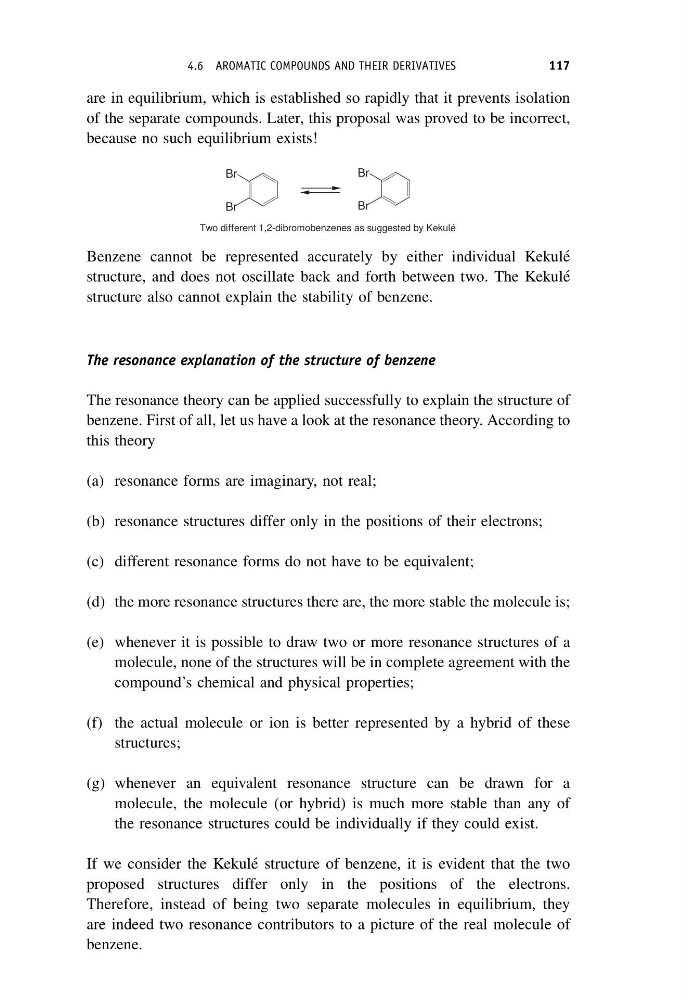
are in equilibrium, which is established so rapidly that it prevents isolation
of the separate compounds. Later, this proposal was proved to be incorrect,
because no such equilibrium exists!
Br
Br
Br
Br
Two different 1,2-dibromobenzenes as suggested by Kekulé
Benzene cannot be represented accurately by either individual Kekule ´
structure, and does not oscillate back and forth between two. The Kekule ´
structure also cannot explain the stability of benzene.
The resonance explanation of the structure of benzene
The resonance theory can be applied successfully to explain the structure of
benzene. First of all, let us have a look at the resonance theory. According to
this theory
(a) resonance forms are imaginary, not real;
(b) resonance structures differ only in the positions of their electrons;
(c) different resonance forms do not have to be equivalent;
(d) the more resonance structures there are, the more stable the molecule is;
(e) whenever it is possible to draw two or more resonance structures of a
molecule, none of the structures will be in complete agreement with the
compound’s chemical and physical properties;
(f) the actual molecule or ion is better represented by a hybrid of these
structures;
(g) whenever an equivalent resonance structure can be drawn for a
molecule, the molecule (or hybrid) is much more stable than any of
the resonance structures could be individually if they could exist.
If we consider the Kekule ´ structure of benzene, it is evident that the two
proposed structures differ only in the positions of the electrons.
Therefore, instead of being two separate molecules in equilibrium, they
are indeed two resonance contributors to a picture of the real molecule of
benzene.
4.6 AROMATIC COMPOUNDS AND THEIR DERIVATIVES
117
of the separate compounds. Later, this proposal was proved to be incorrect,
because no such equilibrium exists!
Br
Br
Br
Br
Two different 1,2-dibromobenzenes as suggested by Kekulé
Benzene cannot be represented accurately by either individual Kekule ´
structure, and does not oscillate back and forth between two. The Kekule ´
structure also cannot explain the stability of benzene.
The resonance explanation of the structure of benzene
The resonance theory can be applied successfully to explain the structure of
benzene. First of all, let us have a look at the resonance theory. According to
this theory
(a) resonance forms are imaginary, not real;
(b) resonance structures differ only in the positions of their electrons;
(c) different resonance forms do not have to be equivalent;
(d) the more resonance structures there are, the more stable the molecule is;
(e) whenever it is possible to draw two or more resonance structures of a
molecule, none of the structures will be in complete agreement with the
compound’s chemical and physical properties;
(f) the actual molecule or ion is better represented by a hybrid of these
structures;
(g) whenever an equivalent resonance structure can be drawn for a
molecule, the molecule (or hybrid) is much more stable than any of
the resonance structures could be individually if they could exist.
If we consider the Kekule ´ structure of benzene, it is evident that the two
proposed structures differ only in the positions of the electrons.
Therefore, instead of being two separate molecules in equilibrium, they
are indeed two resonance contributors to a picture of the real molecule of
benzene.
4.6 AROMATIC COMPOUNDS AND THEIR DERIVATIVES
117