

In the above structure of azulene, there are five conjugated double bonds
and ten p electrons, which means that it follows Hu ¨ckel’s rule
ð4 Â 2 þ 2 ¼ 10Þ.
Macrocyclic These are monocyclic nonbenzene structures, and the ring
sizes are quite big. There is an adequate number of double bonds and p
electrons to conform to Hu ¨ckel’s rule; e.g., [14] annulene obeys Hu ¨ckel’s
rule and is aromatic.
[14] Annulene
Heterocyclic These are compounds having at least one hetero atom (any
other atom but carbon, e.g. O, N and S) within the ring, and conforming to
Hu ¨ckel’s rule. The aromaticity of heterocyclic compounds, e.g. pyridine and
pyrrole, can be explained as follows.
N
N
H
Pyridine
Pyrrole
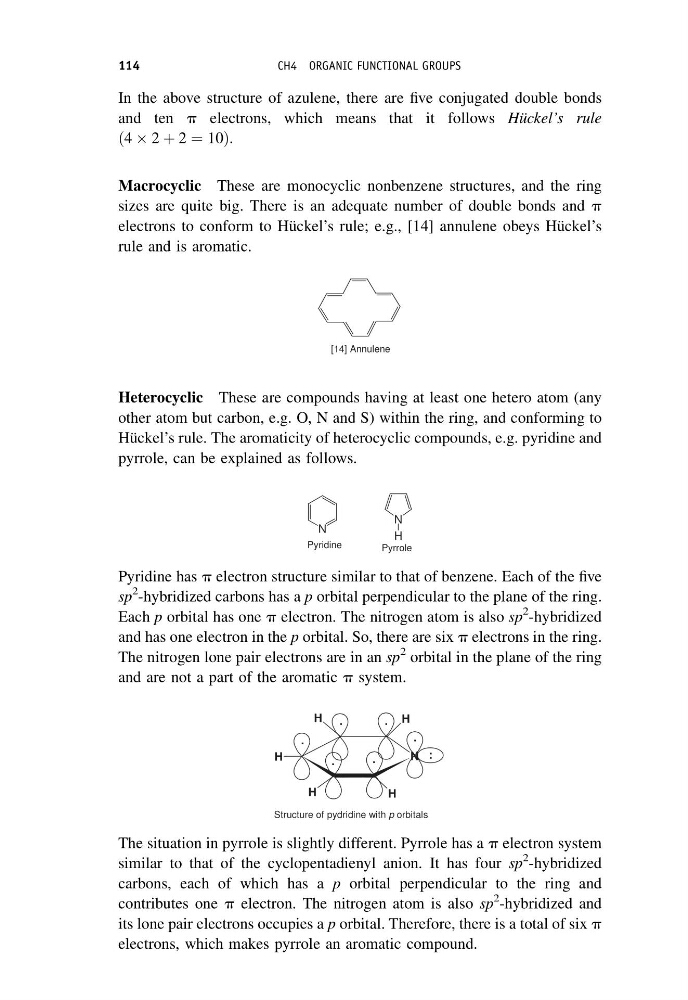
Pyridine has p electron structure similar to that of benzene. Each of the five
sp
2
-hybridized carbons has a p orbital perpendicular to the plane of the ring.
Each p orbital has one p electron. The nitrogen atom is also sp
2 -hybridized
and has one electron in the p orbital. So, there are six p electrons in the ring.
The nitrogen lone pair electrons are in an sp
2 orbital in the plane of the ring
and are not a part of the aromatic p system.
N
H
H
H
H
H
.
.
.
.
.
.
:
Structure of pydridine with p orbitals
The situation in pyrrole is slightly different. Pyrrole has a p electron system
similar to that of the cyclopentadienyl anion. It has four sp
2 -hybridized
carbons, each of which has a p orbital perpendicular to the ring and
contributes one p electron. The nitrogen atom is also sp
2 -hybridized and
its lone pair electrons occupies a p orbital. Therefore, there is a total of six p
electrons, which makes pyrrole an aromatic compound.
114
CH4 ORGANIC FUNCTIONAL GROUPS
and ten p electrons, which means that it follows Hu ¨ckel’s rule
ð4 Â 2 þ 2 ¼ 10Þ.
Macrocyclic These are monocyclic nonbenzene structures, and the ring
sizes are quite big. There is an adequate number of double bonds and p
electrons to conform to Hu ¨ckel’s rule; e.g., [14] annulene obeys Hu ¨ckel’s
rule and is aromatic.
[14] Annulene
Heterocyclic These are compounds having at least one hetero atom (any
other atom but carbon, e.g. O, N and S) within the ring, and conforming to
Hu ¨ckel’s rule. The aromaticity of heterocyclic compounds, e.g. pyridine and
pyrrole, can be explained as follows.
N
N
H
Pyridine
Pyrrole
Pyridine has p electron structure similar to that of benzene. Each of the five
sp
2
-hybridized carbons has a p orbital perpendicular to the plane of the ring.
Each p orbital has one p electron. The nitrogen atom is also sp
2 -hybridized
and has one electron in the p orbital. So, there are six p electrons in the ring.
The nitrogen lone pair electrons are in an sp
2 orbital in the plane of the ring
and are not a part of the aromatic p system.
N
H
H
H
H
H
.
.
.
.
.
.
:
Structure of pydridine with p orbitals
The situation in pyrrole is slightly different. Pyrrole has a p electron system
similar to that of the cyclopentadienyl anion. It has four sp
2 -hybridized
carbons, each of which has a p orbital perpendicular to the ring and
contributes one p electron. The nitrogen atom is also sp
2 -hybridized and
its lone pair electrons occupies a p orbital. Therefore, there is a total of six p
electrons, which makes pyrrole an aromatic compound.
114
CH4 ORGANIC FUNCTIONAL GROUPS