

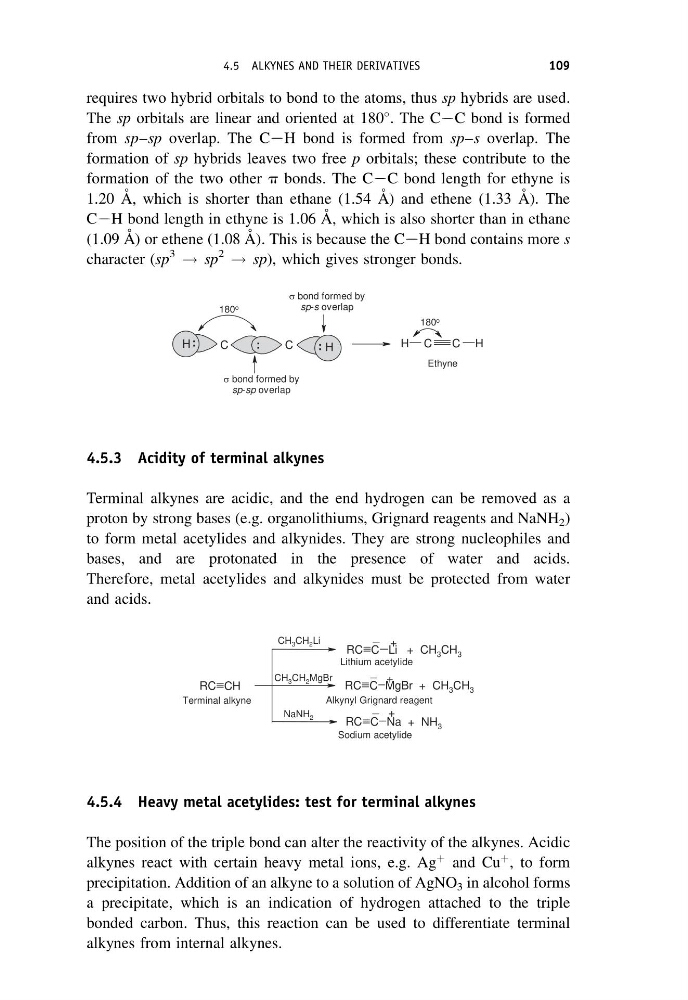
requires two hybrid orbitals to bond to the atoms, thus sp hybrids are used.
The sp orbitals are linear and oriented at 180
. The CÀ ÀC bond is formed
from sp–sp overlap. The CÀ ÀH bond is formed from sp–s overlap. The
formation of sp hybrids leaves two free p orbitals; these contribute to the
formation of the two other p bonds. The CÀ ÀC bond length for ethyne is
1.20 A ˚ , which is shorter than ethane (1.54 A ˚ ) and ethene (1.33 A ˚ ). The
CÀ ÀH bond length in ethyne is 1.06 A ˚ , which is also shorter than in ethane
(1.09 A ˚ ) or ethene (1.08 A ˚ ). This is because the CÀ ÀH bond contains more s
character (sp
3 ! sp
2 ! sp), which gives stronger bonds.
H
H
C
H
C
H
C
C
Ethyne
180 o
σ bond formed by
sp-sp overlap
180 o
σ bond formed by
sp-s overlap
:
:
:
4.5.3 Acidity of terminal alkynes
Terminal alkynes are acidic, and the end hydrogen can be removed as a
proton by strong bases (e.g. organolithiums, Grignard reagents and NaNH 2 )
to form metal acetylides and alkynides. They are strong nucleophiles and
bases, and are protonated in the presence of water and acids.
Therefore, metal acetylides and alkynides must be protected from water
and acids.
RC CH
RC C Li
RC C MgBr
RC C Na
+ CH 3 CH 3
+ NH 3
CH 3 CH 2 Li
+ CH 3 CH 3
CH 3 CH 2 MgBr
+
_
NaNH 2
Terminal alkyne
_
_
+
+
Sodium acetylide
Alkynyl Grignard reagent
Lithium acetylide
4.5.4 Heavy metal acetylides: test for terminal alkynes
The position of the triple bond can alter the reactivity of the alkynes. Acidic
alkynes react with certain heavy metal ions, e.g. Ag
þ and Cu
þ , to form
precipitation. Addition of an alkyne to a solution of AgNO 3 in alcohol forms
a precipitate, which is an indication of hydrogen attached to the triple
bonded carbon. Thus, this reaction can be used to differentiate terminal
alkynes from internal alkynes.
4.5 ALKYNES AND THEIR DERIVATIVES
109
The sp orbitals are linear and oriented at 180
. The CÀ ÀC bond is formed
from sp–sp overlap. The CÀ ÀH bond is formed from sp–s overlap. The
formation of sp hybrids leaves two free p orbitals; these contribute to the
formation of the two other p bonds. The CÀ ÀC bond length for ethyne is
1.20 A ˚ , which is shorter than ethane (1.54 A ˚ ) and ethene (1.33 A ˚ ). The
CÀ ÀH bond length in ethyne is 1.06 A ˚ , which is also shorter than in ethane
(1.09 A ˚ ) or ethene (1.08 A ˚ ). This is because the CÀ ÀH bond contains more s
character (sp
3 ! sp
2 ! sp), which gives stronger bonds.
H
H
C
H
C
H
C
C
Ethyne
180 o
σ bond formed by
sp-sp overlap
180 o
σ bond formed by
sp-s overlap
:
:
:
4.5.3 Acidity of terminal alkynes
Terminal alkynes are acidic, and the end hydrogen can be removed as a
proton by strong bases (e.g. organolithiums, Grignard reagents and NaNH 2 )
to form metal acetylides and alkynides. They are strong nucleophiles and
bases, and are protonated in the presence of water and acids.
Therefore, metal acetylides and alkynides must be protected from water
and acids.
RC CH
RC C Li
RC C MgBr
RC C Na
+ CH 3 CH 3
+ NH 3
CH 3 CH 2 Li
+ CH 3 CH 3
CH 3 CH 2 MgBr
+
_
NaNH 2
Terminal alkyne
_
_
+
+
Sodium acetylide
Alkynyl Grignard reagent
Lithium acetylide
4.5.4 Heavy metal acetylides: test for terminal alkynes
The position of the triple bond can alter the reactivity of the alkynes. Acidic
alkynes react with certain heavy metal ions, e.g. Ag
þ and Cu
þ , to form
precipitation. Addition of an alkyne to a solution of AgNO 3 in alcohol forms
a precipitate, which is an indication of hydrogen attached to the triple
bonded carbon. Thus, this reaction can be used to differentiate terminal
alkynes from internal alkynes.
4.5 ALKYNES AND THEIR DERIVATIVES
109