

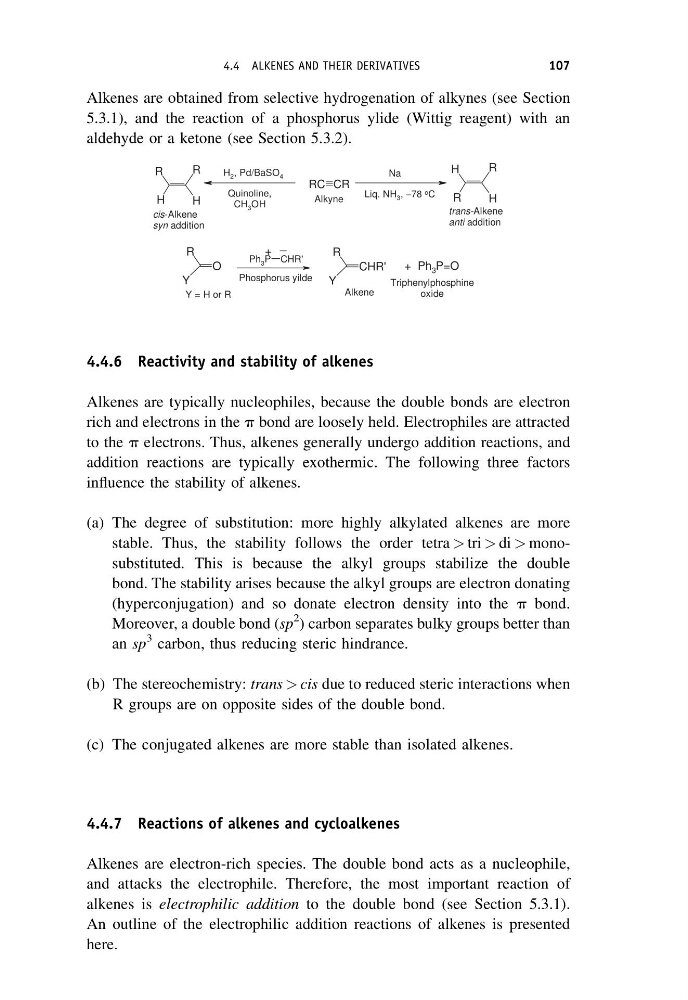
Alkenes are obtained from selective hydrogenation of alkynes (see Section
5.3.1), and the reaction of a phosphorus ylide (Wittig reagent) with an
aldehyde or a ketone (see Section 5.3.2).
RC CR
R
H
R
H
H
R
R
H
Alkyne
H 2 , Pd/BaSO 4
Quinoline,
CH 3 OH
cis-Alkene
syn addition
Na
Liq. NH 3 , −78 o C
trans-Alkene
anti addition
CHR'
Ph 3 P
O
R
Y
CHR'
R
Y
+ Ph 3 P=O
Y = H or R
Alkene
Triphenylphosphine
oxide
+
_
Phosphorus yilde
4.4.6 Reactivity and stability of alkenes
Alkenes are typically nucleophiles, because the double bonds are electron
rich and electrons in the p bond are loosely held. Electrophiles are attracted
to the p electrons. Thus, alkenes generally undergo addition reactions, and
addition reactions are typically exothermic. The following three factors
influence the stability of alkenes.
(a) The degree of substitution: more highly alkylated alkenes are more
stable. Thus, the stability follows the order tetra > tri > di > monosubstituted. This is because the alkyl groups stabilize the double
bond. The stability arises because the alkyl groups are electron donating
(hyperconjugation) and so donate electron density into the p bond.
Moreover, a double bond (sp
2
) carbon separates bulky groups better than
an sp
3 carbon, thus reducing steric hindrance.
(b) The stereochemistry: trans > cis due to reduced steric interactions when
R groups are on opposite sides of the double bond.
(c) The conjugated alkenes are more stable than isolated alkenes.
4.4.7 Reactions of alkenes and cycloalkenes
Alkenes are electron-rich species. The double bond acts as a nucleophile,
and attacks the electrophile. Therefore, the most important reaction of
alkenes is electrophilic addition to the double bond (see Section 5.3.1).
An outline of the electrophilic addition reactions of alkenes is presented
here.
4.4 ALKENES AND THEIR DERIVATIVES
107
5.3.1), and the reaction of a phosphorus ylide (Wittig reagent) with an
aldehyde or a ketone (see Section 5.3.2).
RC CR
R
H
R
H
H
R
R
H
Alkyne
H 2 , Pd/BaSO 4
Quinoline,
CH 3 OH
cis-Alkene
syn addition
Na
Liq. NH 3 , −78 o C
trans-Alkene
anti addition
CHR'
Ph 3 P
O
R
Y
CHR'
R
Y
+ Ph 3 P=O
Y = H or R
Alkene
Triphenylphosphine
oxide
+
_
Phosphorus yilde
4.4.6 Reactivity and stability of alkenes
Alkenes are typically nucleophiles, because the double bonds are electron
rich and electrons in the p bond are loosely held. Electrophiles are attracted
to the p electrons. Thus, alkenes generally undergo addition reactions, and
addition reactions are typically exothermic. The following three factors
influence the stability of alkenes.
(a) The degree of substitution: more highly alkylated alkenes are more
stable. Thus, the stability follows the order tetra > tri > di > monosubstituted. This is because the alkyl groups stabilize the double
bond. The stability arises because the alkyl groups are electron donating
(hyperconjugation) and so donate electron density into the p bond.
Moreover, a double bond (sp
2
) carbon separates bulky groups better than
an sp
3 carbon, thus reducing steric hindrance.
(b) The stereochemistry: trans > cis due to reduced steric interactions when
R groups are on opposite sides of the double bond.
(c) The conjugated alkenes are more stable than isolated alkenes.
4.4.7 Reactions of alkenes and cycloalkenes
Alkenes are electron-rich species. The double bond acts as a nucleophile,
and attacks the electrophile. Therefore, the most important reaction of
alkenes is electrophilic addition to the double bond (see Section 5.3.1).
An outline of the electrophilic addition reactions of alkenes is presented
here.
4.4 ALKENES AND THEIR DERIVATIVES
107