

Answers to Problems of the A Groups
455
CHAPTER 26
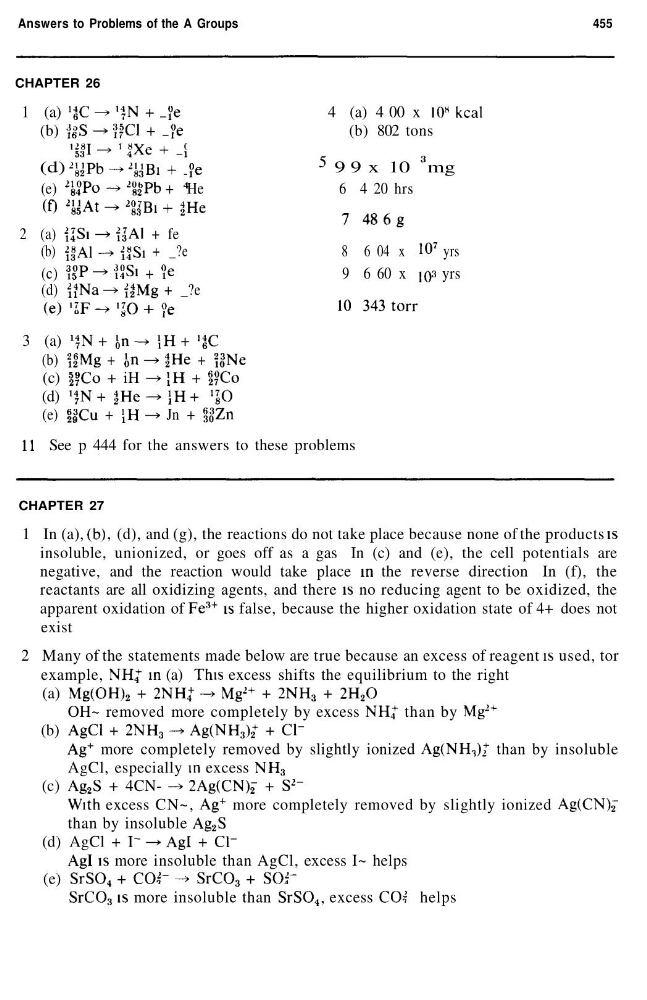
1 (a) 'JC ->
14
7 N + _Je
4 (a) 4 00 x 10" kcal
(b) igS ->
3
!?C1 + _fe
(b) 802 tons
(d)
2
"lJpr^ SB,
+
+" fe
5 9 9 x 10
3 mg
(e)
2
84 °Po -»
2 «JPb +
4 He
6 4 20 hrs
(f)'UAt-'HB, + lHe
? 486g
2 (a) iJSi -»
2
3
7 A1 + fe
(b) i 3
8 Al -*
2
14 «Si + _?e
8 6 04 x 10
7 yrs
(c) ?gP -^ iSSi + ?e
9 6 60 x 10
3 yrs
(d)
2 fNa -^ i 2
4 Mg + _?e
( e )
I7 F-^ 'JO + ?e
10 343 to rr
3 (a)
14
7 N + Jn-* }H + '£C
(b)
2
12
6
Mg + Jn -> ^He + IgNe
(c) l?Co + iH -^ JH + l»Co
(d)
14
7 N +
4
2 He -* IH +
17
8 0
(e) EiCu + IH -^ Jn +
6
3 gZn
11 See p 444 for the answers to these problems
CHAPTER 27
1 In (a), (b), (d), and (g), the reactions do not take place because none of the products is
insoluble, unionized, or goes off as a gas In (c) and (e), the cell potentials are
negative, and the reaction would take place in the reverse direction In (f), the
reactants are all oxidizing agents, and there is no reducing agent to be oxidized, the
apparent oxidation of Fe
3+ is false, because the higher oxidation state of 4+ does not
exist
2 Many of the statements made below are true because an excess of reagent is used, tor
example, NH.J" in (a) This excess shifts the equilibrium to the right
(a) Mg(OH) 2 + 2NH 4 + -^ Mg
2+ + 2NH 3 + 2H 2 O
OH~ removed more completely by excess NH^ than by Mg
2+
(b) AgCl + 2NH 3 -» Ag(NH 3 ) 2 + + Cl~
Ag
+ more completely removed by slightly ionized Ag(NH 3 )2" than by insoluble
AgCl, especially in excess NH 3
(c) Ag 2 S + 4CN- -» 2Ag(CN) 2 - + S
2 ~
With excess CN~, Ag
+ more completely removed by slightly ionized Ag(CN)jf
than by insoluble Ag 2 S
(d) AgCl + r -> Agl + ClAgl is more insoluble than AgCl, excess I~ helps
(e) SrSO 4 + CO
2 - -* SrCO 3 + SO
2
'
SrCO 3 is more insoluble than SrSO 4 , excess CO
2 helps
455
CHAPTER 26
1 (a) 'JC ->
14
7 N + _Je
4 (a) 4 00 x 10" kcal
(b) igS ->
3
!?C1 + _fe
(b) 802 tons
(d)
2
"lJpr^ SB,
+
+" fe
5 9 9 x 10
3 mg
(e)
2
84 °Po -»
2 «JPb +
4 He
6 4 20 hrs
(f)'UAt-'HB, + lHe
? 486g
2 (a) iJSi -»
2
3
7 A1 + fe
(b) i 3
8 Al -*
2
14 «Si + _?e
8 6 04 x 10
7 yrs
(c) ?gP -^ iSSi + ?e
9 6 60 x 10
3 yrs
(d)
2 fNa -^ i 2
4 Mg + _?e
( e )
I7 F-^ 'JO + ?e
10 343 to rr
3 (a)
14
7 N + Jn-* }H + '£C
(b)
2
12
6
Mg + Jn -> ^He + IgNe
(c) l?Co + iH -^ JH + l»Co
(d)
14
7 N +
4
2 He -* IH +
17
8 0
(e) EiCu + IH -^ Jn +
6
3 gZn
11 See p 444 for the answers to these problems
CHAPTER 27
1 In (a), (b), (d), and (g), the reactions do not take place because none of the products is
insoluble, unionized, or goes off as a gas In (c) and (e), the cell potentials are
negative, and the reaction would take place in the reverse direction In (f), the
reactants are all oxidizing agents, and there is no reducing agent to be oxidized, the
apparent oxidation of Fe
3+ is false, because the higher oxidation state of 4+ does not
exist
2 Many of the statements made below are true because an excess of reagent is used, tor
example, NH.J" in (a) This excess shifts the equilibrium to the right
(a) Mg(OH) 2 + 2NH 4 + -^ Mg
2+ + 2NH 3 + 2H 2 O
OH~ removed more completely by excess NH^ than by Mg
2+
(b) AgCl + 2NH 3 -» Ag(NH 3 ) 2 + + Cl~
Ag
+ more completely removed by slightly ionized Ag(NH 3 )2" than by insoluble
AgCl, especially in excess NH 3
(c) Ag 2 S + 4CN- -» 2Ag(CN) 2 - + S
2 ~
With excess CN~, Ag
+ more completely removed by slightly ionized Ag(CN)jf
than by insoluble Ag 2 S
(d) AgCl + r -> Agl + ClAgl is more insoluble than AgCl, excess I~ helps
(e) SrSO 4 + CO
2 - -* SrCO 3 + SO
2
'
SrCO 3 is more insoluble than SrSO 4 , excess CO
2 helps