

452
Answers to Problems of the A Groups
13. (a) 5.74 x lO"
10
15. (a) 7.00
(b) 1.57 x 10~
5
(b) 5.36
(c) 2.19 x 10-"
(c) 11.10
(d) 5.75 x 10¹¹
(d) 8.82
16. (a) Bromthymol blue
14. (a) 9.16
(b) Methyl red
(b) 4.53
(c) Thymolphthalein
(c) 8.09
(d) Phenolphthalein
(d) 7.00
(e) 5.68
17
-
5 '
16
(f) 7.00
(g) 8.73
(h) 7.00 The [H+] from H 2 O is more
important than that from the HC1.
18. Any solution in which the molar ratio of NH^" to NH 3 is 17.4
19. (a) 9.24
(b) 9.33
(c) 9.15
(d) 14.00
(e) 0.00
(f) Small amounts of strong acid and
base, when added to water
(pH = 7), normally cause a tremendous change in pH, as in (d)
and (e). In a buffer solution, small
amounts of acid and base cause
only a very small change in pH, as
in (b) and (c).
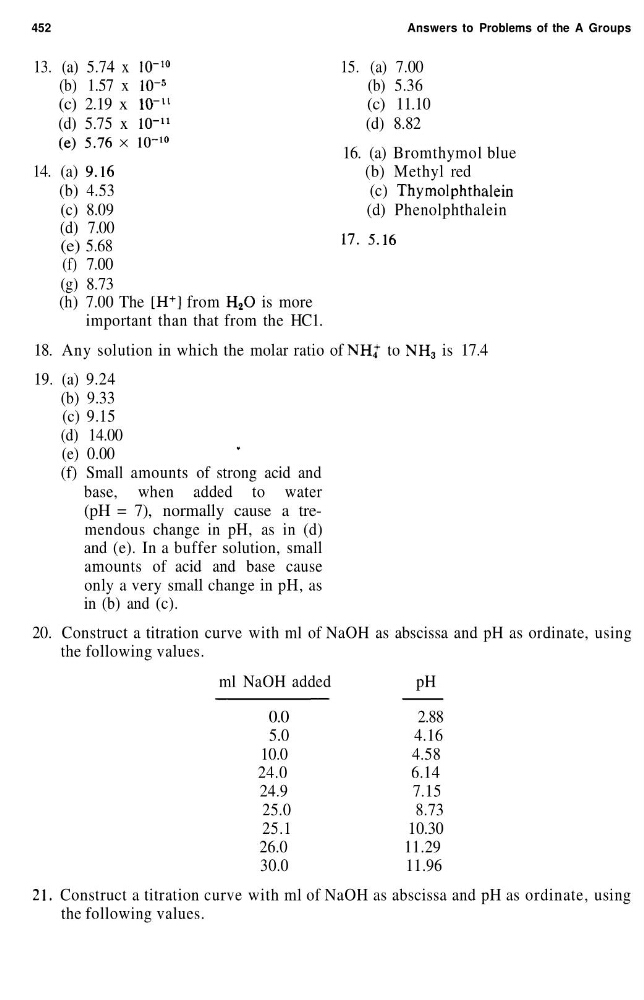
20. Construct a titration curve with ml of NaOH as abscissa and pH as ordinate, using
the following values.
ml NaOH added
pH
0.0
2.88
5.0
4.16
10.0
4.58
24.0
6.14
24.9
7.15
25.0
8.73
25.1
10.30
26.0
11.29
30.0
11.96
21. Construct a titration curve with ml of NaOH as abscissa and pH as ordinate, using
the following values.
Answers to Problems of the A Groups
13. (a) 5.74 x lO"
10
15. (a) 7.00
(b) 1.57 x 10~
5
(b) 5.36
(c) 2.19 x 10-"
(c) 11.10
(d) 5.75 x 10¹¹
(d) 8.82
16. (a) Bromthymol blue
14. (a) 9.16
(b) Methyl red
(b) 4.53
(c) Thymolphthalein
(c) 8.09
(d) Phenolphthalein
(d) 7.00
(e) 5.68
17
-
5 '
16
(f) 7.00
(g) 8.73
(h) 7.00 The [H+] from H 2 O is more
important than that from the HC1.
18. Any solution in which the molar ratio of NH^" to NH 3 is 17.4
19. (a) 9.24
(b) 9.33
(c) 9.15
(d) 14.00
(e) 0.00
(f) Small amounts of strong acid and
base, when added to water
(pH = 7), normally cause a tremendous change in pH, as in (d)
and (e). In a buffer solution, small
amounts of acid and base cause
only a very small change in pH, as
in (b) and (c).
20. Construct a titration curve with ml of NaOH as abscissa and pH as ordinate, using
the following values.
ml NaOH added
pH
0.0
2.88
5.0
4.16
10.0
4.58
24.0
6.14
24.9
7.15
25.0
8.73
25.1
10.30
26.0
11.29
30.0
11.96
21. Construct a titration curve with ml of NaOH as abscissa and pH as ordinate, using
the following values.