

Temperature
37
different for the Fahrenheit scale. The range (temperature difference) from the
freezing point to the boiling point of water is 180°F or 100°C or 100 K. Therefore, in measuring temperature changes or differences, 1°C = 1 K = 1.8°F, or
1°F = 100/180°C = 5/9°C = 5/9 K. Note that these formulas apply only to
temperature differences or changes. They do not take into account the differing
zero points of the three temperature scales. In order to convert a temperature
measurement from one scale to another, we must have formulas that allow for
both the differing unit sizes and the differing zero points.
The following is one logical approach that can be taken to derive a formula
for converting Fahrenheit measurements to Celsius measurements.
1. From the Fahrenheit scale create a new Imaginary temperature scale (call
it °I) that will give a reading of 0°I at freezing point of water (just like the Celsius
scale). This can be accomplished by simply subtracting 32 from all of the
readings on the Fahrenheit scale to give the conversion formula
°I = °F - 32
Note that the size of the units is the same on both scales.
2. The Imaginary scale and the Celsius scale both have the same zero point
(the freezing point of water), but they differ in the size of their units. The
readings on the Celsius scale will always be just 100/180 = 5/9 of the readings
on the Imaginary scale, so the conversion formula from one to the other is
°C = 5/9°I
3. If the readings on the Imaginary scale are now expressed in terms of the
readings on the Fahrenheit scale, we shall have the formula to convert from
Fahrenheit to Celsius given in Table 4-2. That is,
°C = 5/9(°F - 32)
The units of the Kelvin scale are the same size as those of the Celsius scale,
but the zero point of the Kelvin scale is 273.2 units lower than that of the
Celsius scale. Therefore, K = °C + 273.2 = 5/9(°F - 32) + 273.2.
PROBLEM:
Convert 115°F to equivalent Celsius and Kelvin temperatures.
SOLUTION:
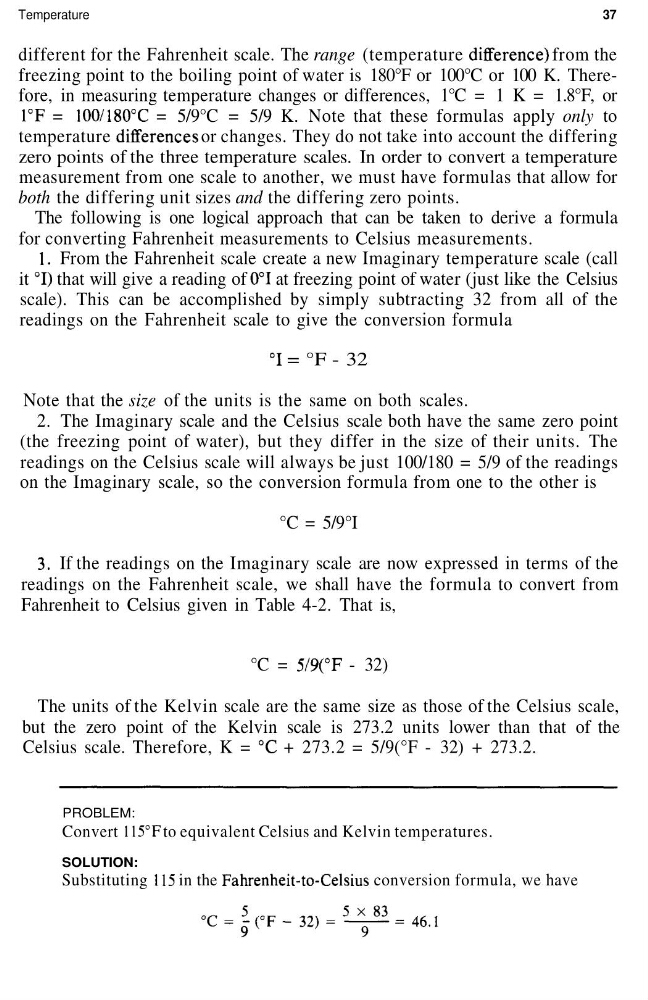
Substituting 115 in the Fahrenheit-to-Celsius conversion formula, we have
37
different for the Fahrenheit scale. The range (temperature difference) from the
freezing point to the boiling point of water is 180°F or 100°C or 100 K. Therefore, in measuring temperature changes or differences, 1°C = 1 K = 1.8°F, or
1°F = 100/180°C = 5/9°C = 5/9 K. Note that these formulas apply only to
temperature differences or changes. They do not take into account the differing
zero points of the three temperature scales. In order to convert a temperature
measurement from one scale to another, we must have formulas that allow for
both the differing unit sizes and the differing zero points.
The following is one logical approach that can be taken to derive a formula
for converting Fahrenheit measurements to Celsius measurements.
1. From the Fahrenheit scale create a new Imaginary temperature scale (call
it °I) that will give a reading of 0°I at freezing point of water (just like the Celsius
scale). This can be accomplished by simply subtracting 32 from all of the
readings on the Fahrenheit scale to give the conversion formula
°I = °F - 32
Note that the size of the units is the same on both scales.
2. The Imaginary scale and the Celsius scale both have the same zero point
(the freezing point of water), but they differ in the size of their units. The
readings on the Celsius scale will always be just 100/180 = 5/9 of the readings
on the Imaginary scale, so the conversion formula from one to the other is
°C = 5/9°I
3. If the readings on the Imaginary scale are now expressed in terms of the
readings on the Fahrenheit scale, we shall have the formula to convert from
Fahrenheit to Celsius given in Table 4-2. That is,
°C = 5/9(°F - 32)
The units of the Kelvin scale are the same size as those of the Celsius scale,
but the zero point of the Kelvin scale is 273.2 units lower than that of the
Celsius scale. Therefore, K = °C + 273.2 = 5/9(°F - 32) + 273.2.
PROBLEM:
Convert 115°F to equivalent Celsius and Kelvin temperatures.
SOLUTION:
Substituting 115 in the Fahrenheit-to-Celsius conversion formula, we have