

415
SYNTHESIS
To prepare compounds, you must use reactions that (by the principles just
outlined) are predicted to "go." Not all reactions that take place, however, are
suitable for synthesis, and attention must be paid to purity of product, cost of
reactants, and ease of preparation. We comment on these factors in the answers
to the A problems, and in the following discussion of the preparation of a
compound X. If your laboratory work includes qualitative analysis, you might
well consider each evolved gas and each precipitate to be a chemical preparation, even though the prime purpose of the project before you is separation or
identification.
The general methods of synthesis outlined below are merely a collection of
simple, common sense, practical techniques presented in an organized manner.
Some of the methods will already be familiar to you from previous experience,
and you will probably gain experience in additional methods as you progress
through your present chemistry course.
X Is a Gas
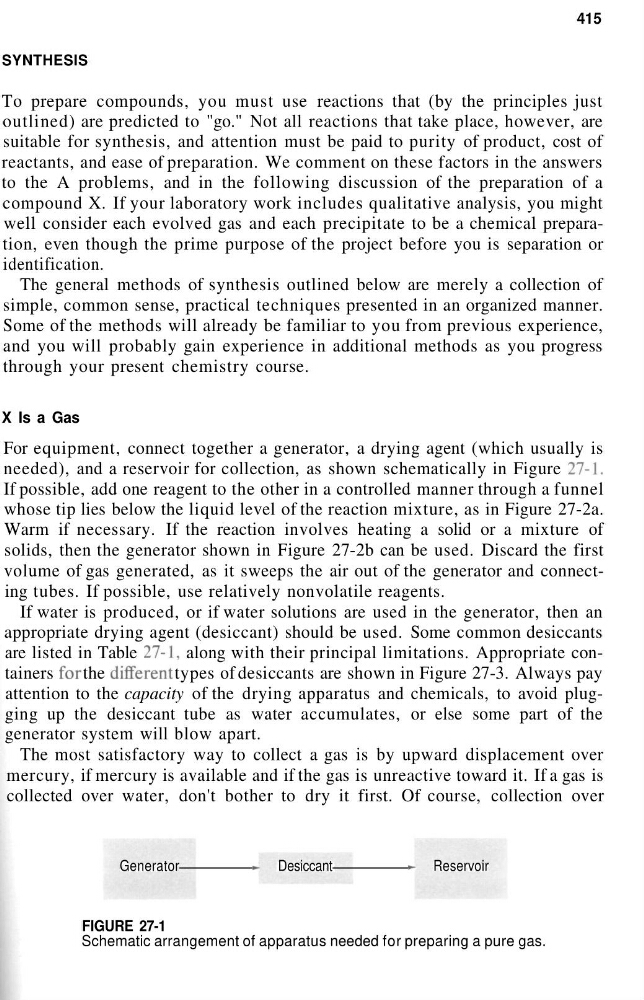
For equipment, connect together a generator, a drying agent (which usually is
needed), and a reservoir for collection, as shown schematically in Figure 27-1.
If possible, add one reagent to the other in a controlled manner through a funnel
whose tip lies below the liquid level of the reaction mixture, as in Figure 27-2a.
Warm if necessary. If the reaction involves heating a solid or a mixture of
solids, then the generator shown in Figure 27-2b can be used. Discard the first
volume of gas generated, as it sweeps the air out of the generator and connecting tubes. If possible, use relatively nonvolatile reagents.
If water is produced, or if water solutions are used in the generator, then an
appropriate drying agent (desiccant) should be used. Some common desiccants
are listed in Table 27-1, along with their principal limitations. Appropriate containers for the different types of desiccants are shown in Figure 27-3. Always pay
attention to the capacity of the drying apparatus and chemicals, to avoid plugging up the desiccant tube as water accumulates, or else some part of the
generator system will blow apart.
The most satisfactory way to collect a gas is by upward displacement over
mercury, if mercury is available and if the gas is unreactive toward it. If a gas is
collected over water, don't bother to dry it first. Of course, collection over
Generator
»- Desiccant
•- Reservoir
FIGURE 27-1
Schematic arrangement of apparatus needed for preparing a pure gas.
SYNTHESIS
To prepare compounds, you must use reactions that (by the principles just
outlined) are predicted to "go." Not all reactions that take place, however, are
suitable for synthesis, and attention must be paid to purity of product, cost of
reactants, and ease of preparation. We comment on these factors in the answers
to the A problems, and in the following discussion of the preparation of a
compound X. If your laboratory work includes qualitative analysis, you might
well consider each evolved gas and each precipitate to be a chemical preparation, even though the prime purpose of the project before you is separation or
identification.
The general methods of synthesis outlined below are merely a collection of
simple, common sense, practical techniques presented in an organized manner.
Some of the methods will already be familiar to you from previous experience,
and you will probably gain experience in additional methods as you progress
through your present chemistry course.
X Is a Gas
For equipment, connect together a generator, a drying agent (which usually is
needed), and a reservoir for collection, as shown schematically in Figure 27-1.
If possible, add one reagent to the other in a controlled manner through a funnel
whose tip lies below the liquid level of the reaction mixture, as in Figure 27-2a.
Warm if necessary. If the reaction involves heating a solid or a mixture of
solids, then the generator shown in Figure 27-2b can be used. Discard the first
volume of gas generated, as it sweeps the air out of the generator and connecting tubes. If possible, use relatively nonvolatile reagents.
If water is produced, or if water solutions are used in the generator, then an
appropriate drying agent (desiccant) should be used. Some common desiccants
are listed in Table 27-1, along with their principal limitations. Appropriate containers for the different types of desiccants are shown in Figure 27-3. Always pay
attention to the capacity of the drying apparatus and chemicals, to avoid plugging up the desiccant tube as water accumulates, or else some part of the
generator system will blow apart.
The most satisfactory way to collect a gas is by upward displacement over
mercury, if mercury is available and if the gas is unreactive toward it. If a gas is
collected over water, don't bother to dry it first. Of course, collection over
Generator
»- Desiccant
•- Reservoir
FIGURE 27-1
Schematic arrangement of apparatus needed for preparing a pure gas.