

Prediction
413
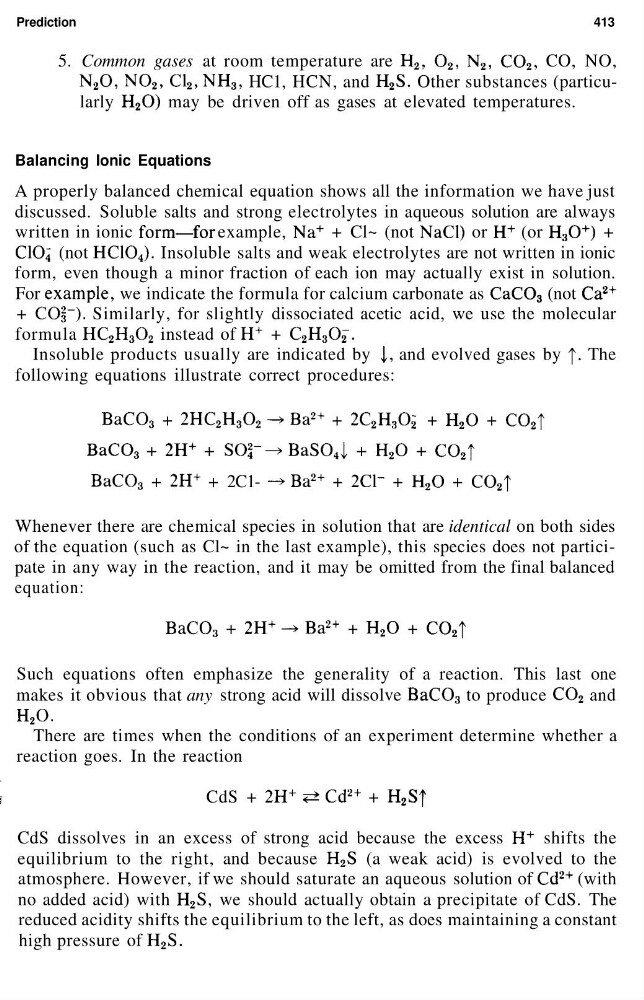
5. Common gases at room temperature are H 2 , O 2 , N 2 , CO 2 , CO, NO,
N 2 O, NO 2 , C1 2 , NH 3 , HC1, HCN, and H 2 S. Other substances (particularly H 2 O) may be driven off as gases at elevated temperatures.
Balancing Ionic Equations
A properly balanced chemical equation shows all the information we have just
discussed. Soluble salts and strong electrolytes in aqueous solution are always
written in ionic form—for example, Na
+ + Cl~ (not NaCl) or H+ (or H 3 O
+ ) +
C1O 4 (not HClO 4 ). Insoluble salts and weak electrolytes are not written in ionic
form, even though a minor fraction of each ion may actually exist in solution.
For example, we indicate the formula for calcium carbonate as CaCO 3 (not Ca
2+
+ COfr). Similarly, for slightly dissociated acetic acid, we use the molecular
formula HC 2 H 3 O 2 instead of H
+ + C 2 H 3 O 2 .
Insoluble products usually are indicated by |, and evolved gases by f. The
following equations illustrate correct procedures:
BaCO 3 + 2HC 2 H 3 O 2 -» Ba
2+ + 2C 2 H 3 O2 + H 2 O + CO 2 |
BaCOg + 2H+ + SOr -> BaSO 4 | + H 2 O + CO 2 t
BaCO 3 + 2H
+ + 2C1- -» Ba
2+ + 2C1~ + H 2 O + CO 2 |
Whenever there are chemical species in solution that are identical on both sides
of the equation (such as Cl~ in the last example), this species does not participate in any way in the reaction, and it may be omitted from the final balanced
equation:
BaCO 3 + 2H
+ -» Ba
2+ + H 2 O + CO 2 |
Such equations often emphasize the generality of a reaction. This last one
makes it obvious that any strong acid will dissolve BaCO 3 to produce CO 2 and
H 2 O.
There are times when the conditions of an experiment determine whether a
reaction goes. In the reaction
CdS + 2H
+ <± Cd
2+ + H 2 S|
CdS dissolves in an excess of strong acid because the excess H
+ shifts the
equilibrium to the right, and because H 2 S (a weak acid) is evolved to the
atmosphere. However, if we should saturate an aqueous solution of Cd
2+ (with
no added acid) with H 2 S, we should actually obtain a precipitate of CdS. The
reduced acidity shifts the equilibrium to the left, as does maintaining a constant
high pressure of H 2 S.
413
5. Common gases at room temperature are H 2 , O 2 , N 2 , CO 2 , CO, NO,
N 2 O, NO 2 , C1 2 , NH 3 , HC1, HCN, and H 2 S. Other substances (particularly H 2 O) may be driven off as gases at elevated temperatures.
Balancing Ionic Equations
A properly balanced chemical equation shows all the information we have just
discussed. Soluble salts and strong electrolytes in aqueous solution are always
written in ionic form—for example, Na
+ + Cl~ (not NaCl) or H+ (or H 3 O
+ ) +
C1O 4 (not HClO 4 ). Insoluble salts and weak electrolytes are not written in ionic
form, even though a minor fraction of each ion may actually exist in solution.
For example, we indicate the formula for calcium carbonate as CaCO 3 (not Ca
2+
+ COfr). Similarly, for slightly dissociated acetic acid, we use the molecular
formula HC 2 H 3 O 2 instead of H
+ + C 2 H 3 O 2 .
Insoluble products usually are indicated by |, and evolved gases by f. The
following equations illustrate correct procedures:
BaCO 3 + 2HC 2 H 3 O 2 -» Ba
2+ + 2C 2 H 3 O2 + H 2 O + CO 2 |
BaCOg + 2H+ + SOr -> BaSO 4 | + H 2 O + CO 2 t
BaCO 3 + 2H
+ + 2C1- -» Ba
2+ + 2C1~ + H 2 O + CO 2 |
Whenever there are chemical species in solution that are identical on both sides
of the equation (such as Cl~ in the last example), this species does not participate in any way in the reaction, and it may be omitted from the final balanced
equation:
BaCO 3 + 2H
+ -» Ba
2+ + H 2 O + CO 2 |
Such equations often emphasize the generality of a reaction. This last one
makes it obvious that any strong acid will dissolve BaCO 3 to produce CO 2 and
H 2 O.
There are times when the conditions of an experiment determine whether a
reaction goes. In the reaction
CdS + 2H
+ <± Cd
2+ + H 2 S|
CdS dissolves in an excess of strong acid because the excess H
+ shifts the
equilibrium to the right, and because H 2 S (a weak acid) is evolved to the
atmosphere. However, if we should saturate an aqueous solution of Cd
2+ (with
no added acid) with H 2 S, we should actually obtain a precipitate of CdS. The
reduced acidity shifts the equilibrium to the left, as does maintaining a constant
high pressure of H 2 S.