

402
Nuclear Chemistry
These equations also illustrate the following general statements.
1. Whenever a radioactive element emits an a particle, its product
(daughter) has a mass number that is 4 less than that of the parent and
an atomic number that is 2 less than that of the parent.
2. Whenever a radioactive element emits a /3 particle, its daughter has a
mass number that is the same as that of the parent and an atomic
number that is 1 greater than that of the parent. Because electrons as
such are not present in the nuclei of atoms, it is not obvious at first why
the loss of a ft particle should cause an increase in atomic number.
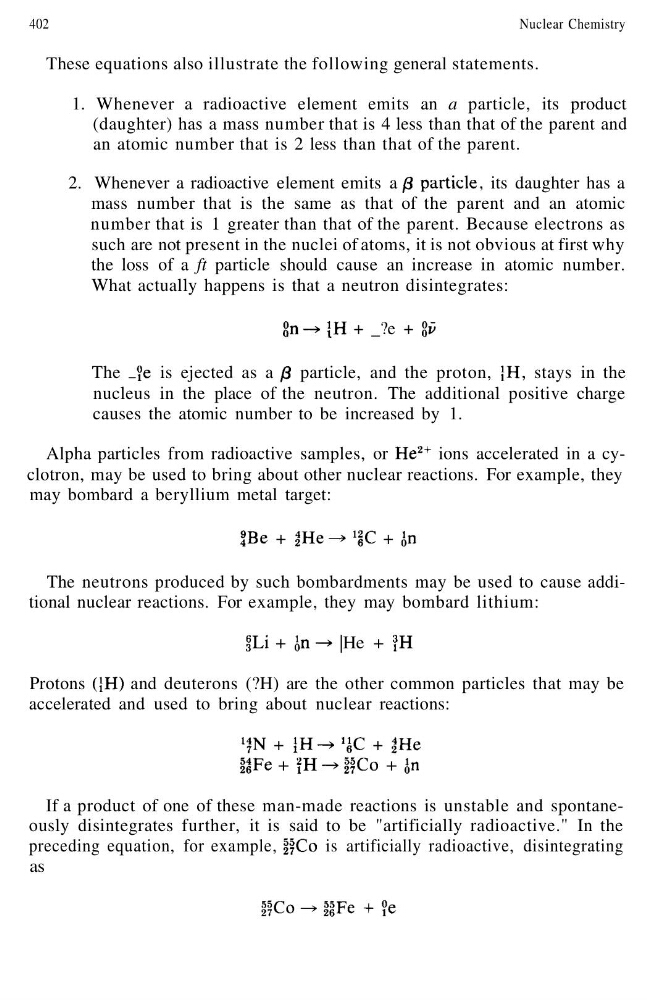
What actually happens is that a neutron disintegrates:
gn -* }H + _?e + &
The _?e is ejected as a /3 particle, and the proton, JH, stays in the
nucleus in the place of the neutron. The additional positive charge
causes the atomic number to be increased by 1.
Alpha particles from radioactive samples, or He
2+ ions accelerated in a cyclotron, may be used to bring about other nuclear reactions. For example, they
may bombard a beryllium metal target:
JBe + |He -» 'jjC + Jn
The neutrons produced by such bombardments may be used to cause additional nuclear reactions. For example, they may bombard lithium:
§Li + Jn -» |He + ?H
Protons (JH) and deuterons (?H) are the other common particles that may be
accelerated and used to bring about nuclear reactions:
'?N + }H -» >JC + |He
||Fe + ?H -» pCo + Jn
If a product of one of these man-made reactions is unstable and spontaneously disintegrates further, it is said to be "artificially radioactive." In the
preceding equation, for example, jjfCo is artificially radioactive, disintegrating
as
?e
Nuclear Chemistry
These equations also illustrate the following general statements.
1. Whenever a radioactive element emits an a particle, its product
(daughter) has a mass number that is 4 less than that of the parent and
an atomic number that is 2 less than that of the parent.
2. Whenever a radioactive element emits a /3 particle, its daughter has a
mass number that is the same as that of the parent and an atomic
number that is 1 greater than that of the parent. Because electrons as
such are not present in the nuclei of atoms, it is not obvious at first why
the loss of a ft particle should cause an increase in atomic number.
What actually happens is that a neutron disintegrates:
gn -* }H + _?e + &
The _?e is ejected as a /3 particle, and the proton, JH, stays in the
nucleus in the place of the neutron. The additional positive charge
causes the atomic number to be increased by 1.
Alpha particles from radioactive samples, or He
2+ ions accelerated in a cyclotron, may be used to bring about other nuclear reactions. For example, they
may bombard a beryllium metal target:
JBe + |He -» 'jjC + Jn
The neutrons produced by such bombardments may be used to cause additional nuclear reactions. For example, they may bombard lithium:
§Li + Jn -» |He + ?H
Protons (JH) and deuterons (?H) are the other common particles that may be
accelerated and used to bring about nuclear reactions:
'?N + }H -» >JC + |He
||Fe + ?H -» pCo + Jn
If a product of one of these man-made reactions is unstable and spontaneously disintegrates further, it is said to be "artificially radioactive." In the
preceding equation, for example, jjfCo is artificially radioactive, disintegrating
as
?e