

Problems A
31
Thus, if you want to convert 20 yd
3 to gallons, you merely multiply 20 by 202, as
follows:
gal = (20 >d*) (202 |p\ = 4040 gal
PROBLEM:
If a runner does the 100 yd dash in 10 seconds, what is his speed in miles per hour?
SOLUTION:
The first thing you should observe is that the units of the desired answer must be
mi/hr, so the original information must be used in the ratio of length/time, or as 100
yd/10 sec. Once you have made the proper decision about how to use the units of
the original data, follow the same procedure as in finding a conversion factor F:
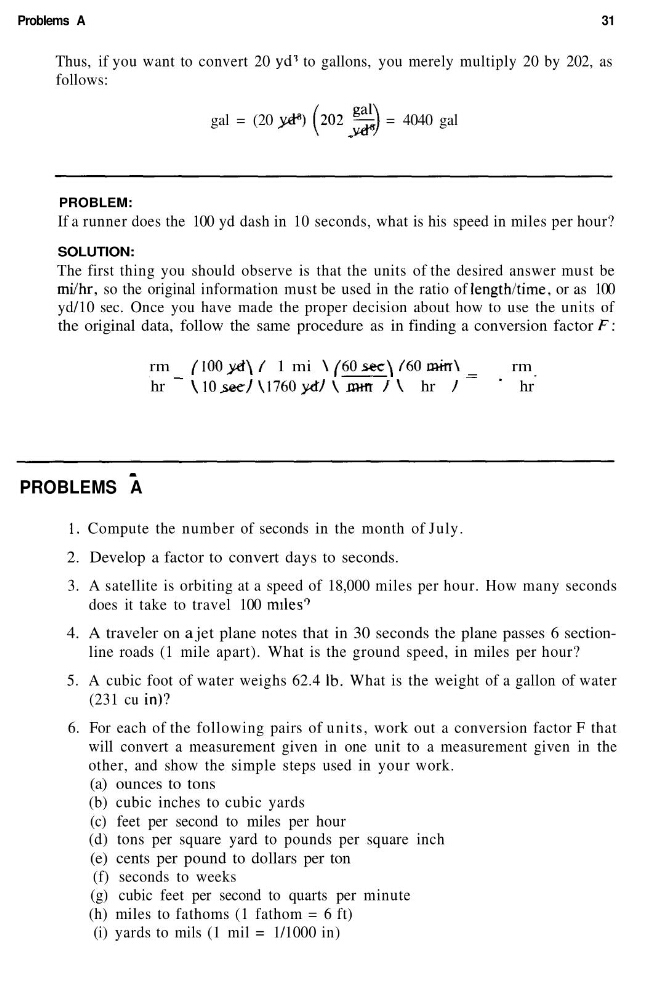
rm /100>d\ / 1 mi \ /60_sec\ /60 mm\ =
rm
hr ~ \ lOjjse/ \1760 yd/ \ jam / \ hr / ~~ ' hr
PROBLEMS A
1. Compute the number of seconds in the month of July.
2. Develop a factor to convert days to seconds.
3. A satellite is orbiting at a speed of 18,000 miles per hour. How many seconds
does it take to travel 100 miles'
1
4. A traveler on a jet plane notes that in 30 seconds the plane passes 6 sectionline roads (1 mile apart). What is the ground speed, in miles per hour?
5. A cubic foot of water weighs 62.4 Ib. What is the weight of a gallon of water
(231 cu in)?
6. For each of the following pairs of units, work out a conversion factor F that
will convert a measurement given in one unit to a measurement given in the
other, and show the simple steps used in your work.
(a) ounces to tons
(b) cubic inches to cubic yards
(c) feet per second to miles per hour
(d) tons per square yard to pounds per square inch
(e) cents per pound to dollars per ton
(f) seconds to weeks
(g) cubic feet per second to quarts per minute
(h) miles to fathoms (1 fathom = 6 ft)
(i) yards to mils (1 mil = 1/1000 in)
31
Thus, if you want to convert 20 yd
3 to gallons, you merely multiply 20 by 202, as
follows:
gal = (20 >d*) (202 |p\ = 4040 gal
PROBLEM:
If a runner does the 100 yd dash in 10 seconds, what is his speed in miles per hour?
SOLUTION:
The first thing you should observe is that the units of the desired answer must be
mi/hr, so the original information must be used in the ratio of length/time, or as 100
yd/10 sec. Once you have made the proper decision about how to use the units of
the original data, follow the same procedure as in finding a conversion factor F:
rm /100>d\ / 1 mi \ /60_sec\ /60 mm\ =
rm
hr ~ \ lOjjse/ \1760 yd/ \ jam / \ hr / ~~ ' hr
PROBLEMS A
1. Compute the number of seconds in the month of July.
2. Develop a factor to convert days to seconds.
3. A satellite is orbiting at a speed of 18,000 miles per hour. How many seconds
does it take to travel 100 miles'
1
4. A traveler on a jet plane notes that in 30 seconds the plane passes 6 sectionline roads (1 mile apart). What is the ground speed, in miles per hour?
5. A cubic foot of water weighs 62.4 Ib. What is the weight of a gallon of water
(231 cu in)?
6. For each of the following pairs of units, work out a conversion factor F that
will convert a measurement given in one unit to a measurement given in the
other, and show the simple steps used in your work.
(a) ounces to tons
(b) cubic inches to cubic yards
(c) feet per second to miles per hour
(d) tons per square yard to pounds per square inch
(e) cents per pound to dollars per ton
(f) seconds to weeks
(g) cubic feet per second to quarts per minute
(h) miles to fathoms (1 fathom = 6 ft)
(i) yards to mils (1 mil = 1/1000 in)