

362
Acid-Base Equilibria
This problem emphasizes the point that, at the endpoint in a titration, there is only
the salt present (no excess acid or base), and the pH of the solution will be
determined entirely by the hydrolysis of that salt.
pH OF "ACID-SALT" SOLUTIONS
How should the salt of a partially neutralized acid (such as NaHSO 4 or KHC0 3 )
be considered? Should the negative ion be treated as a weak acid that ionizes
to make the solution acidic, or as an ion that hydrolyzes to make the solution
basic? We know that such salts are soluble (they are Na
+ and K
+ salts) and
that we can ignore the hydrolysis of the Na
+ and K
+ ions.
Each ion must be considered on its own merits, but the answer is easy to
obtain. We compare the equilibrium constants (A"j and A" h ) for the two possible
reactions of the negative ion, and whichever has the larger constant will be the
predominant reaction, so that we can ignore the other. The following problem
illustrates the decision-making process.
PROBLEM:
What is the pH of a 0. 100 M KHCO 3 solution?
SOLUTION:
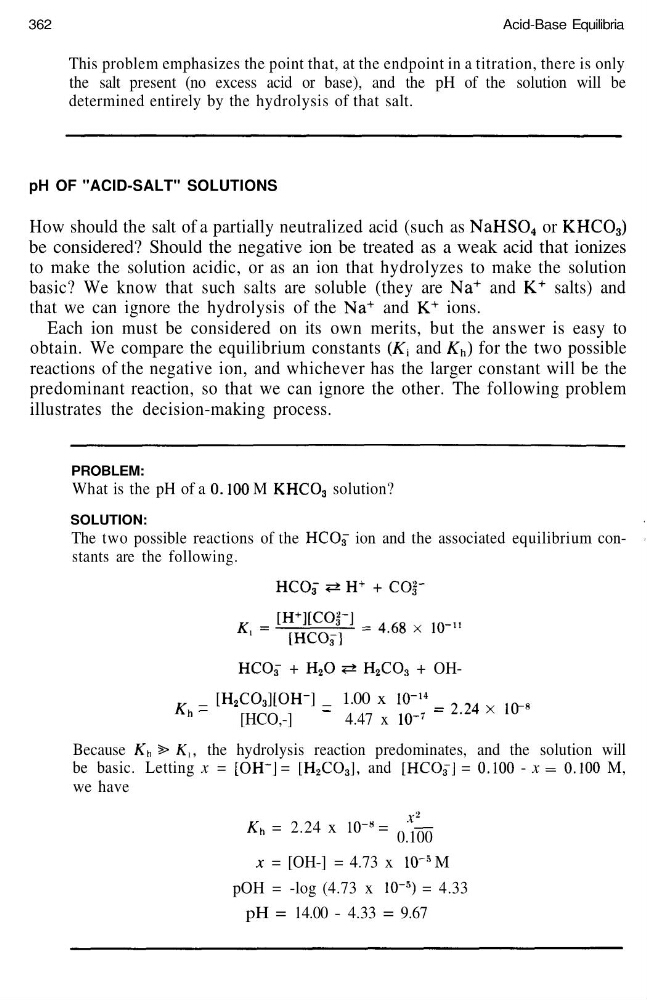
The two possible reactions of the HCO^ ion and the associated equilibrium constants are the following.
HCO 3 - ?± H
+ + CO 3
2
-
HCO 3 - + H 2 O «=* H 2 CO 3 + OH_ [H 2 C0 3 ][OH-] _ 1.00 x 1Q-" _
*
h ~
[HCO,-]
~ 4.47 x 10-' ~
2 '
24 X '°
Because K h ^> K,, the hydrolysis reaction predominates, and the solution will
be basic. Letting x = [OH'] = [H 2 CO 3 ], and [HCO 3 -J = 0.100 - x = 0.100 M,
we have
K h = 2.24 x 108 =
x
0.100
x = [OH-] = 4.73 x 10'
5 M
pOH = -log (4.73 x 10~
5
) = 4.33
pH = 14.00 - 4.33 = 9.67
Acid-Base Equilibria
This problem emphasizes the point that, at the endpoint in a titration, there is only
the salt present (no excess acid or base), and the pH of the solution will be
determined entirely by the hydrolysis of that salt.
pH OF "ACID-SALT" SOLUTIONS
How should the salt of a partially neutralized acid (such as NaHSO 4 or KHC0 3 )
be considered? Should the negative ion be treated as a weak acid that ionizes
to make the solution acidic, or as an ion that hydrolyzes to make the solution
basic? We know that such salts are soluble (they are Na
+ and K
+ salts) and
that we can ignore the hydrolysis of the Na
+ and K
+ ions.
Each ion must be considered on its own merits, but the answer is easy to
obtain. We compare the equilibrium constants (A"j and A" h ) for the two possible
reactions of the negative ion, and whichever has the larger constant will be the
predominant reaction, so that we can ignore the other. The following problem
illustrates the decision-making process.
PROBLEM:
What is the pH of a 0. 100 M KHCO 3 solution?
SOLUTION:
The two possible reactions of the HCO^ ion and the associated equilibrium constants are the following.
HCO 3 - ?± H
+ + CO 3
2
-
HCO 3 - + H 2 O «=* H 2 CO 3 + OH_ [H 2 C0 3 ][OH-] _ 1.00 x 1Q-" _
*
h ~
[HCO,-]
~ 4.47 x 10-' ~
2 '
24 X '°
Because K h ^> K,, the hydrolysis reaction predominates, and the solution will
be basic. Letting x = [OH'] = [H 2 CO 3 ], and [HCO 3 -J = 0.100 - x = 0.100 M,
we have
K h = 2.24 x 108 =
x
0.100
x = [OH-] = 4.73 x 10'
5 M
pOH = -log (4.73 x 10~
5
) = 4.33
pH = 14.00 - 4.33 = 9.67