

Weak Base*
353
PROBLEM:
Calculate the pH of a 0.100 M H 2 S solution.
SOLUTION:
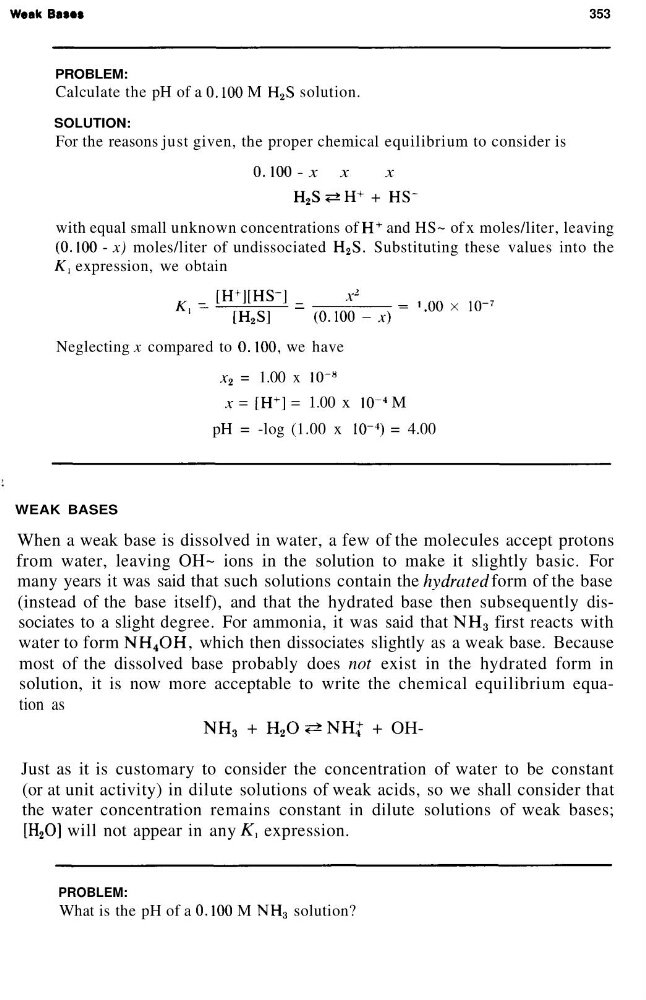
For the reasons just given, the proper chemical equilibrium to consider is
0. 100 - x x
x
H 2 S ?± H
+ + HSwith equal small unknown concentrations of H
+ and HS~ of x moles/liter, leaving
(0.100 - x) moles/liter of undissociated H 2 S. Substituting these values into the
K t expression, we obtain
_ [H+J[HS-J _
^
_
>~
[H 2 S]
~ (0.100-,)- •
Neglecting x compared to 0. 100, we have
x 2 = 1.00 x ID"
8
x = [H+] = 1.00 x 10-" M
pH = -log (1.00 x 10-") = 4.00
WEAK BASES
When a weak base is dissolved in water, a few of the molecules accept protons
from water, leaving OH~ ions in the solution to make it slightly basic. For
many years it was said that such solutions contain the hydmted form of the base
(instead of the base itself), and that the hydrated base then subsequently dissociates to a slight degree. For ammonia, it was said that NH 3 first reacts with
water to form NH 4 OH, which then dissociates slightly as a weak base. Because
most of the dissolved base probably does not exist in the hydrated form in
solution, it is now more acceptable to write the chemical equilibrium equation as
NH 3 + H 2 O «± NHJ + OHJust as it is customary to consider the concentration of water to be constant
(or at unit activity) in dilute solutions of weak acids, so we shall consider that
the water concentration remains constant in dilute solutions of weak bases;
[H 2 0] will not appear in any K l expression.
PROBLEM:
What is the pH of a 0.100 M NH 3 solution?
353
PROBLEM:
Calculate the pH of a 0.100 M H 2 S solution.
SOLUTION:
For the reasons just given, the proper chemical equilibrium to consider is
0. 100 - x x
x
H 2 S ?± H
+ + HSwith equal small unknown concentrations of H
+ and HS~ of x moles/liter, leaving
(0.100 - x) moles/liter of undissociated H 2 S. Substituting these values into the
K t expression, we obtain
_ [H+J[HS-J _
^
_
>~
[H 2 S]
~ (0.100-,)- •
Neglecting x compared to 0. 100, we have
x 2 = 1.00 x ID"
8
x = [H+] = 1.00 x 10-" M
pH = -log (1.00 x 10-") = 4.00
WEAK BASES
When a weak base is dissolved in water, a few of the molecules accept protons
from water, leaving OH~ ions in the solution to make it slightly basic. For
many years it was said that such solutions contain the hydmted form of the base
(instead of the base itself), and that the hydrated base then subsequently dissociates to a slight degree. For ammonia, it was said that NH 3 first reacts with
water to form NH 4 OH, which then dissociates slightly as a weak base. Because
most of the dissolved base probably does not exist in the hydrated form in
solution, it is now more acceptable to write the chemical equilibrium equation as
NH 3 + H 2 O «± NHJ + OHJust as it is customary to consider the concentration of water to be constant
(or at unit activity) in dilute solutions of weak acids, so we shall consider that
the water concentration remains constant in dilute solutions of weak bases;
[H 2 0] will not appear in any K l expression.
PROBLEM:
What is the pH of a 0.100 M NH 3 solution?