

350
Acid-Base Equilibria
The equilibrium constant for the ionization of a weak electrolyte usually is
designated as K t , which we call the ionization constant.
Ionization constants are determined by experimental measurements of
equilibrium concentrations. For example, to determine K { for acetic acid, we
prepare a solution of known concentration and by any of several methods
measure the H
+ concentration or the pH. The method most widely used
today is measuring with a pH meter, which gives a direct dial reading for the
pH. We find experimentally that, in a 0.100 M solution of acetic acid, the
pH is 2.88. From this we calculate the concentrations in the solution, and we
use these to evaluate K,. Starting with [H
+ ], we have
[H
+ ] = 102 -
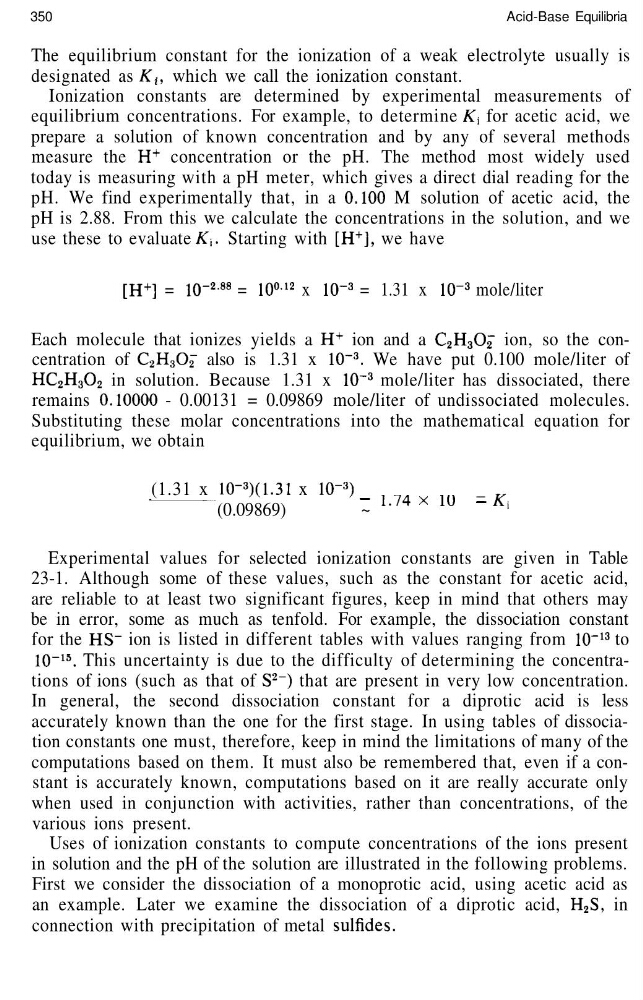
88 = 10°12 x 103 = 1.31 x 10³ mole/liter
Each molecule that ionizes yields a H
+ ion and a C 2 H 3 Oi" ion, so the concentration of C 2 H 3 O 2 - also is 1.31 x 1(T
3
. We have put 0.100 mole/liter of
HC 2 H 3 O 2 in solution. Because 1.31 x 10~
3 mole/liter has dissociated, there
remains 0.10000 - 0.00131 = 0.09869 mole/liter of undissociated molecules.
Substituting these molar concentrations into the mathematical equation for
equilibrium, we obtain
(1.31 x 10³ )(1.31 x 10³
) _
_
(0.09869)
~
L74 X 1U
~
K[
Experimental values for selected ionization constants are given in Table
23-1. Although some of these values, such as the constant for acetic acid,
are reliable to at least two significant figures, keep in mind that others may
be in error, some as much as tenfold. For example, the dissociation constant
for the HS~ ion is listed in different tables with values ranging from 10~
13 to
10~
15 . This uncertainty is due to the difficulty of determining the concentrations of ions (such as that of S
2 ~) that are present in very low concentration.
In general, the second dissociation constant for a diprotic acid is less
accurately known than the one for the first stage. In using tables of dissociation constants one must, therefore, keep in mind the limitations of many of the
computations based on them. It must also be remembered that, even if a constant is accurately known, computations based on it are really accurate only
when used in conjunction with activities, rather than concentrations, of the
various ions present.
Uses of ionization constants to compute concentrations of the ions present
in solution and the pH of the solution are illustrated in the following problems.
First we consider the dissociation of a monoprotic acid, using acetic acid as
an example. Later we examine the dissociation of a diprotic acid, H 2 S, in
connection with precipitation of metal sulfides.
Acid-Base Equilibria
The equilibrium constant for the ionization of a weak electrolyte usually is
designated as K t , which we call the ionization constant.
Ionization constants are determined by experimental measurements of
equilibrium concentrations. For example, to determine K { for acetic acid, we
prepare a solution of known concentration and by any of several methods
measure the H
+ concentration or the pH. The method most widely used
today is measuring with a pH meter, which gives a direct dial reading for the
pH. We find experimentally that, in a 0.100 M solution of acetic acid, the
pH is 2.88. From this we calculate the concentrations in the solution, and we
use these to evaluate K,. Starting with [H
+ ], we have
[H
+ ] = 102 -
88 = 10°12 x 103 = 1.31 x 10³ mole/liter
Each molecule that ionizes yields a H
+ ion and a C 2 H 3 Oi" ion, so the concentration of C 2 H 3 O 2 - also is 1.31 x 1(T
3
. We have put 0.100 mole/liter of
HC 2 H 3 O 2 in solution. Because 1.31 x 10~
3 mole/liter has dissociated, there
remains 0.10000 - 0.00131 = 0.09869 mole/liter of undissociated molecules.
Substituting these molar concentrations into the mathematical equation for
equilibrium, we obtain
(1.31 x 10³ )(1.31 x 10³
) _
_
(0.09869)
~
L74 X 1U
~
K[
Experimental values for selected ionization constants are given in Table
23-1. Although some of these values, such as the constant for acetic acid,
are reliable to at least two significant figures, keep in mind that others may
be in error, some as much as tenfold. For example, the dissociation constant
for the HS~ ion is listed in different tables with values ranging from 10~
13 to
10~
15 . This uncertainty is due to the difficulty of determining the concentrations of ions (such as that of S
2 ~) that are present in very low concentration.
In general, the second dissociation constant for a diprotic acid is less
accurately known than the one for the first stage. In using tables of dissociation constants one must, therefore, keep in mind the limitations of many of the
computations based on them. It must also be remembered that, even if a constant is accurately known, computations based on it are really accurate only
when used in conjunction with activities, rather than concentrations, of the
various ions present.
Uses of ionization constants to compute concentrations of the ions present
in solution and the pH of the solution are illustrated in the following problems.
First we consider the dissociation of a monoprotic acid, using acetic acid as
an example. Later we examine the dissociation of a diprotic acid, H 2 S, in
connection with precipitation of metal sulfides.