

Colllgatlve Properties of Electrolytes
333
77 = (0.0821)(298)(1.00 x KT
4 ) = 2.45 x 10~
3 atm
= (2.45 x 10³ atm) 760
= 1.86 torr
\
atm/
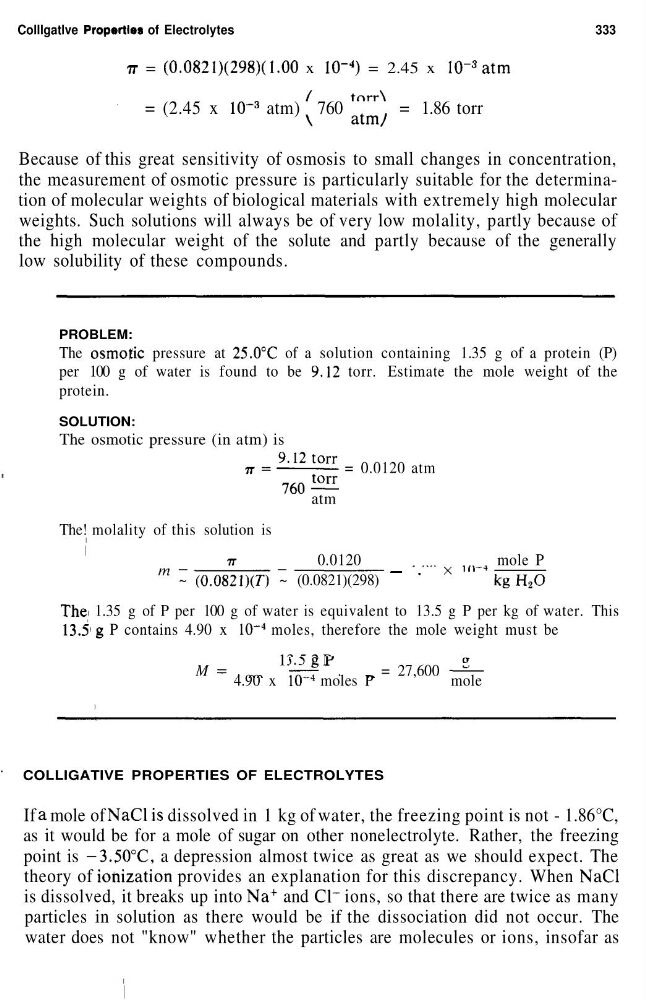
Because of this great sensitivity of osmosis to small changes in concentration,
the measurement of osmotic pressure is particularly suitable for the determination of molecular weights of biological materials with extremely high molecular
weights. Such solutions will always be of very low molality, partly because of
the high molecular weight of the solute and partly because of the generally
low solubility of these compounds.
PROBLEM:
The osmotic pressure at 25.0°C of a solution containing 1.35 g of a protein (P)
per 100 g of water is found to be 9.12 torr. Estimate the mole weight of the
protein.
SOLUTION:
The osmotic pressure (in atm) is
= 0.0120 atm
760^1
atm
The! molality of this solution is
0.0120
mole P
~ '
x
~ (0.0821XT) ~ (0.0821)(298) ~ '
kg H 2 O
Thei 1.35 g of P per 100 g of water is equivalent to 13.5 g P per kg of water. This
13. 5' g P contains 4.90 x 10~
4 moles, therefore the mole weight must be
13 5 2 P
"
M = . „„
.;*
V . „ = 27,600
4.90 x 10~
4 moles P
mole
COLLIGATIVE PROPERTIES OF ELECTROLYTES
If a mole of NaClis dissolved in 1 kg of water, the freezing point is not - 1.86°C,
as it would be for a mole of sugar on other nonelectrolyte. Rather, the freezing
point is -3.50°C, a depression almost twice as great as we should expect. The
theory of ionization provides an explanation for this discrepancy. When NaCl
is dissolved, it breaks up into Na
+ and Cl~ ions, so that there are twice as many
particles in solution as there would be if the dissociation did not occur. The
water does not "know" whether the particles are molecules or ions, insofar as
333
77 = (0.0821)(298)(1.00 x KT
4 ) = 2.45 x 10~
3 atm
= (2.45 x 10³ atm) 760
= 1.86 torr
\
atm/
Because of this great sensitivity of osmosis to small changes in concentration,
the measurement of osmotic pressure is particularly suitable for the determination of molecular weights of biological materials with extremely high molecular
weights. Such solutions will always be of very low molality, partly because of
the high molecular weight of the solute and partly because of the generally
low solubility of these compounds.
PROBLEM:
The osmotic pressure at 25.0°C of a solution containing 1.35 g of a protein (P)
per 100 g of water is found to be 9.12 torr. Estimate the mole weight of the
protein.
SOLUTION:
The osmotic pressure (in atm) is
= 0.0120 atm
760^1
atm
The! molality of this solution is
0.0120
mole P
~ '
x
~ (0.0821XT) ~ (0.0821)(298) ~ '
kg H 2 O
Thei 1.35 g of P per 100 g of water is equivalent to 13.5 g P per kg of water. This
13. 5' g P contains 4.90 x 10~
4 moles, therefore the mole weight must be
13 5 2 P
"
M = . „„
.;*
V . „ = 27,600
4.90 x 10~
4 moles P
mole
COLLIGATIVE PROPERTIES OF ELECTROLYTES
If a mole of NaClis dissolved in 1 kg of water, the freezing point is not - 1.86°C,
as it would be for a mole of sugar on other nonelectrolyte. Rather, the freezing
point is -3.50°C, a depression almost twice as great as we should expect. The
theory of ionization provides an explanation for this discrepancy. When NaCl
is dissolved, it breaks up into Na
+ and Cl~ ions, so that there are twice as many
particles in solution as there would be if the dissociation did not occur. The
water does not "know" whether the particles are molecules or ions, insofar as