

316
Electrochemistry III: Electrolysis
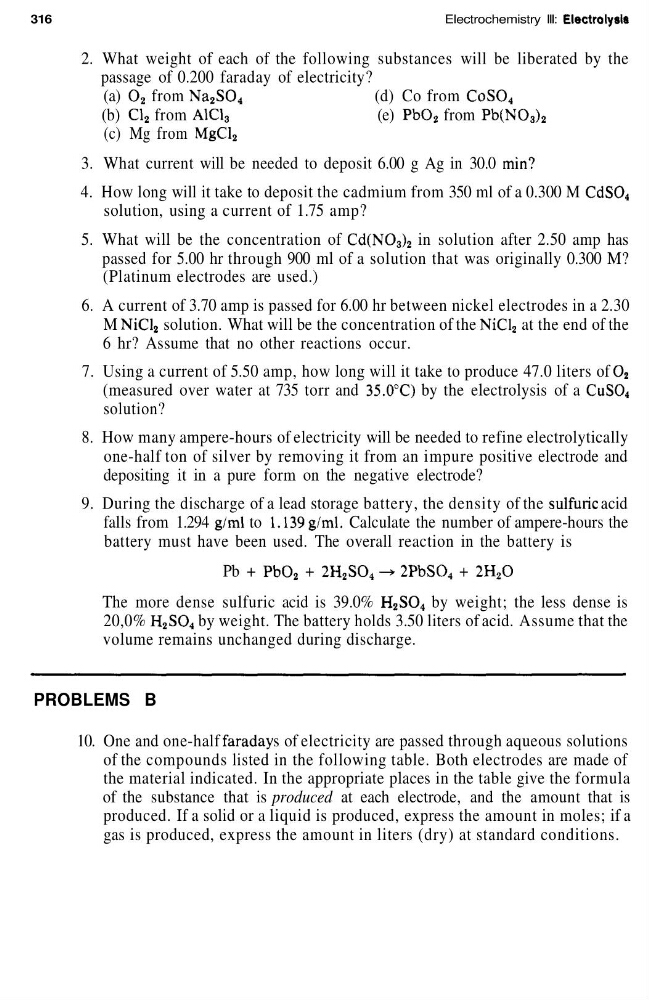
2. What weight of each of the following substances will be liberated by the
passage of 0.200 faraday of electricity?
(a) O 2 from Na 2 SO 4
(d) Co from CoSO 4
(b) Cl 2 from A!C1 3
(e) PbO 2 from Pb(NO 3 ) 2
(c) Mg from MgCl 2
3. What current will be needed to deposit 6.00 g Ag in 30.0 min?
4. How long will it take to deposit the cadmium from 350 ml of a 0.300 M CdS0 4
solution, using a current of 1.75 amp?
5. What will be the concentration of Cd(NO 3 ) 2 in solution after 2.50 amp has
passed for 5.00 hr through 900 ml of a solution that was originally 0.300 M?
(Platinum electrodes are used.)
6. A current of 3.70 amp is passed for 6.00 hr between nickel electrodes in a 2.30
M NiCl 2 solution. What will be the concentration of the NiCl 2 at the end of the
6 hr? Assume that no other reactions occur.
7. Using a current of 5.50 amp, how long will it take to produce 47.0 liters of 0 2
(measured over water at 735 torr and 35.0°C) by the electrolysis of a CuS0 4
solution?
8. How many ampere-hours of electricity will be needed to refine electrolytically
one-half ton of silver by removing it from an impure positive electrode and
depositing it in a pure form on the negative electrode?
9. During the discharge of a lead storage battery, the density of the sulfuric acid
falls from 1.294 g/ml to 1.139 g/ml. Calculate the number of ampere-hours the
battery must have been used. The overall reaction in the battery is
Pb + PbO 2 + 2H 2 SO 4 -» 2PbSO 4 + 2H 2 O
The more dense sulfuric acid is 39.0% H 2 SO 4 by weight; the less dense is
20,0% H 2 SO 4 by weight. The battery holds 3.50 liters of acid. Assume that the
volume remains unchanged during discharge.
PROBLEMS B
10. One and one-half faraday s of electricity are passed through aqueous solutions
of the compounds listed in the following table. Both electrodes are made of
the material indicated. In the appropriate places in the table give the formula
of the substance that is produced at each electrode, and the amount that is
produced. If a solid or a liquid is produced, express the amount in moles; if a
gas is produced, express the amount in liters (dry) at standard conditions.
Electrochemistry III: Electrolysis
2. What weight of each of the following substances will be liberated by the
passage of 0.200 faraday of electricity?
(a) O 2 from Na 2 SO 4
(d) Co from CoSO 4
(b) Cl 2 from A!C1 3
(e) PbO 2 from Pb(NO 3 ) 2
(c) Mg from MgCl 2
3. What current will be needed to deposit 6.00 g Ag in 30.0 min?
4. How long will it take to deposit the cadmium from 350 ml of a 0.300 M CdS0 4
solution, using a current of 1.75 amp?
5. What will be the concentration of Cd(NO 3 ) 2 in solution after 2.50 amp has
passed for 5.00 hr through 900 ml of a solution that was originally 0.300 M?
(Platinum electrodes are used.)
6. A current of 3.70 amp is passed for 6.00 hr between nickel electrodes in a 2.30
M NiCl 2 solution. What will be the concentration of the NiCl 2 at the end of the
6 hr? Assume that no other reactions occur.
7. Using a current of 5.50 amp, how long will it take to produce 47.0 liters of 0 2
(measured over water at 735 torr and 35.0°C) by the electrolysis of a CuS0 4
solution?
8. How many ampere-hours of electricity will be needed to refine electrolytically
one-half ton of silver by removing it from an impure positive electrode and
depositing it in a pure form on the negative electrode?
9. During the discharge of a lead storage battery, the density of the sulfuric acid
falls from 1.294 g/ml to 1.139 g/ml. Calculate the number of ampere-hours the
battery must have been used. The overall reaction in the battery is
Pb + PbO 2 + 2H 2 SO 4 -» 2PbSO 4 + 2H 2 O
The more dense sulfuric acid is 39.0% H 2 SO 4 by weight; the less dense is
20,0% H 2 SO 4 by weight. The battery holds 3.50 liters of acid. Assume that the
volume remains unchanged during discharge.
PROBLEMS B
10. One and one-half faraday s of electricity are passed through aqueous solutions
of the compounds listed in the following table. Both electrodes are made of
the material indicated. In the appropriate places in the table give the formula
of the substance that is produced at each electrode, and the amount that is
produced. If a solid or a liquid is produced, express the amount in moles; if a
gas is produced, express the amount in liters (dry) at standard conditions.