

312
Electrochemistry III: Electrolysis
The statements in this summary are, of necessity, oversimplified. Factors
such as current density and the presence of strong oxidizing agents may greatly
alter the surfaces of some electrodes and make them passive (inert) and incapable of acting as described in category 3. The presence of strong complexing
agents such as CN~ can make Au and Pt become active and go into solution as
in category 3.
QUANTITATIVE RELATIONS IN ELECTROLYSIS
Electron-Transfer Equivalents (Chemical)
In writing electron-transfer reactions, we express the quantity of electricity in
terms of moles of electrons. One mole of electrons is equivalent to 96,487
coulombs of electrical charge. This quantity of electricity is called the Faraday
constant (F), in honor of Michael Faraday, the first pioneer in quantitative
electrochemistry. The value of F can be expressed either as 96,487 coulombs or
as 1 faraday.
It is easy to find the quantity of material that is oxidized or reduced in an
electron-transfer reaction when one faraday of electricity is passed. Simply
take the half-reaction from Table 17-1 and divide the coefficient of each component by the number (n) of moles of electrons in the half- reaction, thus obtaining
an equation involving one mole of electrons (one faraday of electricity). For
example,
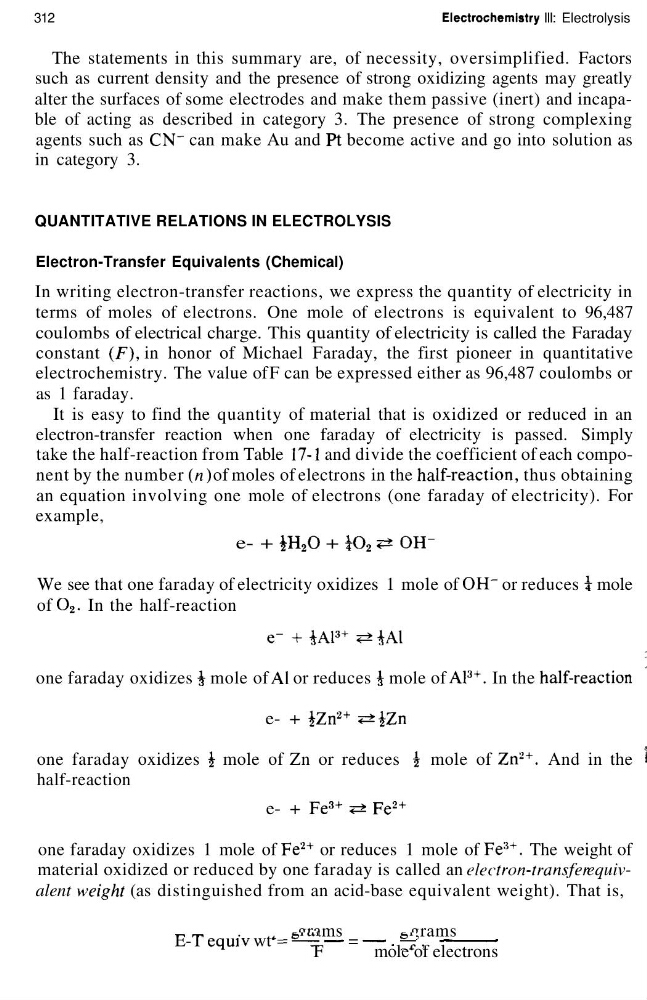
e- + iH 2 0 + i0 2 ?
We see that one faraday of electricity oxidizes 1 mole of OH~ or reduces i mole
of O 2 . In the half-reaction
?* AA1
one faraday oxidizes i mole of Al or reduces i mole of A1
3+
. In the half- reaction
e- + iZn
2+ *± iZn
one faraday oxidizes J mole of Zn or reduces \ mole of Zn
2+ . And in the
half-reaction
e- + Fe
3+ ?± Fe
2+
one faraday oxidizes 1 mole of Fe
2+ or reduces 1 mole of Fe
3+ . The weight of
material oxidized or reduced by one faraday is called an electron-transfer equivalent weight (as distinguished from an acid-base equivalent weight). That is,
~ r.
„ grams
grams
E-T equiv wt =
s —= — = — . % , -
F
mole of electrons
Electrochemistry III: Electrolysis
The statements in this summary are, of necessity, oversimplified. Factors
such as current density and the presence of strong oxidizing agents may greatly
alter the surfaces of some electrodes and make them passive (inert) and incapable of acting as described in category 3. The presence of strong complexing
agents such as CN~ can make Au and Pt become active and go into solution as
in category 3.
QUANTITATIVE RELATIONS IN ELECTROLYSIS
Electron-Transfer Equivalents (Chemical)
In writing electron-transfer reactions, we express the quantity of electricity in
terms of moles of electrons. One mole of electrons is equivalent to 96,487
coulombs of electrical charge. This quantity of electricity is called the Faraday
constant (F), in honor of Michael Faraday, the first pioneer in quantitative
electrochemistry. The value of F can be expressed either as 96,487 coulombs or
as 1 faraday.
It is easy to find the quantity of material that is oxidized or reduced in an
electron-transfer reaction when one faraday of electricity is passed. Simply
take the half-reaction from Table 17-1 and divide the coefficient of each component by the number (n) of moles of electrons in the half- reaction, thus obtaining
an equation involving one mole of electrons (one faraday of electricity). For
example,
e- + iH 2 0 + i0 2 ?
We see that one faraday of electricity oxidizes 1 mole of OH~ or reduces i mole
of O 2 . In the half-reaction
?* AA1
one faraday oxidizes i mole of Al or reduces i mole of A1
3+
. In the half- reaction
e- + iZn
2+ *± iZn
one faraday oxidizes J mole of Zn or reduces \ mole of Zn
2+ . And in the
half-reaction
e- + Fe
3+ ?± Fe
2+
one faraday oxidizes 1 mole of Fe
2+ or reduces 1 mole of Fe
3+ . The weight of
material oxidized or reduced by one faraday is called an electron-transfer equivalent weight (as distinguished from an acid-base equivalent weight). That is,
~ r.
„ grams
grams
E-T equiv wt =
s —= — = — . % , -
F
mole of electrons