

309
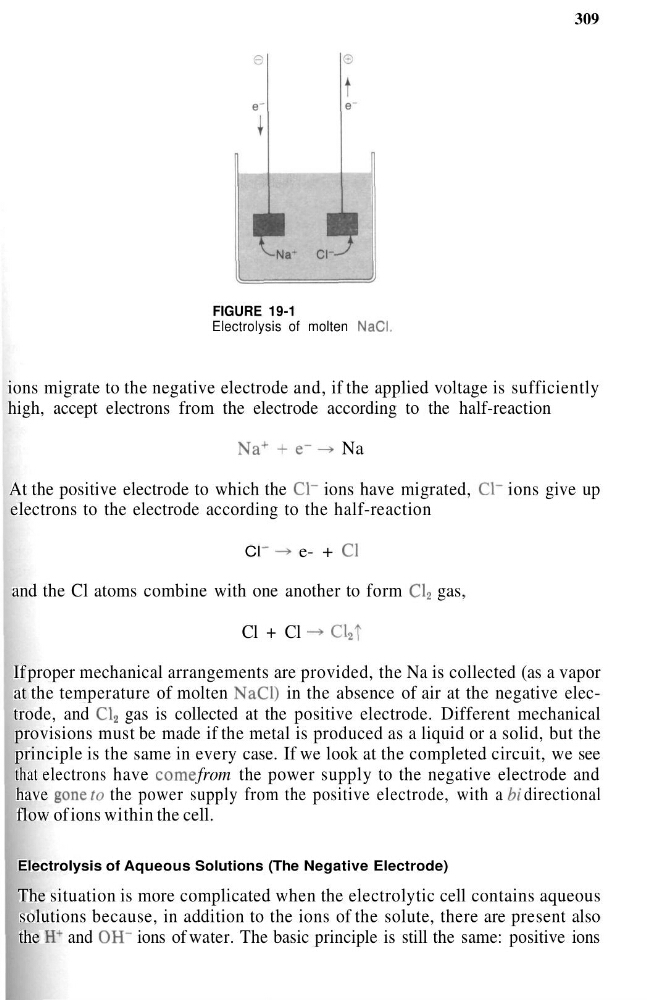
FIGURE 19-1
Electrolysis of molten NaCI.
ions migrate to the negative electrode and, if the applied voltage is sufficiently
high, accept electrons from the electrode according to the half-reaction
Na
+
Na
At the positive electrode to which the Cl~ ions have migrated, Cl~ ions give up
electrons to the electrode according to the half-reaction
Cl
e- + Cl
and the Cl atoms combine with one another to form C1 2 gas,
Cl + Cl -> CUT
If proper mechanical arrangements are provided, the Na is collected (as a vapor
at the temperature of molten NaCI) in the absence of air at the negative electrode, and C1 2 gas is collected at the positive electrode. Different mechanical
provisions must be made if the metal is produced as a liquid or a solid, but the
principle is the same in every case. If we look at the completed circuit, we see
that electrons have come from the power supply to the negative electrode and
have gonefo the power supply from the positive electrode, with a hi directional
flow of ions within the cell.
Electrolysis of Aqueous Solutions (The Negative Electrode)
The situation is more complicated when the electrolytic cell contains aqueous
solutions because, in addition to the ions of the solute, there are present also
the H
+ and OH~ ions of water. The basic principle is still the same: positive ions
FIGURE 19-1
Electrolysis of molten NaCI.
ions migrate to the negative electrode and, if the applied voltage is sufficiently
high, accept electrons from the electrode according to the half-reaction
Na
+
Na
At the positive electrode to which the Cl~ ions have migrated, Cl~ ions give up
electrons to the electrode according to the half-reaction
Cl
e- + Cl
and the Cl atoms combine with one another to form C1 2 gas,
Cl + Cl -> CUT
If proper mechanical arrangements are provided, the Na is collected (as a vapor
at the temperature of molten NaCI) in the absence of air at the negative electrode, and C1 2 gas is collected at the positive electrode. Different mechanical
provisions must be made if the metal is produced as a liquid or a solid, but the
principle is the same in every case. If we look at the completed circuit, we see
that electrons have come from the power supply to the negative electrode and
have gonefo the power supply from the positive electrode, with a hi directional
flow of ions within the cell.
Electrolysis of Aqueous Solutions (The Negative Electrode)
The situation is more complicated when the electrolytic cell contains aqueous
solutions because, in addition to the ions of the solute, there are present also
the H
+ and OH~ ions of water. The basic principle is still the same: positive ions