

Effect of Acid Concentration
303
PROBLEM:
Calculate the electrode potential for the Cr
3+ -Cr 2 O?~ half-reaction if the
Cr 2 Of~ and Cr
3+ ions are kept at unit activity, and the H
+ concentration is
(a) raised to an activity of 5 M or (b) lowered to 10~
7 M as it is in distilled water.
SOLUTION:
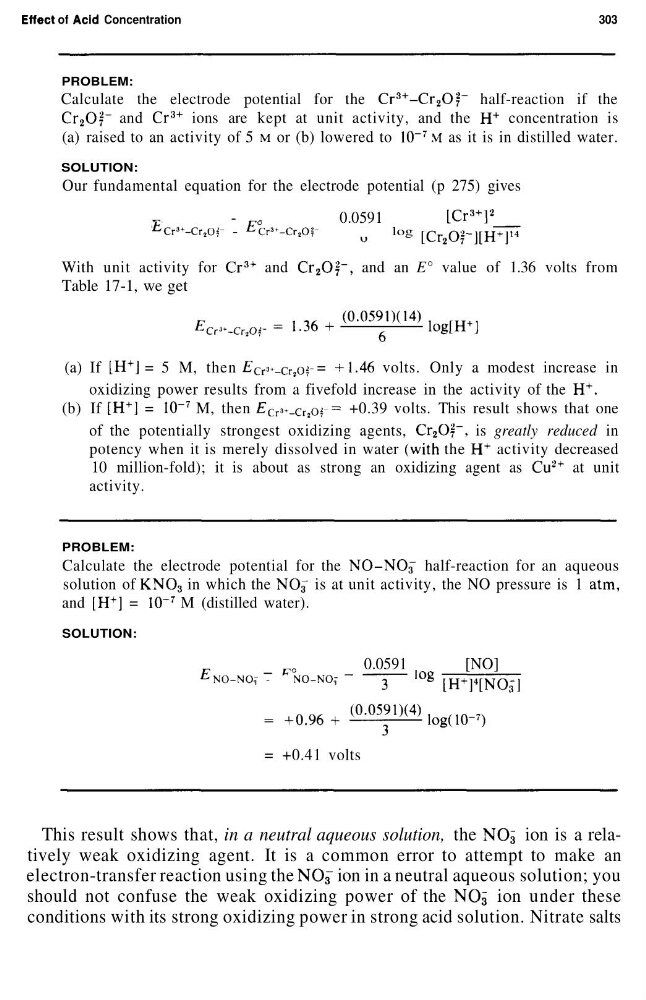
Our fundamental equation for the electrode potential (p 275) gives
f
- ir=
0.0591
[Cr
3 +]
2
£cr--Cr,or - £ C r--Cr 2 Or
log
With unit activity for Cr
3+ and Cr 2 O?~, and an E° value of 1.36 volts from
Table 17-1, we get
(a) If [H
+ J = 5 M, then £cr»+-CrjOr = +1.46 volts. Only a modest increase in
oxidizing power results from a fivefold increase in the activity of the H
+ .
(b) If [H
+ ] = 10~
7 M, then £ C r
s +-cr ! o!-= +0.39 volts. This result shows that one
of the potentially strongest oxidizing agents, Cr 2 Of~, is greatly reduced in
potency when it is merely dissolved in water (with the H
+ activity decreased
10 million-fold); it is about as strong an oxidizing agent as Cu
2+ at unit
activity.
PROBLEM:
Calculate the electrode potential for the NO-NO^" half-reaction for an aqueous
solution of KNO 3 in which the NOj is at unit activity, the NO pressure is 1 atm,
and [H
+ ] = 10~
7 M (distilled water).
SOLUTION:
- NO-NO,- -
NO-NO
0.0591
[NO]
I0g
[H+]4[NQ= +0.41 volts
This result shows that, in a neutral aqueous solution, the NO 3 ion is a relatively weak oxidizing agent. It is a common error to attempt to make an
electron-transfer reaction using the NO^ ion in a neutral aqueous solution; you
should not confuse the weak oxidizing power of the NOa ion under these
conditions with its strong oxidizing power in strong acid solution. Nitrate salts
303
PROBLEM:
Calculate the electrode potential for the Cr
3+ -Cr 2 O?~ half-reaction if the
Cr 2 Of~ and Cr
3+ ions are kept at unit activity, and the H
+ concentration is
(a) raised to an activity of 5 M or (b) lowered to 10~
7 M as it is in distilled water.
SOLUTION:
Our fundamental equation for the electrode potential (p 275) gives
f
- ir=
0.0591
[Cr
3 +]
2
£cr--Cr,or - £ C r--Cr 2 Or
log
With unit activity for Cr
3+ and Cr 2 O?~, and an E° value of 1.36 volts from
Table 17-1, we get
(a) If [H
+ J = 5 M, then £cr»+-CrjOr = +1.46 volts. Only a modest increase in
oxidizing power results from a fivefold increase in the activity of the H
+ .
(b) If [H
+ ] = 10~
7 M, then £ C r
s +-cr ! o!-= +0.39 volts. This result shows that one
of the potentially strongest oxidizing agents, Cr 2 Of~, is greatly reduced in
potency when it is merely dissolved in water (with the H
+ activity decreased
10 million-fold); it is about as strong an oxidizing agent as Cu
2+ at unit
activity.
PROBLEM:
Calculate the electrode potential for the NO-NO^" half-reaction for an aqueous
solution of KNO 3 in which the NOj is at unit activity, the NO pressure is 1 atm,
and [H
+ ] = 10~
7 M (distilled water).
SOLUTION:
- NO-NO,- -
NO-NO
0.0591
[NO]
I0g
[H+]4[NQ= +0.41 volts
This result shows that, in a neutral aqueous solution, the NO 3 ion is a relatively weak oxidizing agent. It is a common error to attempt to make an
electron-transfer reaction using the NO^ ion in a neutral aqueous solution; you
should not confuse the weak oxidizing power of the NOa ion under these
conditions with its strong oxidizing power in strong acid solution. Nitrate salts