

301
TABLE 18-1
Electron Transfer Table by Chemical Groups
Group
number
Chemical group
E° (volts)
1
Alkali metals (e~ + M
+ «;
Li, Cs, Rb, K, Na
± M)
-3.04 to -2.71
2
Alkaline earth metals (2e~ + M
2+ «* M)
Ba, Sr, Ca, Mg
3
Active metals (ne~ + M"
Al, Zn, Cr(3+), Fe(2+)
-2.90 to -2.36
+ s=* M)
Cd
-0.7610 -0.40 (Alls -1.66)
4
Medium active metals (ne~ + M
n+ +* M)
Co(2+), Ni(2+), Sn(2 +
5
Midrange:
2e~ + 2
2e~ + 2H
+ -
6
Second stage oxidation
Sn
2 +, Fe
2+
, Hgl
+
H 2 SO 3 , H 3 AsO 3 , HN0 2
), Pb(2+)
-0.40 to -0.13
H
+ ?±H 2
0.00
- S +^ H S
0
(ne~ + -ic «=s -ous)
0.15, 0
0.17, 0
14
77, 0.91
56, 0.94
7
Jewelry metals (ne~ + M"
+ ?± M)
Cu(2+), Ag(1 +), Hg(2+), Pt(2 + ), Au(3+)
0.34, 0.80, 0
8
Halogens (2e- + X 2 <*2X~)
I-, Br- CI-, F9
Oxidizing negative ions
~~ NOf
lOj
0 2
MnO 2
ne- + H+ +
C
B
2
°J:
ClOs"
Pb0 2
MnOj
H 2 0 2
0.54, 1.07
and others
85, 1.20, 1.50
, 1.36, 2.87
f±NO ~~|
0.96
f±\1.20
P±H 2 O
1.23
i^Mn
2 *
1
San
+H2 °
I
28
33
44
psCI1.45
?±Pb
2+
1
p±Mn
2+
1
f*H 2 O J
1
45
51
78
NOTE In each group the elements are listed from left to right in decreasing strength as reducing agents Half-cell potentials correspond to unit activity and 25
g C The number in parentheses after the symbol of some elements denotes the
electrical charge of the oxidized form
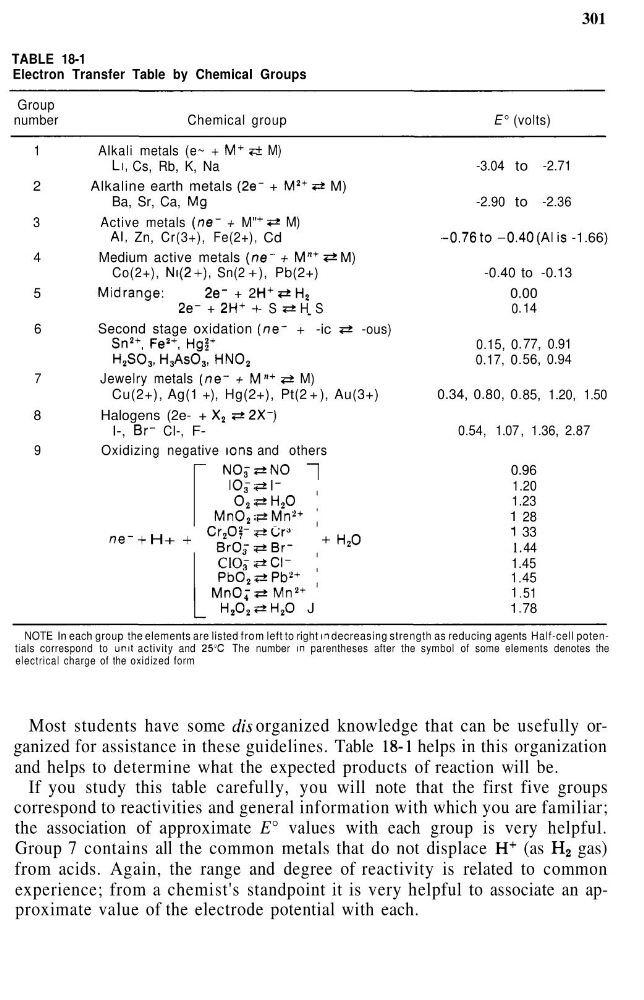
Most students have some d/s organized knowledge that can be usefully organized for assistance in these guidelines. Table 18-1 helps in this organization
and helps to determine what the expected products of reaction will be.
If you study this table carefully, you will note that the first five groups
correspond to reactivities and general information with which you are familiar;
the association of approximate E° values with each group is very helpful.
Group 7 contains all the common metals that do not displace H
+ (as H 2 gas)
from acids. Again, the range and degree of reactivity is related to common
experience; from a chemist's standpoint it is very helpful to associate an approximate value of the electrode potential with each.
TABLE 18-1
Electron Transfer Table by Chemical Groups
Group
number
Chemical group
E° (volts)
1
Alkali metals (e~ + M
+ «;
Li, Cs, Rb, K, Na
± M)
-3.04 to -2.71
2
Alkaline earth metals (2e~ + M
2+ «* M)
Ba, Sr, Ca, Mg
3
Active metals (ne~ + M"
Al, Zn, Cr(3+), Fe(2+)
-2.90 to -2.36
+ s=* M)
Cd
-0.7610 -0.40 (Alls -1.66)
4
Medium active metals (ne~ + M
n+ +* M)
Co(2+), Ni(2+), Sn(2 +
5
Midrange:
2e~ + 2
2e~ + 2H
+ -
6
Second stage oxidation
Sn
2 +, Fe
2+
, Hgl
+
H 2 SO 3 , H 3 AsO 3 , HN0 2
), Pb(2+)
-0.40 to -0.13
H
+ ?±H 2
0.00
- S +^ H S
0
(ne~ + -ic «=s -ous)
0.15, 0
0.17, 0
14
77, 0.91
56, 0.94
7
Jewelry metals (ne~ + M"
+ ?± M)
Cu(2+), Ag(1 +), Hg(2+), Pt(2 + ), Au(3+)
0.34, 0.80, 0
8
Halogens (2e- + X 2 <*2X~)
I-, Br- CI-, F9
Oxidizing negative ions
~~ NOf
lOj
0 2
MnO 2
ne- + H+ +
C
B
2
°J:
ClOs"
Pb0 2
MnOj
H 2 0 2
0.54, 1.07
and others
85, 1.20, 1.50
, 1.36, 2.87
f±NO ~~|
0.96
f±\1.20
P±H 2 O
1.23
i^Mn
2 *
1
San
+H2 °
I
28
33
44
psCI1.45
?±Pb
2+
1
p±Mn
2+
1
f*H 2 O J
1
45
51
78
NOTE In each group the elements are listed from left to right in decreasing strength as reducing agents Half-cell potentials correspond to unit activity and 25
g C The number in parentheses after the symbol of some elements denotes the
electrical charge of the oxidized form
Most students have some d/s organized knowledge that can be usefully organized for assistance in these guidelines. Table 18-1 helps in this organization
and helps to determine what the expected products of reaction will be.
If you study this table carefully, you will note that the first five groups
correspond to reactivities and general information with which you are familiar;
the association of approximate E° values with each group is very helpful.
Group 7 contains all the common metals that do not displace H
+ (as H 2 gas)
from acids. Again, the range and degree of reactivity is related to common
experience; from a chemist's standpoint it is very helpful to associate an approximate value of the electrode potential with each.