

294
Electrochemistry II Balancing Equations
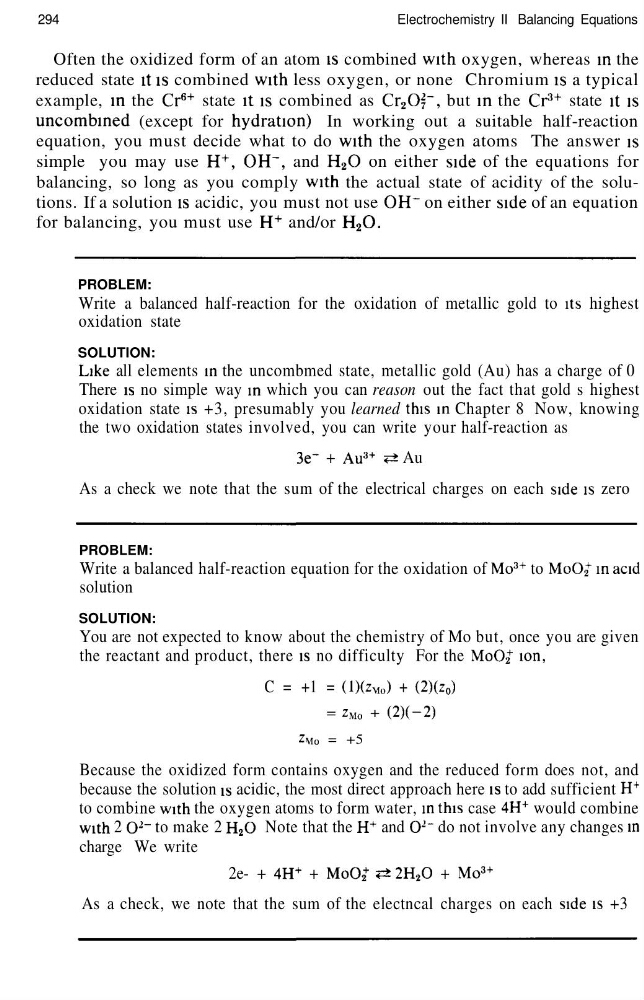
Often the oxidized form of an atom is combined with oxygen, whereas in the
reduced state it is combined with less oxygen, or none Chromium is a typical
example, in the Cr
8+ state it is combined as Cr 2 Of~, but in the Cr
3
"
1
" state it is
uncombmed (except for hydration) In working out a suitable half-reaction
equation, you must decide what to do with the oxygen atoms The answer is
simple you may use H
+ , OH~, and H 2 O on either side of the equations for
balancing, so long as you comply with the actual state of acidity of the solutions. If a solution is acidic, you must not use OH~ on either side of an equation
for balancing, you must use H
+ and/or H 2 O.
PROBLEM:
Write a balanced half-reaction for the oxidation of metallic gold to its highest
oxidation state
SOLUTION:
Like all elements in the uncombmed state, metallic gold (Au) has a charge of 0
There is no simple way in which you can reason out the fact that gold s highest
oxidation state is +3, presumably you learned this in Chapter 8 Now, knowing
the two oxidation states involved, you can write your half-reaction as
3e~ + Au
3+ *± Au
As a check we note that the sum of the electrical charges on each side is zero
PROBLEM:
Write a balanced half-reaction equation for the oxidation of Mo
3+ to MoO^ in acid
solution
SOLUTION:
You are not expected to know about the chemistry of Mo but, once you are given
the reactant and product, there is no difficulty For the MoO^ ion,
C = +1 = (l)(z Mo ) + (2)(z 0 )
= Z MO + (2)(-2)
Z Mo = +5
Because the oxidized form contains oxygen and the reduced form does not, and
because the solution is acidic, the most direct approach here is to add sufficient H
+
to combine with the oxygen atoms to form water, in this case 4H
+ would combine
with 2 O
2 ~ to make 2 H 2 O Note that the H
+ and O
2 ~ do not involve any changes in
charge We write
2e- + 4H
+ + MoO 2
+ f± 2H 2 O + Mo
3+
As a check, we note that the sum of the electncal charges on each side is +3
Electrochemistry II Balancing Equations
Often the oxidized form of an atom is combined with oxygen, whereas in the
reduced state it is combined with less oxygen, or none Chromium is a typical
example, in the Cr
8+ state it is combined as Cr 2 Of~, but in the Cr
3
"
1
" state it is
uncombmed (except for hydration) In working out a suitable half-reaction
equation, you must decide what to do with the oxygen atoms The answer is
simple you may use H
+ , OH~, and H 2 O on either side of the equations for
balancing, so long as you comply with the actual state of acidity of the solutions. If a solution is acidic, you must not use OH~ on either side of an equation
for balancing, you must use H
+ and/or H 2 O.
PROBLEM:
Write a balanced half-reaction for the oxidation of metallic gold to its highest
oxidation state
SOLUTION:
Like all elements in the uncombmed state, metallic gold (Au) has a charge of 0
There is no simple way in which you can reason out the fact that gold s highest
oxidation state is +3, presumably you learned this in Chapter 8 Now, knowing
the two oxidation states involved, you can write your half-reaction as
3e~ + Au
3+ *± Au
As a check we note that the sum of the electrical charges on each side is zero
PROBLEM:
Write a balanced half-reaction equation for the oxidation of Mo
3+ to MoO^ in acid
solution
SOLUTION:
You are not expected to know about the chemistry of Mo but, once you are given
the reactant and product, there is no difficulty For the MoO^ ion,
C = +1 = (l)(z Mo ) + (2)(z 0 )
= Z MO + (2)(-2)
Z Mo = +5
Because the oxidized form contains oxygen and the reduced form does not, and
because the solution is acidic, the most direct approach here is to add sufficient H
+
to combine with the oxygen atoms to form water, in this case 4H
+ would combine
with 2 O
2 ~ to make 2 H 2 O Note that the H
+ and O
2 ~ do not involve any changes in
charge We write
2e- + 4H
+ + MoO 2
+ f± 2H 2 O + Mo
3+
As a check, we note that the sum of the electncal charges on each side is +3