

284
Electrochemistry I: Batteries and Free Energy
PC1 5(9 ,
v*
PC1 3(9)
+
Cl 2(fl)
(1 mole) ( -77.59 -^L) (1 mo i e) ( _ 68 . 42 JE£5L) 0 mo i e ) ( 0.00 ^L)
\
mole/
V
mole/
\
mole/
Z(AG;) 1)rodutts = (1X-68.42) + (1)(0.00)
= -68.42 kcal
2XAG;) reacldnts = (1X-77.59)
= -77.59 kcal
(AG°) rea( . tlon = (-68.42 kcal) - (-77.59 kcal) = +9 17 kcal
.
„
-AG°
_
-9170
cal
_
log K e = = - - - - — - - = -6.73
K e = 1.85 x 10⁷ moles/liter
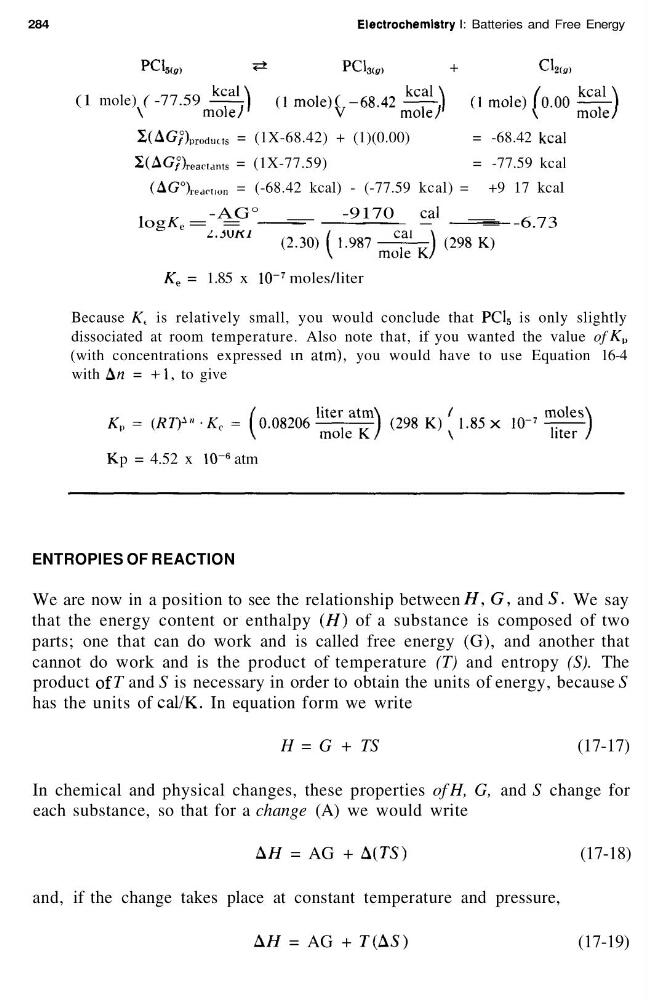
Because K^ is relatively small, you would conclude that PC1 5 is only slightly
dissociated at room temperature. Also note that, if you wanted the value of K v
(with concentrations expressed in atm), you would have to use Equation 16-4
with Arc = +1, to give
K, ,.„ x ,0p = 4.52 x 10⁶ atm
ENTROPIES OF REACTION
We are now in a position to see the relationship between H, G, and S. We say
that the energy content or enthalpy (//) of a substance is composed of two
parts; one that can do work and is called free energy (G), and another that
cannot do work and is the product of temperature (T) and entropy (S). The
product of T and S is necessary in order to obtain the units of energy, because S
has the units of cal/K. In equation form we write
H = G + TS
(17-17)
In chemical and physical changes, these properties of H, G, and S change for
each substance, so that for a change (A) we would write
A// = AG + A(7S)
(17-18)
and, if the change takes place at constant temperature and pressure,
A// = AG + 7(A5)
(17-19)
Electrochemistry I: Batteries and Free Energy
PC1 5(9 ,
v*
PC1 3(9)
+
Cl 2(fl)
(1 mole) ( -77.59 -^L) (1 mo i e) ( _ 68 . 42 JE£5L) 0 mo i e ) ( 0.00 ^L)
\
mole/
V
mole/
\
mole/
Z(AG;) 1)rodutts = (1X-68.42) + (1)(0.00)
= -68.42 kcal
2XAG;) reacldnts = (1X-77.59)
= -77.59 kcal
(AG°) rea( . tlon = (-68.42 kcal) - (-77.59 kcal) = +9 17 kcal
.
„
-AG°
_
-9170
cal
_
log K e = = - - - - — - - = -6.73
K e = 1.85 x 10⁷ moles/liter
Because K^ is relatively small, you would conclude that PC1 5 is only slightly
dissociated at room temperature. Also note that, if you wanted the value of K v
(with concentrations expressed in atm), you would have to use Equation 16-4
with Arc = +1, to give
K, ,.„ x ,0p = 4.52 x 10⁶ atm
ENTROPIES OF REACTION
We are now in a position to see the relationship between H, G, and S. We say
that the energy content or enthalpy (//) of a substance is composed of two
parts; one that can do work and is called free energy (G), and another that
cannot do work and is the product of temperature (T) and entropy (S). The
product of T and S is necessary in order to obtain the units of energy, because S
has the units of cal/K. In equation form we write
H = G + TS
(17-17)
In chemical and physical changes, these properties of H, G, and S change for
each substance, so that for a change (A) we would write
A// = AG + A(7S)
(17-18)
and, if the change takes place at constant temperature and pressure,
A// = AG + 7(A5)
(17-19)