

281
ir
Reactants (Zn + Cu
2 *)
cal
Products (Zn
2 -+- Cu)
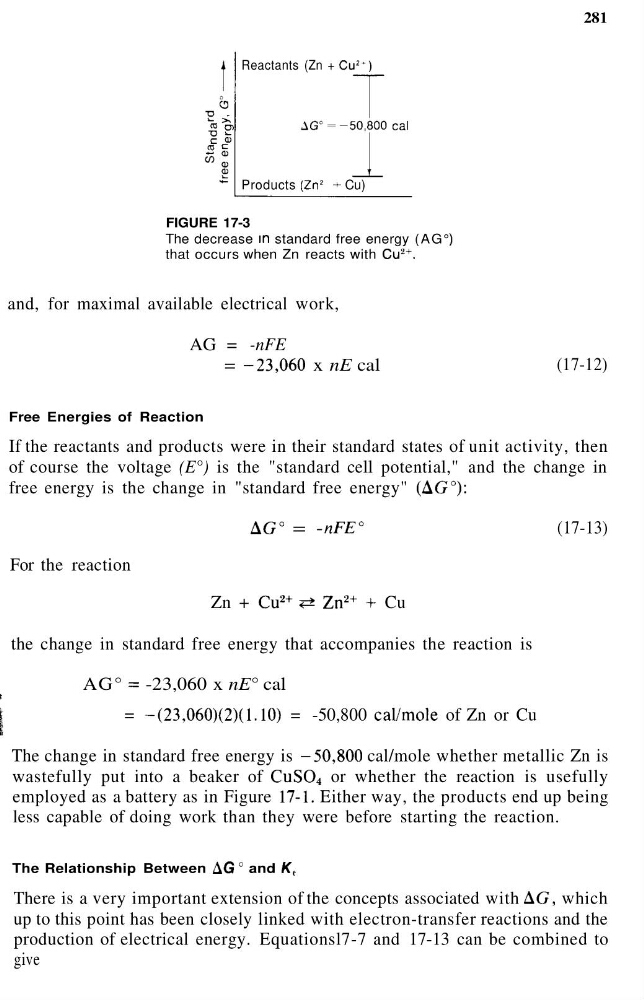
FIGURE 17-3
The decrease in standard free energy (AG°
that occurs when Zn reacts with Cu
2+
.
and, for maximal available electrical work,
AG = -nFE
= -23,060 x nE cal
(17-12)
Free Energies of Reaction
If the reactants and products were in their standard states of unit activity, then
of course the voltage (E°) is the "standard cell potential," and the change in
free energy is the change in "standard free energy" (AG°):
AG° = -
(17-13)
For the reaction
Zn + Cu
2
Zn
2
Cu
the change in standard free energy that accompanies the reaction is
AG° = -23,060 x nE° cal
= -(23,060)(2)(1.10) = -50,800 cal/mole of Zn or Cu
The change in standard free energy is -50,800 cal/mole whether metallic Zn is
wastefully put into a beaker of CuSO 4 or whether the reaction is usefully
employed as a battery as in Figure 17-1. Either way, the products end up being
less capable of doing work than they were before starting the reaction.
The Relationship Between AG° and K,
There is a very important extension of the concepts associated with AG, which
up to this point has been closely linked with electron-transfer reactions and the
production of electrical energy. Equationsl7-7 and 17-13 can be combined to
give
ir
Reactants (Zn + Cu
2 *)
cal
Products (Zn
2 -+- Cu)
FIGURE 17-3
The decrease in standard free energy (AG°
that occurs when Zn reacts with Cu
2+
.
and, for maximal available electrical work,
AG = -nFE
= -23,060 x nE cal
(17-12)
Free Energies of Reaction
If the reactants and products were in their standard states of unit activity, then
of course the voltage (E°) is the "standard cell potential," and the change in
free energy is the change in "standard free energy" (AG°):
AG° = -
(17-13)
For the reaction
Zn + Cu
2
Zn
2
Cu
the change in standard free energy that accompanies the reaction is
AG° = -23,060 x nE° cal
= -(23,060)(2)(1.10) = -50,800 cal/mole of Zn or Cu
The change in standard free energy is -50,800 cal/mole whether metallic Zn is
wastefully put into a beaker of CuSO 4 or whether the reaction is usefully
employed as a battery as in Figure 17-1. Either way, the products end up being
less capable of doing work than they were before starting the reaction.
The Relationship Between AG° and K,
There is a very important extension of the concepts associated with AG, which
up to this point has been closely linked with electron-transfer reactions and the
production of electrical energy. Equationsl7-7 and 17-13 can be combined to
give