

Electron-Transfer Equilibrium
279
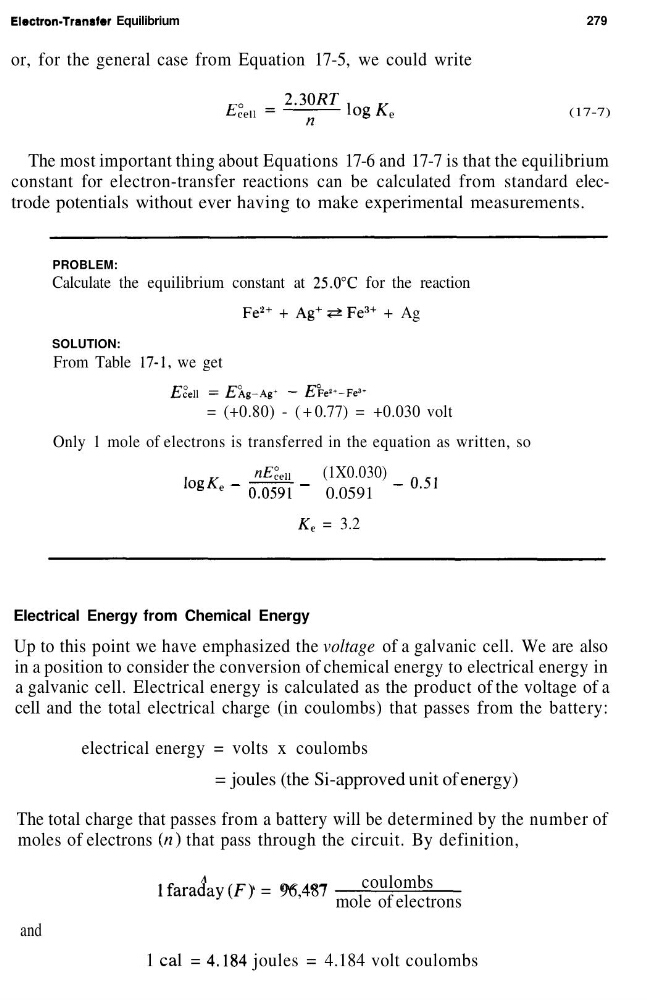
or, for the general case from Equation 17-5, we could write
0 6 K e
(17-7)
The most important thing about Equations 17-6 and 17-7 is that the equilibrium
constant for electron-transfer reactions can be calculated from standard electrode potentials without ever having to make experimental measurements.
PROBLEM:
Calculate the equilibrium constant at 25.0°C for the reaction
Fe
2+ + Ag
+ ?± Fe
3+ + Ag
SOLUTION:
From Table 17-1, we get
= (+0.80) - ( + 0.77) = +0.030 volt
Only 1 mole of electrons is transferred in the equation as written, so
,
nE° eU
(1X0.030)
'°
g Ke ~ 0^597 ~ 0.0591 ~ °'
5 '
K e = 3.2
Electrical Energy from Chemical Energy
Up to this point we have emphasized the voltage of a galvanic cell. We are also
in a position to consider the conversion of chemical energy to electrical energy in
a galvanic cell. Electrical energy is calculated as the product of the voltage of a
cell and the total electrical charge (in coulombs) that passes from the battery:
electrical energy = volts x coulombs
= joules (the Si-approved unit of energy)
The total charge that passes from a battery will be determined by the number of
moles of electrons («) that pass through the circuit. By definition,
ir A f r\
n f AC,-,
coulombs
Ifaraday(F) = 96,487 mole of electrons
and
1 cal = 4.184 joules = 4.184 volt coulombs
279
or, for the general case from Equation 17-5, we could write
0 6 K e
(17-7)
The most important thing about Equations 17-6 and 17-7 is that the equilibrium
constant for electron-transfer reactions can be calculated from standard electrode potentials without ever having to make experimental measurements.
PROBLEM:
Calculate the equilibrium constant at 25.0°C for the reaction
Fe
2+ + Ag
+ ?± Fe
3+ + Ag
SOLUTION:
From Table 17-1, we get
= (+0.80) - ( + 0.77) = +0.030 volt
Only 1 mole of electrons is transferred in the equation as written, so
,
nE° eU
(1X0.030)
'°
g Ke ~ 0^597 ~ 0.0591 ~ °'
5 '
K e = 3.2
Electrical Energy from Chemical Energy
Up to this point we have emphasized the voltage of a galvanic cell. We are also
in a position to consider the conversion of chemical energy to electrical energy in
a galvanic cell. Electrical energy is calculated as the product of the voltage of a
cell and the total electrical charge (in coulombs) that passes from the battery:
electrical energy = volts x coulombs
= joules (the Si-approved unit of energy)
The total charge that passes from a battery will be determined by the number of
moles of electrons («) that pass through the circuit. By definition,
ir A f r\
n f AC,-,
coulombs
Ifaraday(F) = 96,487 mole of electrons
and
1 cal = 4.184 joules = 4.184 volt coulombs