

Calorimetry
209
157 cal
, f „„„
cal
energy per mole = ..-,-:——r- = 15,700
0.0100 mole AgCl
'
mole AgCl
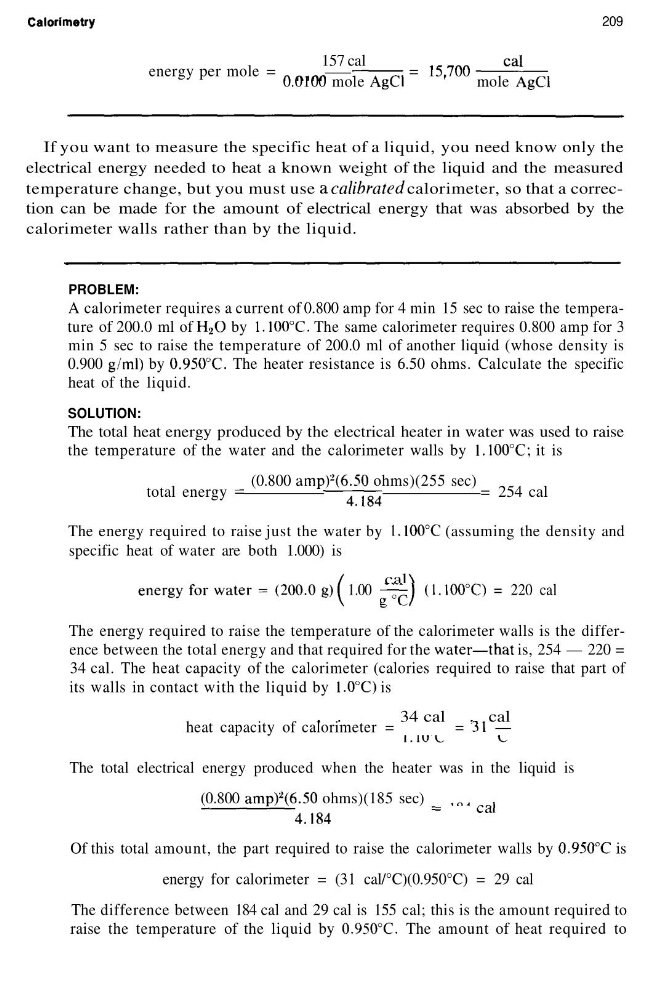
If you want to measure the specific heat of a liquid, you need know only the
electrical energy needed to heat a known weight of the liquid and the measured
temperature change, but you must use ^calibrated calorimeter, so that a correction can be made for the amount of electrical energy that was absorbed by the
calorimeter walls rather than by the liquid.
PROBLEM:
A calorimeter requires a current of 0.800 amp for 4 min 15 sec to raise the temperature of 200.0 ml of H 2 O by 1.100°C. The same calorimeter requires 0.800 amp for 3
min 5 sec to raise the temperature of 200.0 ml of another liquid (whose density is
0.900 g/ml) by 0.950°C. The heater resistance is 6.50 ohms. Calculate the specific
heat of the liquid.
SOLUTION:
The total heat energy produced by the electrical heater in water was used to raise
the temperature of the water and the calorimeter walls by 1.100°C; it is
(0.800 amp)
2 (6.50 ohms)(255 sec)
total energy =
—TTT;
= 254 cal
The energy required to raise just the water by 1.100°C (assuming the density and
specific heat of water are both 1.000) is
(
cal \
1.00 —J (1.100°C) = 220 cal
The energy required to raise the temperature of the calorimeter walls is the difference between the total energy and that required for the water—that is, 254 — 220 =
34 cal. The heat capacity of the calorimeter (calories required to raise that part of
its walls in contact with the liquid by 1.0°C) is
, .
34 cal , cal
heat capacity of calorimeter =
= 31 —
The total electrical energy produced when the heater was in the liquid is
(0.800 amp)
2 (6.50 ohms)(185 sec) _
4.184
~
Ca
Of this total amount, the part required to raise the calorimeter walls by 0.950°C is
energy for calorimeter = (31 cal/°C)(0.950°C) = 29 cal
The difference between 184 cal and 29 cal is 155 cal; this is the amount required to
raise the temperature of the liquid by 0.950°C. The amount of heat required to
209
157 cal
, f „„„
cal
energy per mole = ..-,-:——r- = 15,700
0.0100 mole AgCl
'
mole AgCl
If you want to measure the specific heat of a liquid, you need know only the
electrical energy needed to heat a known weight of the liquid and the measured
temperature change, but you must use ^calibrated calorimeter, so that a correction can be made for the amount of electrical energy that was absorbed by the
calorimeter walls rather than by the liquid.
PROBLEM:
A calorimeter requires a current of 0.800 amp for 4 min 15 sec to raise the temperature of 200.0 ml of H 2 O by 1.100°C. The same calorimeter requires 0.800 amp for 3
min 5 sec to raise the temperature of 200.0 ml of another liquid (whose density is
0.900 g/ml) by 0.950°C. The heater resistance is 6.50 ohms. Calculate the specific
heat of the liquid.
SOLUTION:
The total heat energy produced by the electrical heater in water was used to raise
the temperature of the water and the calorimeter walls by 1.100°C; it is
(0.800 amp)
2 (6.50 ohms)(255 sec)
total energy =
—TTT;
= 254 cal
The energy required to raise just the water by 1.100°C (assuming the density and
specific heat of water are both 1.000) is
(
cal \
1.00 —J (1.100°C) = 220 cal
The energy required to raise the temperature of the calorimeter walls is the difference between the total energy and that required for the water—that is, 254 — 220 =
34 cal. The heat capacity of the calorimeter (calories required to raise that part of
its walls in contact with the liquid by 1.0°C) is
, .
34 cal , cal
heat capacity of calorimeter =
= 31 —
The total electrical energy produced when the heater was in the liquid is
(0.800 amp)
2 (6.50 ohms)(185 sec) _
4.184
~
Ca
Of this total amount, the part required to raise the calorimeter walls by 0.950°C is
energy for calorimeter = (31 cal/°C)(0.950°C) = 29 cal
The difference between 184 cal and 29 cal is 155 cal; this is the amount required to
raise the temperature of the liquid by 0.950°C. The amount of heat required to