

Logarithms
13
3 x 1 x 5 x 102
15
1 x 6 x 1 x 10
7
6
= — x ID9 = 2.5 x 10-" (approximate)
After considerable practice, you will find that you can carry out such approximate calculations in your head. One useful way to get that practice is to make a
regular habit of first estimating an approximate answer, and then checking
your final exact answer against it to be sure that you are "in the right ballpark."
LOGARITHMS
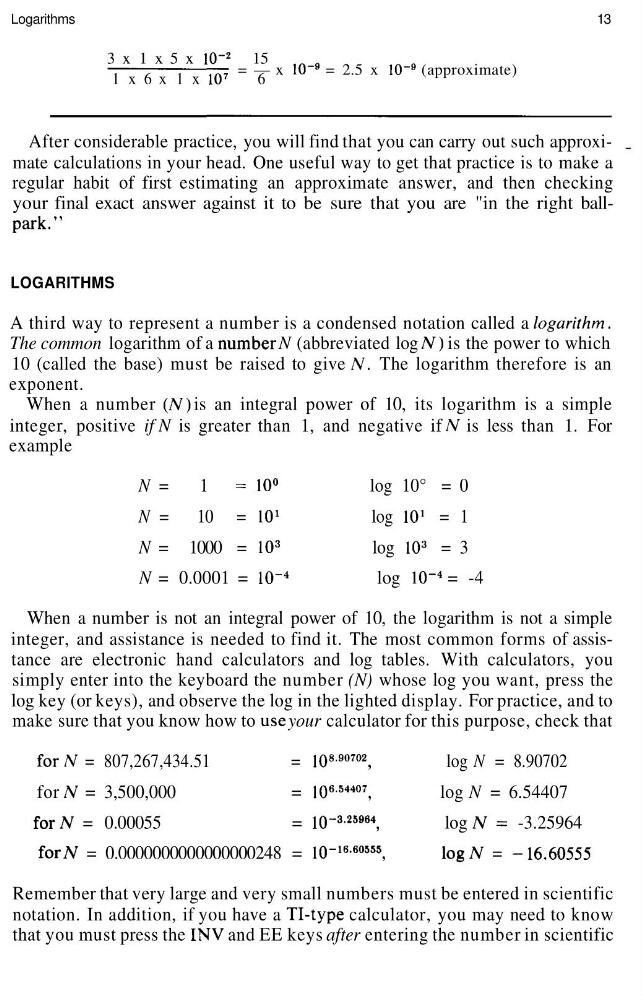
A third way to represent a number is a condensed notation called a logarithm.
The common logarithm of a number N (abbreviated log N) is the power to which
10 (called the base) must be raised to give N. The logarithm therefore is an
exponent.
When a number (N) is an integral power of 10, its logarithm is a simple
integer, positive if N is greater than 1, and negative if N is less than 1. For
example
N =
1 =10°
log 10° = 0
N = 10 = 10
1
log 10
1 = 1
N = 1000 = 10
3
log 10
3 = 3
N = 0.0001 = 104
log 104 = -4
When a number is not an integral power of 10, the logarithm is not a simple
integer, and assistance is needed to find it. The most common forms of assistance are electronic hand calculators and log tables. With calculators, you
simply enter into the keyboard the number (N) whose log you want, press the
log key (or keys), and observe the log in the lighted display. For practice, and to
make sure that you know how to use your calculator for this purpose, check that
for/V = 807,267,434.51
= 10
8 -
90702 ,
log N = 8.90702
for AT = 3,500,000
= 10
6 -
54407 ,
log N = 6.54407
forN = 0.00055
= lO"
3 -
25964 ,
log N = -3.25964
for AT = 0.0000000000000000248 = IQ18 -
60555 ,
logW = -16.60555
Remember that very large and very small numbers must be entered in scientific
notation. In addition, if you have a Tl-type calculator, you may need to know
that you must press the INV and EE keys after entering the number in scientific
13
3 x 1 x 5 x 102
15
1 x 6 x 1 x 10
7
6
= — x ID9 = 2.5 x 10-" (approximate)
After considerable practice, you will find that you can carry out such approximate calculations in your head. One useful way to get that practice is to make a
regular habit of first estimating an approximate answer, and then checking
your final exact answer against it to be sure that you are "in the right ballpark."
LOGARITHMS
A third way to represent a number is a condensed notation called a logarithm.
The common logarithm of a number N (abbreviated log N) is the power to which
10 (called the base) must be raised to give N. The logarithm therefore is an
exponent.
When a number (N) is an integral power of 10, its logarithm is a simple
integer, positive if N is greater than 1, and negative if N is less than 1. For
example
N =
1 =10°
log 10° = 0
N = 10 = 10
1
log 10
1 = 1
N = 1000 = 10
3
log 10
3 = 3
N = 0.0001 = 104
log 104 = -4
When a number is not an integral power of 10, the logarithm is not a simple
integer, and assistance is needed to find it. The most common forms of assistance are electronic hand calculators and log tables. With calculators, you
simply enter into the keyboard the number (N) whose log you want, press the
log key (or keys), and observe the log in the lighted display. For practice, and to
make sure that you know how to use your calculator for this purpose, check that
for/V = 807,267,434.51
= 10
8 -
90702 ,
log N = 8.90702
for AT = 3,500,000
= 10
6 -
54407 ,
log N = 6.54407
forN = 0.00055
= lO"
3 -
25964 ,
log N = -3.25964
for AT = 0.0000000000000000248 = IQ18 -
60555 ,
logW = -16.60555
Remember that very large and very small numbers must be entered in scientific
notation. In addition, if you have a Tl-type calculator, you may need to know
that you must press the INV and EE keys after entering the number in scientific