

Problems A
1 79
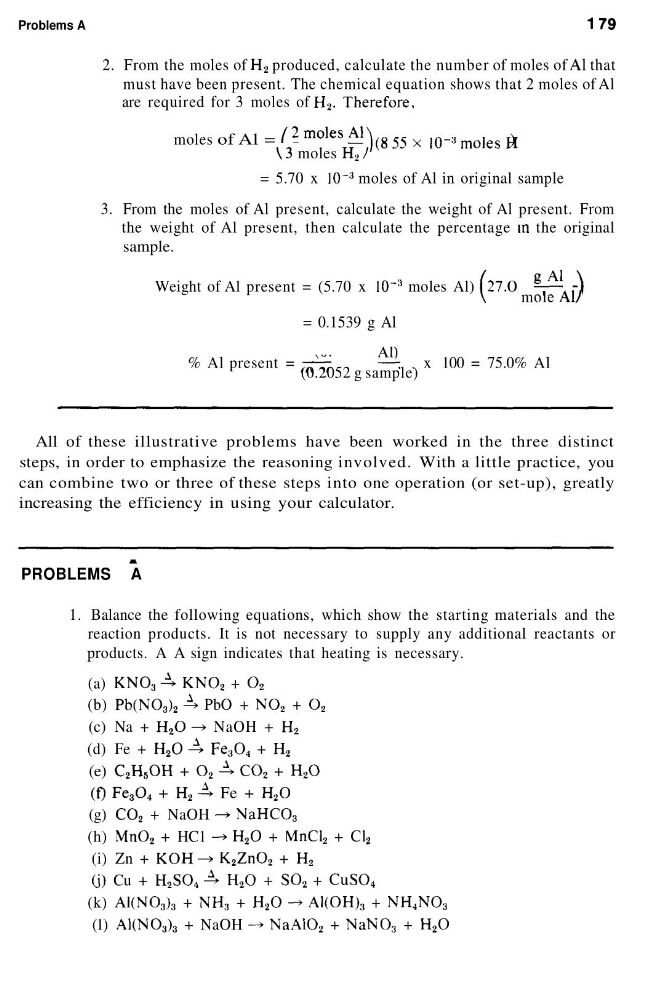
2. From the moles of H 2 produced, calculate the number of moles of Al that
must have been present. The chemical equation shows that 2 moles of Al
are required for 3 moles of H 2 . Therefore,
moles of Al = /
2 moles Alx j (8 55 x lo -.-3 moles H )
\3 moles H 2 7
= 5.70 x I0~
:i moles of Al in original sample
3. From the moles of Al present, calculate the weight of Al present. From
the weight of Al present, then calculate the percentage in the original
sample.
Weight of Al present = (5.70 x I0~
3 moles Al) (27.
\
0
g ,
A ' ,]
mole Al/
= 0.1539 g Al
% Al present = , '
A1)
. . x 100 = 75.0% Al
(0.2052 g sample)
All of these illustrative problems have been worked in the three distinct
steps, in order to emphasize the reasoning involved. With a little practice, you
can combine two or three of these steps into one operation (or set-up), greatly
increasing the efficiency in using your calculator.
PROBLEMS A
1. Balance the following equations, which show the starting materials and the
reaction products. It is not necessary to supply any additional reactants or
products. A A sign indicates that heating is necessary.
(a) KNO 3 A KNO 2 + O 2
(b) Pb(NO 3 ) 2 -^ PbO + NO 2 + O 2
(c) Na + H 2 O -> NaOH + H 2
(d) Fe + H 2 O 4. Fe 3 O 4 + H 2
(e) C 2 H 5 OH + O 2 ± CO 2 + H 2 O
(f) Fe 3 O 4 + H 2 ^ Fe + H 2 O
(g) CO 2 + NaOH -H> NaHCO 3
(h) MnO 2 + HC1 -> H 2 O + MnCl 2 + C1 2
(i) Zn + KOH ->• K 2 ZnO 2 + H 2
(j) Cu + H 2 SO 4 4. H 2 O + SO 2 + CuSO 4
(k) A1(NO 3 ) 3 + NH 3 + H 2 O -» A1(OH) 3 + NH 4 NO 3
(1) A1(NO 3 ) 3 + NaOH -* NaAlO 2 + NaNO 3 + H 2 O
1 79
2. From the moles of H 2 produced, calculate the number of moles of Al that
must have been present. The chemical equation shows that 2 moles of Al
are required for 3 moles of H 2 . Therefore,
moles of Al = /
2 moles Alx j (8 55 x lo -.-3 moles H )
\3 moles H 2 7
= 5.70 x I0~
:i moles of Al in original sample
3. From the moles of Al present, calculate the weight of Al present. From
the weight of Al present, then calculate the percentage in the original
sample.
Weight of Al present = (5.70 x I0~
3 moles Al) (27.
\
0
g ,
A ' ,]
mole Al/
= 0.1539 g Al
% Al present = , '
A1)
. . x 100 = 75.0% Al
(0.2052 g sample)
All of these illustrative problems have been worked in the three distinct
steps, in order to emphasize the reasoning involved. With a little practice, you
can combine two or three of these steps into one operation (or set-up), greatly
increasing the efficiency in using your calculator.
PROBLEMS A
1. Balance the following equations, which show the starting materials and the
reaction products. It is not necessary to supply any additional reactants or
products. A A sign indicates that heating is necessary.
(a) KNO 3 A KNO 2 + O 2
(b) Pb(NO 3 ) 2 -^ PbO + NO 2 + O 2
(c) Na + H 2 O -> NaOH + H 2
(d) Fe + H 2 O 4. Fe 3 O 4 + H 2
(e) C 2 H 5 OH + O 2 ± CO 2 + H 2 O
(f) Fe 3 O 4 + H 2 ^ Fe + H 2 O
(g) CO 2 + NaOH -H> NaHCO 3
(h) MnO 2 + HC1 -> H 2 O + MnCl 2 + C1 2
(i) Zn + KOH ->• K 2 ZnO 2 + H 2
(j) Cu + H 2 SO 4 4. H 2 O + SO 2 + CuSO 4
(k) A1(NO 3 ) 3 + NH 3 + H 2 O -» A1(OH) 3 + NH 4 NO 3
(1) A1(NO 3 ) 3 + NaOH -* NaAlO 2 + NaNO 3 + H 2 O