

Calculations Based on Chemical Equations
177
PROBLEM:
Sulfur dioxide is prepared by heating iron pyrites, FeS 2 , in the presence of air. The
reaction is
4FeS 2 + 11O 2 -^ 2Fe 2 O 3 + 8SO 2
(a) How many tons of SO 2 can be obtained from 20.0 tons of FeS 2 ?
(b) What volume of air, in cubic feet at 0.90 atm and 77°F, is required for the
treatmen
SOLUTION:
First, you need to know that it is not necessary to convert tons to grams to moles,
and then at the end reconvert moles to grams to tons. You recall that the atomic
weight scale (inside back cover) is a relative atomic weight scale habitually used
with gram as the mass unit. For problems like this where tons (or Ib, or oz, or
whatever) are involved, it is easier to use ton as the mass unit and to use ton
molecular weights (ton-moles) instead of gram molecular weights (moles). We still
use the three-step approach.
1. From the weight of FeS 2 given, compute the number of ton-moles that are
given.
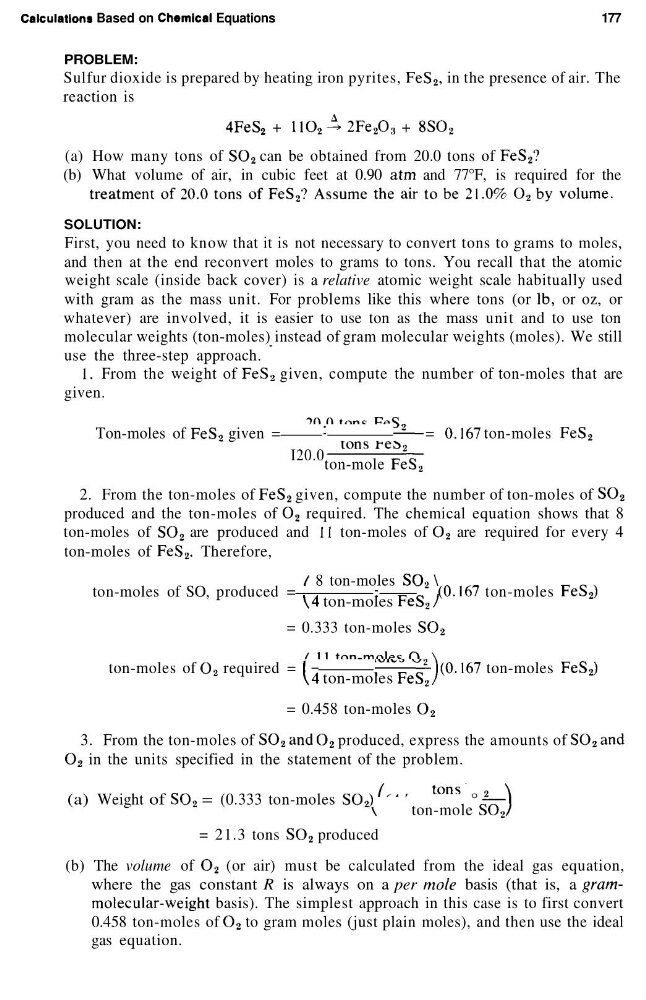
Ton-moles of FeS 2 given =
:
-^— = 0.167 ton-moles FeS 2
I20.0 ton-mole
2. From the ton-moles of FeS 2 given, compute the number of ton-moles of SO 2
produced and the ton-moles of O 2 required. The chemical equation shows that 8
ton-moles of SO 2 are produced and 11 ton-moles of O 2 are required for every 4
ton-moles of FeS 2 . Therefore,
/ 8 ton-moles SO 2 \
ton-moles of SO, produced =
:
_ (0.167 ton-moles FeS 2 )
\4 ton-moles FeS 2 /
= 0.333 ton-moles SO 2
ton-moles of O 2 required = I:—=—f 1(0.167 ton-moles FeS 2 )
\4 ton-moles FeS 2 /
= 0.458 ton-moles O 2
3. From the ton-moles of SO 2 and O 2 produced, express the amounts of SO 2 and
O 2 in the units specified in the statement of the problem.
(a) Weight of SO 2 = (0.333 ton-moles SO 2 )
l " '
tOnS °
ton-mole SO 2 7
= 21.3 tons SO 2 produced
(b) The volume of O 2 (or air) must be calculated from the ideal gas equation,
where the gas constant R is always on a per mole basis (that is, a grammolecular-weight basis). The simplest approach in this case is to first convert
0.458 ton-moles of O 2 to gram moles (just plain moles), and then use the ideal
gas equation.
177
PROBLEM:
Sulfur dioxide is prepared by heating iron pyrites, FeS 2 , in the presence of air. The
reaction is
4FeS 2 + 11O 2 -^ 2Fe 2 O 3 + 8SO 2
(a) How many tons of SO 2 can be obtained from 20.0 tons of FeS 2 ?
(b) What volume of air, in cubic feet at 0.90 atm and 77°F, is required for the
treatmen
SOLUTION:
First, you need to know that it is not necessary to convert tons to grams to moles,
and then at the end reconvert moles to grams to tons. You recall that the atomic
weight scale (inside back cover) is a relative atomic weight scale habitually used
with gram as the mass unit. For problems like this where tons (or Ib, or oz, or
whatever) are involved, it is easier to use ton as the mass unit and to use ton
molecular weights (ton-moles) instead of gram molecular weights (moles). We still
use the three-step approach.
1. From the weight of FeS 2 given, compute the number of ton-moles that are
given.
Ton-moles of FeS 2 given =
:
-^— = 0.167 ton-moles FeS 2
I20.0 ton-mole
2. From the ton-moles of FeS 2 given, compute the number of ton-moles of SO 2
produced and the ton-moles of O 2 required. The chemical equation shows that 8
ton-moles of SO 2 are produced and 11 ton-moles of O 2 are required for every 4
ton-moles of FeS 2 . Therefore,
/ 8 ton-moles SO 2 \
ton-moles of SO, produced =
:
_ (0.167 ton-moles FeS 2 )
\4 ton-moles FeS 2 /
= 0.333 ton-moles SO 2
ton-moles of O 2 required = I:—=—f 1(0.167 ton-moles FeS 2 )
\4 ton-moles FeS 2 /
= 0.458 ton-moles O 2
3. From the ton-moles of SO 2 and O 2 produced, express the amounts of SO 2 and
O 2 in the units specified in the statement of the problem.
(a) Weight of SO 2 = (0.333 ton-moles SO 2 )
l " '
tOnS °
ton-mole SO 2 7
= 21.3 tons SO 2 produced
(b) The volume of O 2 (or air) must be calculated from the ideal gas equation,
where the gas constant R is always on a per mole basis (that is, a grammolecular-weight basis). The simplest approach in this case is to first convert
0.458 ton-moles of O 2 to gram moles (just plain moles), and then use the ideal
gas equation.