

166
Gases
(1 mole) (62.4
tO1T
,
lt ^
r ) (303 K)
\
mole K /
V =
698 torr
= 27.1 liter
GRAHAM'S LAW OF DIFFUSION AND EFFUSION
When we put two gases together, the molecules diffuse throughout the container, so that within a short time the mixture is homogeneous, or of uniform
concentration throughout. Not all gases diffuse at the same rate, however: the
lighter the molecule, the more rapid the diffusion process.
If different gases are put into a container at the same temperature and
pressure and then allowed to effuse (leak out) through a pinhole in the container, you can compare their rates (r) of effusion (measured in ml/min). The
simplest,way to do this is to determine the times (t) required for equal volumes
to effuse through the pinhole. The rates are just inversely proportional to the
times; the shorter the time, the faster the rate. Such a comparison of any two
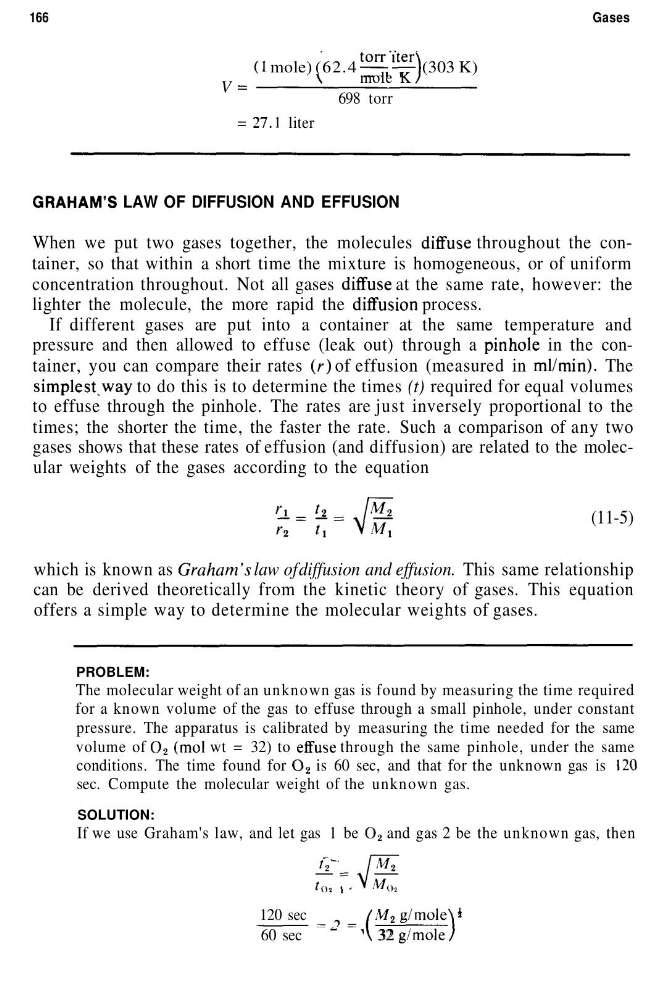
gases shows that these rates of effusion (and diffusion) are related to the molecular weights of the gases according to the equation
(11-5)
which is known as Graham's law of diffusion and effusion. This same relationship
can be derived theoretically from the kinetic theory of gases. This equation
offers a simple way to determine the molecular weights of gases.
PROBLEM:
The molecular weight of an unknown gas is found by measuring the time required
for a known volume of the gas to effuse through a small pinhole, under constant
pressure. The apparatus is calibrated by measuring the time needed for the same
volume of O 2 (mol wt = 32) to effuse through the same pinhole, under the same
conditions. The time found for O 2 is 60 sec, and that for the unknown gas is 120
sec. Compute the molecular weight of the unknown gas.
SOLUTION:
If we use Graham's law, and let gas 1 be O 2 and gas 2 be the unknown gas, then
120 sec
60 sec
^ V 32 g/mole
(
M 2 g/mole\
J
32 g/mole/
Gases
(1 mole) (62.4
tO1T
,
lt ^
r ) (303 K)
\
mole K /
V =
698 torr
= 27.1 liter
GRAHAM'S LAW OF DIFFUSION AND EFFUSION
When we put two gases together, the molecules diffuse throughout the container, so that within a short time the mixture is homogeneous, or of uniform
concentration throughout. Not all gases diffuse at the same rate, however: the
lighter the molecule, the more rapid the diffusion process.
If different gases are put into a container at the same temperature and
pressure and then allowed to effuse (leak out) through a pinhole in the container, you can compare their rates (r) of effusion (measured in ml/min). The
simplest,way to do this is to determine the times (t) required for equal volumes
to effuse through the pinhole. The rates are just inversely proportional to the
times; the shorter the time, the faster the rate. Such a comparison of any two
gases shows that these rates of effusion (and diffusion) are related to the molecular weights of the gases according to the equation
(11-5)
which is known as Graham's law of diffusion and effusion. This same relationship
can be derived theoretically from the kinetic theory of gases. This equation
offers a simple way to determine the molecular weights of gases.
PROBLEM:
The molecular weight of an unknown gas is found by measuring the time required
for a known volume of the gas to effuse through a small pinhole, under constant
pressure. The apparatus is calibrated by measuring the time needed for the same
volume of O 2 (mol wt = 32) to effuse through the same pinhole, under the same
conditions. The time found for O 2 is 60 sec, and that for the unknown gas is 120
sec. Compute the molecular weight of the unknown gas.
SOLUTION:
If we use Graham's law, and let gas 1 be O 2 and gas 2 be the unknown gas, then
120 sec
60 sec
^ V 32 g/mole
(
M 2 g/mole\
J
32 g/mole/