

Isotopes and Atomic Weight
151
PROBLEMFrom a specific heat measurement, the approximate atomic weight of a metal (M)
is found to be I3"i A 0 2341 g sample of M is heated to constant weight in air to
convert it to the oxide The weight of the residue is 0 274<> g Find the true atomic
weight of the metal (and therefore its identity), and determine the formula of the
metal oxide
SOLUTION:
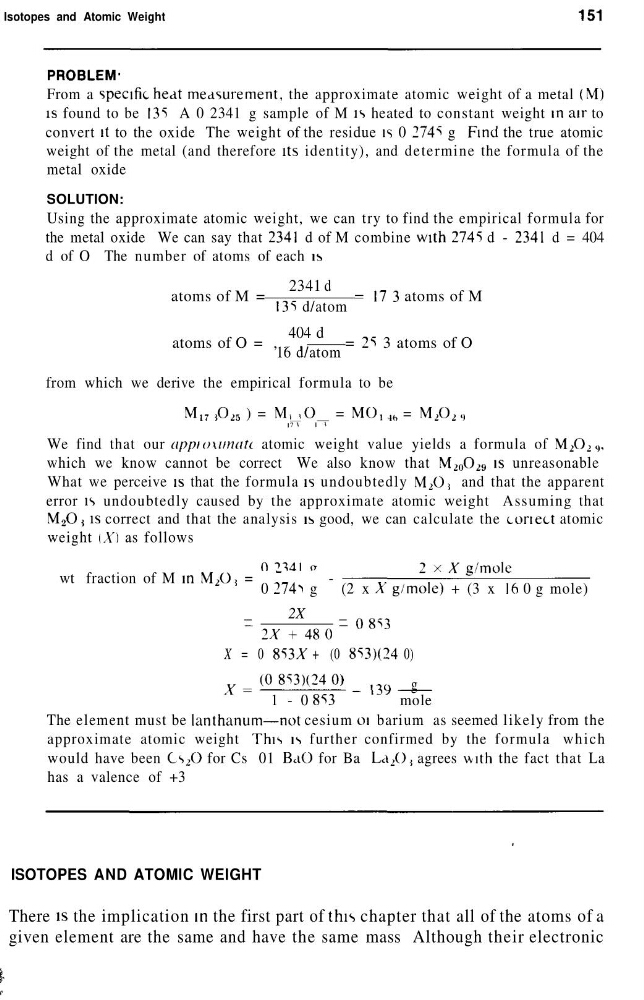
Using the approximate atomic weight, we can try to find the empirical formula for
the metal oxide We can say that 2341 d of M combine with 274 "> d - 2341 d = 404
d of O The number of atoms of each is
2341 d
atoms of M =
=173 atoms of M
13^ d/atom
404 d
atoms of O = , . .,
= 2S 3 atoms of O
16 d/atom
from which we derive the empirical formula to be
M 17i O 25 ) = M,^O_ = MO, 4h = M 2 O 2 ,
We find that our appitntmatc atomic weight value yields a formula of M 2 O 29 ,
which we know cannot be correct We also know that M 20 O 29 is unreasonable
What we perceive is that the formula is undoubtedly M 2 O S and that the apparent
error is undoubtedly caused by the approximate atomic weight Assuming that
M 2 O s is correct and that the analysis is good, we can calculate the conect atomic
weight (A*) as follows
wt fraction of M in M 2 O, = "
-
0 274s g
(2 x A" g/mole) + (3 x 16 0 g mole)
_
2X
_
X = 0 8KX + (0 8
1 - 0 8^3
mole
The element must be lanthanum—not cesium 01 barium as seemed likely from the
approximate atomic weight This is further confirmed by the formula which
would have been Cs 2 O for Cs 01 BaO for Ba La 2 Oj agrees with the fact that La
has a valence of +3
ISOTOPES AND ATOMIC WEIGHT
There is the implication in the first part of this chapter that all of the atoms of a
given element are the same and have the same mass Although their electronic
151
PROBLEMFrom a specific heat measurement, the approximate atomic weight of a metal (M)
is found to be I3"i A 0 2341 g sample of M is heated to constant weight in air to
convert it to the oxide The weight of the residue is 0 274<> g Find the true atomic
weight of the metal (and therefore its identity), and determine the formula of the
metal oxide
SOLUTION:
Using the approximate atomic weight, we can try to find the empirical formula for
the metal oxide We can say that 2341 d of M combine with 274 "> d - 2341 d = 404
d of O The number of atoms of each is
2341 d
atoms of M =
=173 atoms of M
13^ d/atom
404 d
atoms of O = , . .,
= 2S 3 atoms of O
16 d/atom
from which we derive the empirical formula to be
M 17i O 25 ) = M,^O_ = MO, 4h = M 2 O 2 ,
We find that our appitntmatc atomic weight value yields a formula of M 2 O 29 ,
which we know cannot be correct We also know that M 20 O 29 is unreasonable
What we perceive is that the formula is undoubtedly M 2 O S and that the apparent
error is undoubtedly caused by the approximate atomic weight Assuming that
M 2 O s is correct and that the analysis is good, we can calculate the conect atomic
weight (A*) as follows
wt fraction of M in M 2 O, = "
-
0 274s g
(2 x A" g/mole) + (3 x 16 0 g mole)
_
2X
_
X = 0 8KX + (0 8
1 - 0 8^3
mole
The element must be lanthanum—not cesium 01 barium as seemed likely from the
approximate atomic weight This is further confirmed by the formula which
would have been Cs 2 O for Cs 01 BaO for Ba La 2 Oj agrees with the fact that La
has a valence of +3
ISOTOPES AND ATOMIC WEIGHT
There is the implication in the first part of this chapter that all of the atoms of a
given element are the same and have the same mass Although their electronic