

148
Stoichiometry I: Calculations Based on Formulas
SOLUTION:
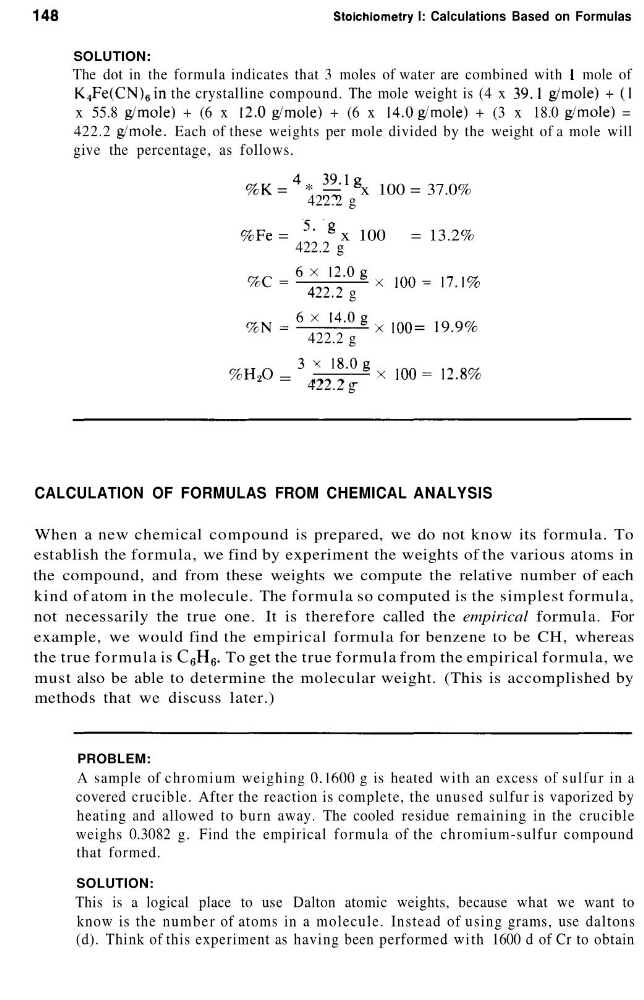
The dot in the formula indicates that 3 moles of water are combined with I mole of
K 4 Fe(CN) 6 in the crystalline compound. The mole weight is (4 x 39. 1 g/mole) + (I
x 55.8 g/mole) + (6 x 12. 0 g/mole) + (6 x 14.0 g/mole) + (3 x 18.0 g/mole) =
422.2 g/mole. Each of these weights per mole divided by the weight of a mole will
give the percentage, as follows.
%K =
4 *
3 ^'
l g x 100 = 37.0%
422.2 g
%Fe =
5 '
8 x 100
= 13.2%
422.2 g
100 =17.1%
g
x 100 = 19.9%
422.2 g
%H 2 0 =
3 X J!'°
S x 10
° =
12 -
8%
422.2 g
CALCULATION OF FORMULAS FROM CHEMICAL ANALYSIS
When a new chemical compound is prepared, we do not know its formula. To
establish the formula, we find by experiment the weights of the various atoms in
the compound, and from these weights we compute the relative number of each
kind of atom in the molecule. The formula so computed is the simplest formula,
not necessarily the true one. It is therefore called the empirical formula. For
example, we would find the empirical formula for benzene to be CH, whereas
the true formula is C 8 H 6 . To get the true formula from the empirical formula, we
must also be able to determine the molecular weight. (This is accomplished by
methods that we discuss later.)
PROBLEM:
A sample of chromium weighing 0.1600 g is heated with an excess of sulfur in a
covered crucible. After the reaction is complete, the unused sulfur is vaporized by
heating and allowed to burn away. The cooled residue remaining in the crucible
weighs 0.3082 g. Find the empirical formula of the chromium-sulfur compound
that formed.
SOLUTION:
This is a logical place to use Dalton atomic weights, because what we want to
know is the number of atoms in a molecule. Instead of using grams, use daltons
(d). Think of this experiment as having been performed with 1600 d of Cr to obtain
Stoichiometry I: Calculations Based on Formulas
SOLUTION:
The dot in the formula indicates that 3 moles of water are combined with I mole of
K 4 Fe(CN) 6 in the crystalline compound. The mole weight is (4 x 39. 1 g/mole) + (I
x 55.8 g/mole) + (6 x 12. 0 g/mole) + (6 x 14.0 g/mole) + (3 x 18.0 g/mole) =
422.2 g/mole. Each of these weights per mole divided by the weight of a mole will
give the percentage, as follows.
%K =
4 *
3 ^'
l g x 100 = 37.0%
422.2 g
%Fe =
5 '
8 x 100
= 13.2%
422.2 g
100 =17.1%
g
x 100 = 19.9%
422.2 g
%H 2 0 =
3 X J!'°
S x 10
° =
12 -
8%
422.2 g
CALCULATION OF FORMULAS FROM CHEMICAL ANALYSIS
When a new chemical compound is prepared, we do not know its formula. To
establish the formula, we find by experiment the weights of the various atoms in
the compound, and from these weights we compute the relative number of each
kind of atom in the molecule. The formula so computed is the simplest formula,
not necessarily the true one. It is therefore called the empirical formula. For
example, we would find the empirical formula for benzene to be CH, whereas
the true formula is C 8 H 6 . To get the true formula from the empirical formula, we
must also be able to determine the molecular weight. (This is accomplished by
methods that we discuss later.)
PROBLEM:
A sample of chromium weighing 0.1600 g is heated with an excess of sulfur in a
covered crucible. After the reaction is complete, the unused sulfur is vaporized by
heating and allowed to burn away. The cooled residue remaining in the crucible
weighs 0.3082 g. Find the empirical formula of the chromium-sulfur compound
that formed.
SOLUTION:
This is a logical place to use Dalton atomic weights, because what we want to
know is the number of atoms in a molecule. Instead of using grams, use daltons
(d). Think of this experiment as having been performed with 1600 d of Cr to obtain