

146
Mold ule
H
0 2
H 2 SO 4
Relative
molecular \\ eights
1. 0079
31.9984
98.07
Dahon
molecular \\eighti
1.0079 d/atom
31.9984 d/molecule
98.07 d/molecule
Gi am
molecular u eights
1.0079g/mole
31.9984 g/mole
98.07 g/mole
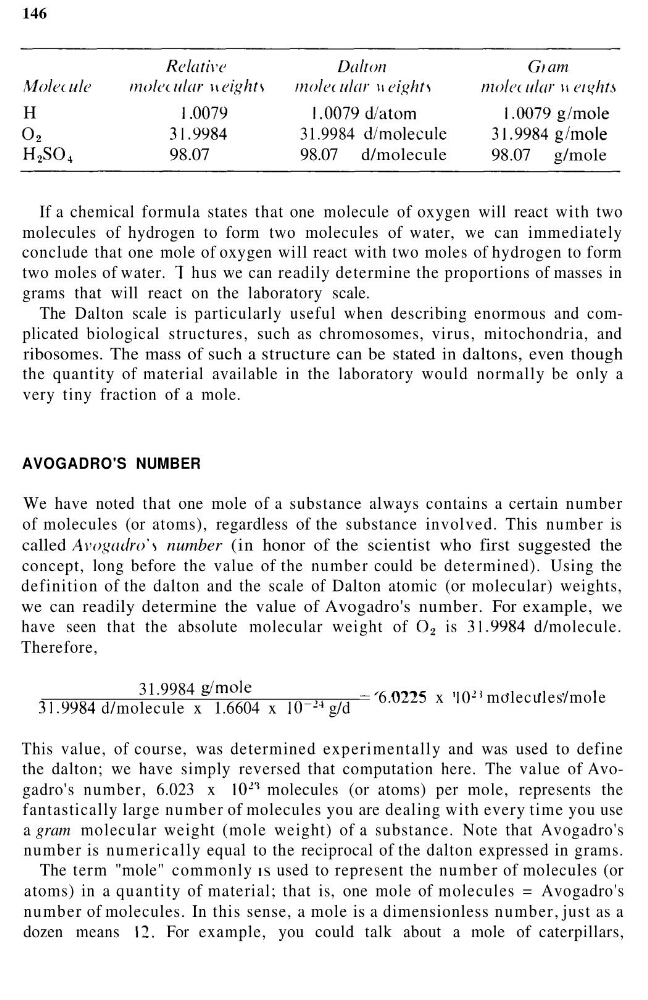
If a chemical formula states that one molecule of oxygen will react with two
molecules of hydrogen to form two molecules of water, we can immediately
conclude that one mole of oxygen will react with two moles of hydrogen to form
two moles of water. 1 hus we can readily determine the proportions of masses in
grams that will react on the laboratory scale.
The Dalton scale is particularly useful when describing enormous and complicated biological structures, such as chromosomes, virus, mitochondria, and
ribosomes. The mass of such a structure can be stated in daltons, even though
the quantity of material available in the laboratory would normally be only a
very tiny fraction of a mole.
AVOGADRO'S NUMBER
We have noted that one mole of a substance always contains a certain number
of molecules (or atoms), regardless of the substance involved. This number is
called Avogadro'\ number (in honor of the scientist who first suggested the
concept, long before the value of the number could be determined). Using the
definition of the dalton and the scale of Dalton atomic (or molecular) weights,
we can readily determine the value of Avogadro's number. For example, we
have seen that the absolute molecular weight of O 2 is 31.9984 d/molecule.
Therefore,
31.9984 g/mole
, n ^ c
, n >*
,
, , ,
= 6.0225 x 10
2i molecules/mole
31.9984 d/molecule x 1.6604 x lO"
24 g/d
This value, of course, was determined experimentally and was used to define
the dalton; we have simply reversed that computation here. The value of Avogadro's number, 6.023 x 10
2
'
! molecules (or atoms) per mole, represents the
fantastically large number of molecules you are dealing with every time you use
a gram molecular weight (mole weight) of a substance. Note that Avogadro's
number is numerically equal to the reciprocal of the dalton expressed in grams.
The term "mole" commonly is used to represent the number of molecules (or
atoms) in a quantity of material; that is, one mole of molecules = Avogadro's
number of molecules. In this sense, a mole is a dimensionless number, just as a
dozen means 12. For example, you could talk about a mole of caterpillars,
Mold ule
H
0 2
H 2 SO 4
Relative
molecular \\ eights
1. 0079
31.9984
98.07
Dahon
molecular \\eighti
1.0079 d/atom
31.9984 d/molecule
98.07 d/molecule
Gi am
molecular u eights
1.0079g/mole
31.9984 g/mole
98.07 g/mole
If a chemical formula states that one molecule of oxygen will react with two
molecules of hydrogen to form two molecules of water, we can immediately
conclude that one mole of oxygen will react with two moles of hydrogen to form
two moles of water. 1 hus we can readily determine the proportions of masses in
grams that will react on the laboratory scale.
The Dalton scale is particularly useful when describing enormous and complicated biological structures, such as chromosomes, virus, mitochondria, and
ribosomes. The mass of such a structure can be stated in daltons, even though
the quantity of material available in the laboratory would normally be only a
very tiny fraction of a mole.
AVOGADRO'S NUMBER
We have noted that one mole of a substance always contains a certain number
of molecules (or atoms), regardless of the substance involved. This number is
called Avogadro'\ number (in honor of the scientist who first suggested the
concept, long before the value of the number could be determined). Using the
definition of the dalton and the scale of Dalton atomic (or molecular) weights,
we can readily determine the value of Avogadro's number. For example, we
have seen that the absolute molecular weight of O 2 is 31.9984 d/molecule.
Therefore,
31.9984 g/mole
, n ^ c
, n >*
,
, , ,
= 6.0225 x 10
2i molecules/mole
31.9984 d/molecule x 1.6604 x lO"
24 g/d
This value, of course, was determined experimentally and was used to define
the dalton; we have simply reversed that computation here. The value of Avogadro's number, 6.023 x 10
2
'
! molecules (or atoms) per mole, represents the
fantastically large number of molecules you are dealing with every time you use
a gram molecular weight (mole weight) of a substance. Note that Avogadro's
number is numerically equal to the reciprocal of the dalton expressed in grams.
The term "mole" commonly is used to represent the number of molecules (or
atoms) in a quantity of material; that is, one mole of molecules = Avogadro's
number of molecules. In this sense, a mole is a dimensionless number, just as a
dozen means 12. For example, you could talk about a mole of caterpillars,