

135
Cl
—
H
Cl
"
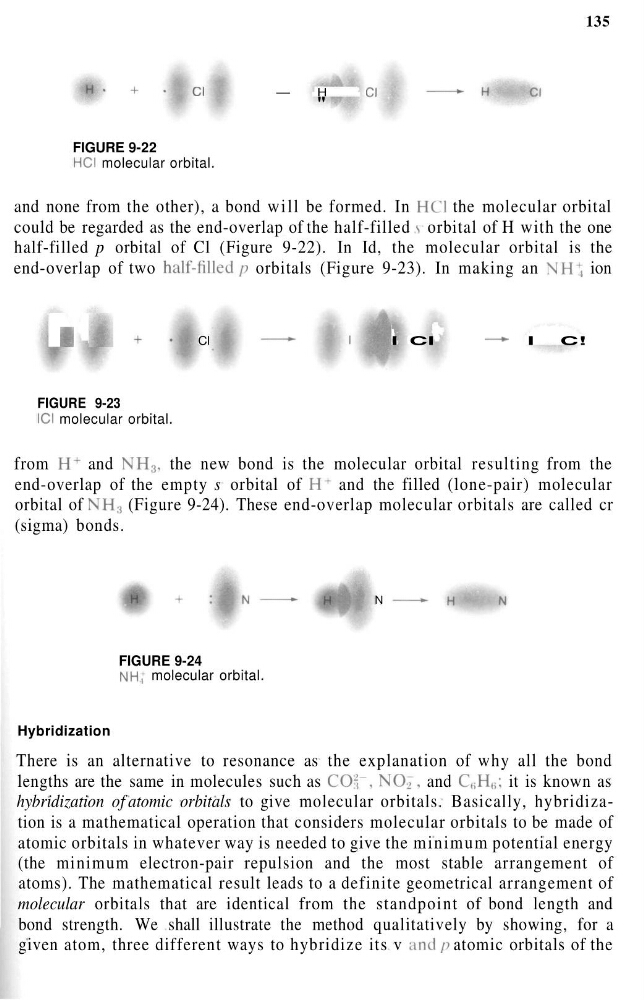
FIGURE 9-22
HCI molecular orbital.
and none from the other), a bond will be formed. In HCI the molecular orbital
could be regarded as the end-overlap of the half-filled . v orbital of H with the one
half-filled p orbital of Cl (Figure 9-22). In Id, the molecular orbital is the
end-overlap of two half-filled/? orbitals (Figure 9-23). In making an NH^ ion
. i Cl
I Cl
— I
C!
FIGURE 9-23
ICI molecular orbital.
from H
+ and NH 3 , the new bond is the molecular orbital resulting from the
end-overlap of the empty s orbital of H
+ and the filled (lone-pair) molecular
orbital of NH 3 (Figure 9-24). These end-overlap molecular orbitals are called cr
(sigma) bonds.
N
FIGURE 9-24
NH; molecular orbital.
Hybridization
There is an alternative to resonance as the explanation of why all the bond
lengths are the same in molecules such as CO?r, NO^, and C H H,;; it is known as
hybridization of atomic orbitals to give molecular orbitals. Basically, hybridization is a mathematical operation that considers molecular orbitals to be made of
atomic orbitals in whatever way is needed to give the minimum potential energy
(the minimum electron-pair repulsion and the most stable arrangement of
atoms). The mathematical result leads to a definite geometrical arrangement of
molecular orbitals that are identical from the standpoint of bond length and
bond strength. We shall illustrate the method qualitatively by showing, for a
given atom, three different ways to hybridize its v andp atomic orbitals of the
Cl
—
H
Cl
"
FIGURE 9-22
HCI molecular orbital.
and none from the other), a bond will be formed. In HCI the molecular orbital
could be regarded as the end-overlap of the half-filled . v orbital of H with the one
half-filled p orbital of Cl (Figure 9-22). In Id, the molecular orbital is the
end-overlap of two half-filled/? orbitals (Figure 9-23). In making an NH^ ion
. i Cl
I Cl
— I
C!
FIGURE 9-23
ICI molecular orbital.
from H
+ and NH 3 , the new bond is the molecular orbital resulting from the
end-overlap of the empty s orbital of H
+ and the filled (lone-pair) molecular
orbital of NH 3 (Figure 9-24). These end-overlap molecular orbitals are called cr
(sigma) bonds.
N
FIGURE 9-24
NH; molecular orbital.
Hybridization
There is an alternative to resonance as the explanation of why all the bond
lengths are the same in molecules such as CO?r, NO^, and C H H,;; it is known as
hybridization of atomic orbitals to give molecular orbitals. Basically, hybridization is a mathematical operation that considers molecular orbitals to be made of
atomic orbitals in whatever way is needed to give the minimum potential energy
(the minimum electron-pair repulsion and the most stable arrangement of
atoms). The mathematical result leads to a definite geometrical arrangement of
molecular orbitals that are identical from the standpoint of bond length and
bond strength. We shall illustrate the method qualitatively by showing, for a
given atom, three different ways to hybridize its v andp atomic orbitals of the