

Covalent Bond Radii
117
PROBLEM:
Calculate approximate values for the bond energy and the percent ionic character
for the C-Cl bond in CCl 4 .
SOLUTION:
From Table 9-1 we find
Atf c _ c =83.1 kcal/mole
A# C1 _ C1 = 58.0 kcal/mole
and
€ C = 2.5
6 ( , = 3.0
With the Pauling equation, we obtain
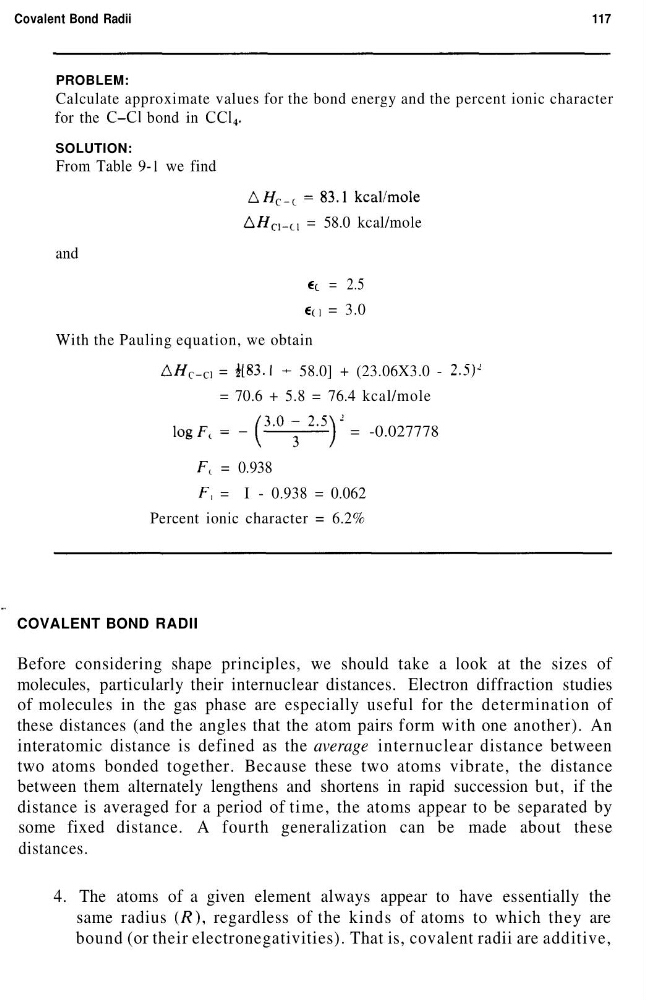
A//C-CI = M83.1 + 58.0] + (23.06X3.0 - 2.5)= 70.6 + 5.8 = 76.4 kcal/mole
= -0.027778
F c = 0.938
F, = I - 0.938 = 0.062
Percent ionic character = 6.2%
COVALENT BOND RADII
Before considering shape principles, we should take a look at the sizes of
molecules, particularly their internuclear distances. Electron diffraction studies
of molecules in the gas phase are especially useful for the determination of
these distances (and the angles that the atom pairs form with one another). An
interatomic distance is defined as the average internuclear distance between
two atoms bonded together. Because these two atoms vibrate, the distance
between them alternately lengthens and shortens in rapid succession but, if the
distance is averaged for a period of time, the atoms appear to be separated by
some fixed distance. A fourth generalization can be made about these
distances.
4. The atoms of a given element always appear to have essentially the
same radius (/?), regardless of the kinds of atoms to which they are
bound (or their electronegativities). That is, covalent radii are additive,
117
PROBLEM:
Calculate approximate values for the bond energy and the percent ionic character
for the C-Cl bond in CCl 4 .
SOLUTION:
From Table 9-1 we find
Atf c _ c =83.1 kcal/mole
A# C1 _ C1 = 58.0 kcal/mole
and
€ C = 2.5
6 ( , = 3.0
With the Pauling equation, we obtain
A//C-CI = M83.1 + 58.0] + (23.06X3.0 - 2.5)= 70.6 + 5.8 = 76.4 kcal/mole
= -0.027778
F c = 0.938
F, = I - 0.938 = 0.062
Percent ionic character = 6.2%
COVALENT BOND RADII
Before considering shape principles, we should take a look at the sizes of
molecules, particularly their internuclear distances. Electron diffraction studies
of molecules in the gas phase are especially useful for the determination of
these distances (and the angles that the atom pairs form with one another). An
interatomic distance is defined as the average internuclear distance between
two atoms bonded together. Because these two atoms vibrate, the distance
between them alternately lengthens and shortens in rapid succession but, if the
distance is averaged for a period of time, the atoms appear to be separated by
some fixed distance. A fourth generalization can be made about these
distances.
4. The atoms of a given element always appear to have essentially the
same radius (/?), regardless of the kinds of atoms to which they are
bound (or their electronegativities). That is, covalent radii are additive,