

Binary Compounds Not Derived from Acids
109
are actually replaced. For example, with H 3 PO 4 and NaOH, three different
reactions are possible:
3 NaOH + H 3 PO 4 -» Na 3 PO 4 + 3 H 2 O
2 NaOH + H 3 PO 4 -» Na2HPO 4 + 2 H 2 O
NaOH + H 3 PO 4 -» NaH 2 PO 4 + H 2 O
Each of these reactions is possible, and each equation is balanced. Obviously,
we need different names for the three different kinds of sodium phosphate salts.
Of the several ways to accomplish this, the most highly recommended and
unequivocal is to include as part of the name the number of H
+ ions that have
not been replaced in salt formation. In the example above we would have
Na 3 PO 4
sodium phosphate
Na 2 HPO 4
sodium monohydrogen phosphate
NaH 2 PO 4
sodium dihydrogen phosphate
If the acid contains only two H
+ , then only two different salts are possible;
they are most acceptably named by the method just described. However, another traditional method that will probably continue in use for many years is to
use the prefix bi- for the salt of the acid with just half of the hydrogen atoms
replaced, as illustrated for the sodium bisulfate that is produced by the reaction
NaOH + H 2 SO 4 -* NaHSO 4 + H 2 O
BINARY COMPOUNDS NOT DERIVED FROM ACIDS
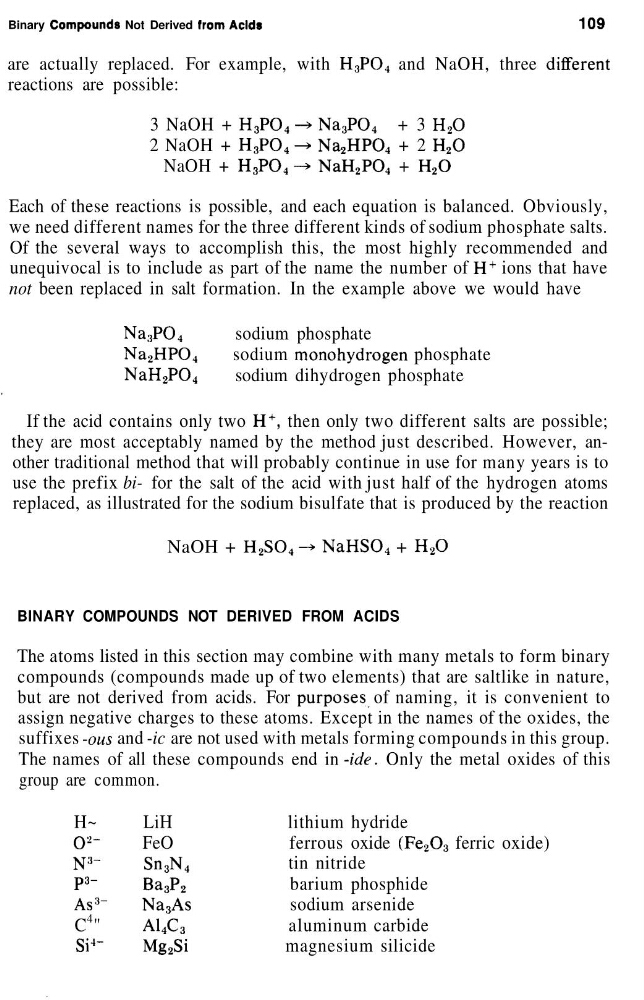
The atoms listed in this section may combine with many metals to form binary
compounds (compounds made up of two elements) that are saltlike in nature,
but are not derived from acids. For purposes of naming, it is convenient to
assign negative charges to these atoms. Except in the names of the oxides, the
suffixes -ous and -ic are not used with metals forming compounds in this group.
The names of all these compounds end in -ide. Only the metal oxides of this
group are common.
H~
LiH
lithium hydride
Q-~
FeO
ferrous oxide (Fe 2 O 3 ferric oxide)
N
3 ~
Sn 3 N 4
tin nitride
P
3 ~
Ba 3 P 2
barium phosphide
As
3 "
Na 3 As
sodium arsenide
C
4 "
Al 4 C 3
aluminum carbide
Si
4
"
Mg 2 Si
magnesium silicide
109
are actually replaced. For example, with H 3 PO 4 and NaOH, three different
reactions are possible:
3 NaOH + H 3 PO 4 -» Na 3 PO 4 + 3 H 2 O
2 NaOH + H 3 PO 4 -» Na2HPO 4 + 2 H 2 O
NaOH + H 3 PO 4 -» NaH 2 PO 4 + H 2 O
Each of these reactions is possible, and each equation is balanced. Obviously,
we need different names for the three different kinds of sodium phosphate salts.
Of the several ways to accomplish this, the most highly recommended and
unequivocal is to include as part of the name the number of H
+ ions that have
not been replaced in salt formation. In the example above we would have
Na 3 PO 4
sodium phosphate
Na 2 HPO 4
sodium monohydrogen phosphate
NaH 2 PO 4
sodium dihydrogen phosphate
If the acid contains only two H
+ , then only two different salts are possible;
they are most acceptably named by the method just described. However, another traditional method that will probably continue in use for many years is to
use the prefix bi- for the salt of the acid with just half of the hydrogen atoms
replaced, as illustrated for the sodium bisulfate that is produced by the reaction
NaOH + H 2 SO 4 -* NaHSO 4 + H 2 O
BINARY COMPOUNDS NOT DERIVED FROM ACIDS
The atoms listed in this section may combine with many metals to form binary
compounds (compounds made up of two elements) that are saltlike in nature,
but are not derived from acids. For purposes of naming, it is convenient to
assign negative charges to these atoms. Except in the names of the oxides, the
suffixes -ous and -ic are not used with metals forming compounds in this group.
The names of all these compounds end in -ide. Only the metal oxides of this
group are common.
H~
LiH
lithium hydride
Q-~
FeO
ferrous oxide (Fe 2 O 3 ferric oxide)
N
3 ~
Sn 3 N 4
tin nitride
P
3 ~
Ba 3 P 2
barium phosphide
As
3 "
Na 3 As
sodium arsenide
C
4 "
Al 4 C 3
aluminum carbide
Si
4
"
Mg 2 Si
magnesium silicide