

107
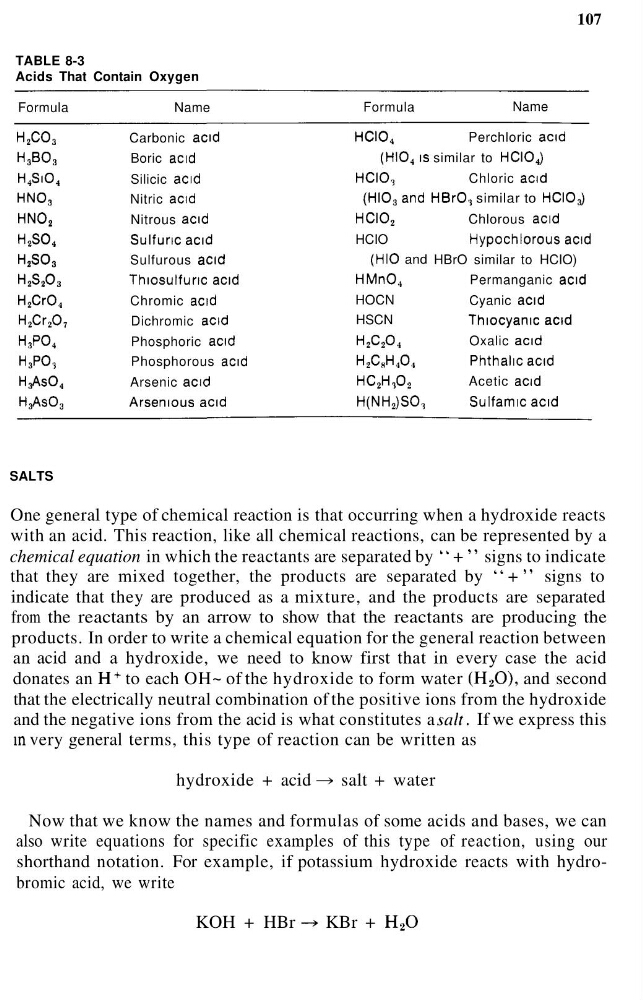
TABLE 8-3
Acids That Contain Oxygen
Formula
H 2 C0 3
H 3 BO 3
H 4 SiO 4
HNO 3
HN0 2
H 2 S0 4
H 2 S0 3
H 2 S 2 0 3
H 2 Cr0 4
H 2 Cr 2 0 7
H 3 P0 4
H 3 PO,
H 3 As0 4
H 3 As0 3
Name
Carbonic acid
Boric acid
Silicic acid
Nitric acid
Nitrous acid
Sulfunc acid
Sulfurous acid
Thiosulfunc acid
Chromic acid
Dichromic acid
Phosphoric acid
Phosphorous acid
Arsenic acid
Arsenious acid
Formula
HCI0 4
(HI0 4 is
HCIO,
(HIO 3 and
HCIO 2
HCIO
(HIO and
HMn0 4
HOCN
HSCN
H 2 C 2 O 4
H 2 C 8 H 4 0 4
HC 2 H,0 2
H(NH 2 )SO,
Name
Perchloric acid
similar to HCI0 4 )
Chloric acid
HBrO, similar to HCIO^
Chlorous acid
Hypochlorous acid
HBrO similar to HCIO)
Permanganic acid
Cyanic acid
Thiocyamc acid
Oxalic acid
Phthalic acid
Acetic acid
Sulfamic acid
SALTS
One general type of chemical reaction is that occurring when a hydroxide reacts
with an acid. This reaction, like all chemical reactions, can be represented by a
chemical equation in which the reactants are separated by " + " signs to indicate
that they are mixed together, the products are separated by " + " signs to
indicate that they are produced as a mixture, and the products are separated
from the reactants by an arrow to show that the reactants are producing the
products. In order to write a chemical equation for the general reaction between
an acid and a hydroxide, we need to know first that in every case the acid
donates an H
+ to each OH~ of the hydroxide to form water (H 2 O), and second
that the electrically neutral combination of the positive ions from the hydroxide
and the negative ions from the acid is what constitutes a salt. If we express this
in very general terms, this type of reaction can be written as
hydroxide + acid —> salt + water
Now that we know the names and formulas of some acids and bases, we can
also write equations for specific examples of this type of reaction, using our
shorthand notation. For example, if potassium hydroxide reacts with hydrobromic acid, we write
KOH + HBr -> KBr + H 2 O
TABLE 8-3
Acids That Contain Oxygen
Formula
H 2 C0 3
H 3 BO 3
H 4 SiO 4
HNO 3
HN0 2
H 2 S0 4
H 2 S0 3
H 2 S 2 0 3
H 2 Cr0 4
H 2 Cr 2 0 7
H 3 P0 4
H 3 PO,
H 3 As0 4
H 3 As0 3
Name
Carbonic acid
Boric acid
Silicic acid
Nitric acid
Nitrous acid
Sulfunc acid
Sulfurous acid
Thiosulfunc acid
Chromic acid
Dichromic acid
Phosphoric acid
Phosphorous acid
Arsenic acid
Arsenious acid
Formula
HCI0 4
(HI0 4 is
HCIO,
(HIO 3 and
HCIO 2
HCIO
(HIO and
HMn0 4
HOCN
HSCN
H 2 C 2 O 4
H 2 C 8 H 4 0 4
HC 2 H,0 2
H(NH 2 )SO,
Name
Perchloric acid
similar to HCI0 4 )
Chloric acid
HBrO, similar to HCIO^
Chlorous acid
Hypochlorous acid
HBrO similar to HCIO)
Permanganic acid
Cyanic acid
Thiocyamc acid
Oxalic acid
Phthalic acid
Acetic acid
Sulfamic acid
SALTS
One general type of chemical reaction is that occurring when a hydroxide reacts
with an acid. This reaction, like all chemical reactions, can be represented by a
chemical equation in which the reactants are separated by " + " signs to indicate
that they are mixed together, the products are separated by " + " signs to
indicate that they are produced as a mixture, and the products are separated
from the reactants by an arrow to show that the reactants are producing the
products. In order to write a chemical equation for the general reaction between
an acid and a hydroxide, we need to know first that in every case the acid
donates an H
+ to each OH~ of the hydroxide to form water (H 2 O), and second
that the electrically neutral combination of the positive ions from the hydroxide
and the negative ions from the acid is what constitutes a salt. If we express this
in very general terms, this type of reaction can be written as
hydroxide + acid —> salt + water
Now that we know the names and formulas of some acids and bases, we can
also write equations for specific examples of this type of reaction, using our
shorthand notation. For example, if potassium hydroxide reacts with hydrobromic acid, we write
KOH + HBr -> KBr + H 2 O