

96
Density and Buoyancy
In reality there is no correction, because you could weigh only to four decimals
in the first place; the true weight is the observed weight of 0.5000 g.
Finally, if the object has a greater density than the weights (d 0 > c/ w ), the
buoyancy correction factor will be less than 1.000000, because the smaller
volume of the object displaces a smaller mass of air than the weights. Platinum,
gold, and lead are metals with appreciably greater density than brass.
Calibration of Volumetric Flasks
The accurate calibration of volumetric glassware must also take buoyancy into
account. For example, in the previous problem, if the observed weight of water
is that needed to fill a 100 ml volumetric flask exactly to the mark, we could
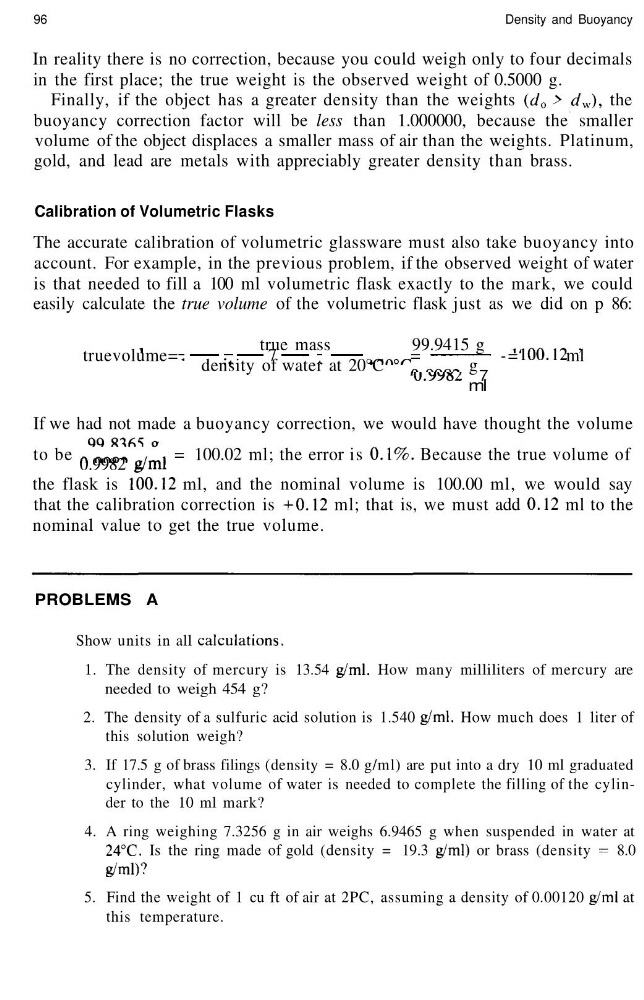
easily calculate the true volume of the volumetric flask just as we did on p 86:
,
true mass
99.9415 g inn ,„ ,
true volume = -. - - t - 7 - : - , ..,„„ = - - = 100.12 ml
density of water at 20°C n QQO , g
u.yyoz 7
ml
If we had not made a buoyancy correction, we would have thought the volume
to be A .o/i = 100.02 ml; the error is 0.1%. Because the true volume of
0.9982 g/ml
the flask is 100.12 ml, and the nominal volume is 100.00 ml, we would say
that the calibration correction is +0.12 ml; that is, we must add 0.12 ml to the
nominal value to get the true volume.
PROBLEMS A
Show units in all calculations.
1. The density of mercury is 13.54 g/ml. How many milliliters of mercury are
needed to weigh 454 g?
2. The density of a sulfuric acid solution is 1.540 g/ml. How much does 1 liter of
this solution weigh?
3. If 17.5 g of brass filings (density = 8.0 g/ml) are put into a dry 10 ml graduated
cylinder, what volume of water is needed to complete the filling of the cylinder to the 10 ml mark?
4. A ring weighing 7.3256 g in air weighs 6.9465 g when suspended in water at
24°C. Is the ring made of gold (density = 19.3 g/ml) or brass (density = 8.0
g/ml)?
5. Find the weight of 1 cu ft of air at 2PC, assuming a density of 0.00120 g/ml at
this temperature.
Density and Buoyancy
In reality there is no correction, because you could weigh only to four decimals
in the first place; the true weight is the observed weight of 0.5000 g.
Finally, if the object has a greater density than the weights (d 0 > c/ w ), the
buoyancy correction factor will be less than 1.000000, because the smaller
volume of the object displaces a smaller mass of air than the weights. Platinum,
gold, and lead are metals with appreciably greater density than brass.
Calibration of Volumetric Flasks
The accurate calibration of volumetric glassware must also take buoyancy into
account. For example, in the previous problem, if the observed weight of water
is that needed to fill a 100 ml volumetric flask exactly to the mark, we could
easily calculate the true volume of the volumetric flask just as we did on p 86:
,
true mass
99.9415 g inn ,„ ,
true volume = -. - - t - 7 - : - , ..,„„ = - - = 100.12 ml
density of water at 20°C n QQO , g
u.yyoz 7
ml
If we had not made a buoyancy correction, we would have thought the volume
to be A .o/i = 100.02 ml; the error is 0.1%. Because the true volume of
0.9982 g/ml
the flask is 100.12 ml, and the nominal volume is 100.00 ml, we would say
that the calibration correction is +0.12 ml; that is, we must add 0.12 ml to the
nominal value to get the true volume.
PROBLEMS A
Show units in all calculations.
1. The density of mercury is 13.54 g/ml. How many milliliters of mercury are
needed to weigh 454 g?
2. The density of a sulfuric acid solution is 1.540 g/ml. How much does 1 liter of
this solution weigh?
3. If 17.5 g of brass filings (density = 8.0 g/ml) are put into a dry 10 ml graduated
cylinder, what volume of water is needed to complete the filling of the cylinder to the 10 ml mark?
4. A ring weighing 7.3256 g in air weighs 6.9465 g when suspended in water at
24°C. Is the ring made of gold (density = 19.3 g/ml) or brass (density = 8.0
g/ml)?
5. Find the weight of 1 cu ft of air at 2PC, assuming a density of 0.00120 g/ml at
this temperature.