

2
(1) holds when and only when x < 10. But x < 3 implies x < 10, and, therefore, the inequality (1) holds
for all x<3.
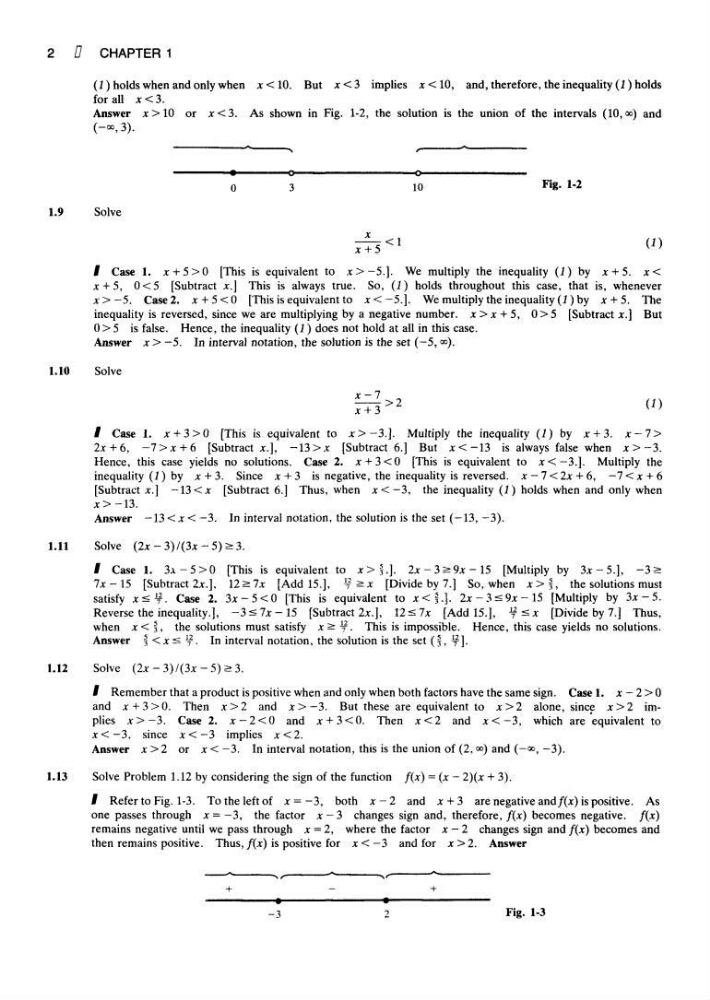
Answer *>10 or x<3. As shown in Fig. 1-2, the solution is the union of the intervals (10, oo) and
(~»,3).
x + 5, 0<5 [Subtract x.] This is always true. So, (1) holds throughout this case, that is, wheneverx + 5, 0<5 [Subtract x.] This is always true. So, (1) holds throughout this case, that is, whenever
x>-5. Case 2. x + 5<0 [This is equivalent to x<-5.]. We multiply the inequality (1) by x + 5. The
inequality is reversed, since we are multiplying by a negative number. x>x + 5, 0>5 [Subtract*.] Butinequality is reversed, since we are multiplying by a negative number. x>x + 5, 0>5 [Subtract*.] But
0 > 5 is false. Hence, the inequality (1) does not hold at all in this case.
Answer x > -5. In interval notation, the solution is the set (-5, °°).
2x + 6, -7>x+6 [Subtract x.], -13>x [Subtract 6.] But x<-13 is always false when *>-3.
Hence, this case yields no solutions. Case 2. x + 3<0 [This is equivalent to x<— 3.]. Multiply the
inequality (1) by x + 3. Since x + 3 is negative, the inequality is reversed. x-7<2x + 6, —7
Answer —13 < x < —3. In interval notation, the solution is the set (—13, —3).
1.11
Solve (2jt-3)/(3;t-5)>3.
7x-15 [Subtract 2x.], I2>7x [Add 15.], T
a * [Divide by 7.] So, when x>f, the solutions must
satisfy x<". Case 2. 3x-5<0 [This is equivalent to x<|.]. 2* - 3 < 9* - 15 [Multiply by 3*-5.
Reverse the inequality.], -3<7jr-15 [Subtract 2*.], 12 < 7x [Add 15.], ^ s x [Divide by 7.] Thus,
when x< f, the solutions must satisfy x^
! f. This is impossible. Hence, this case yields no solutions.
Answer f < x s -y. In interval notation, the solution is the set (§, ^].
1.12
Solve (2*-3)/(3*-5)>3.
and x + 3>0. Then x>2 and jt>—3. But these are equivalent to x>2 alone, since x>2 im-and x + 3>0. Then x>2 and jt>—3. But these are equivalent to x>2 alone, since x>2 implies x>-3. Case 2. *-2<0 and A: + 3<0. Then x<2 and jc<—3, which are equivalent to
x<—3, since x<-3 implies x<2.
Answer x > 2 or x < -3. In interval notation, this is the union of (2, °°) and (—<», —3).
1.13
Solve Problem 1.12 by considering the sign of the function f(x) = (x — 2)(x + 3).
one passes through x - — 3, the factor x - 3 changes sign and, therefore, f(x) becomes negative. f(x)
remains negative until we pass through x = 2, where the factor x — 2 changes sign and f(x) becomes and
then remains positive. Thus, f(x) is positive for x < — 3 and for x > 2. Answer
1.9
Solve
Fig. 1-2
1.10
Solve
Fig. 1-3
1. x + 5>0 [This is equivalent to x>-5.]. We multiply the inequality (1) by x + 5. x0 [This is equivalent to x>-5.]. We multiply the inequality (1) by x + 5. x<
Case 1. x + 3>0 [This is equivalent to jc>-3.]. Multiply the inequality (1) by x + 3. x-7>
Case 1. 3A.-5>0 [This is equivalent to *>§.]. 2x-3>9x-l5 [Multiply by 3jf-5.], -3>
Remember that a product is positive when and only when both factors have the same sign. Casel. Jt-2>0
Refer to Fig. 1-3. To the left of x = — 3, both x-2 and x + 3 are negative and /(*) is positive. As
CHAPTER 1
(1) holds when and only when x < 10. But x < 3 implies x < 10, and, therefore, the inequality (1) holds
for all x<3.
Answer *>10 or x<3. As shown in Fig. 1-2, the solution is the union of the intervals (10, oo) and
(~»,3).
x + 5, 0<5 [Subtract x.] This is always true. So, (1) holds throughout this case, that is, wheneverx + 5, 0<5 [Subtract x.] This is always true. So, (1) holds throughout this case, that is, whenever
x>-5. Case 2. x + 5<0 [This is equivalent to x<-5.]. We multiply the inequality (1) by x + 5. The
inequality is reversed, since we are multiplying by a negative number. x>x + 5, 0>5 [Subtract*.] Butinequality is reversed, since we are multiplying by a negative number. x>x + 5, 0>5 [Subtract*.] But
0 > 5 is false. Hence, the inequality (1) does not hold at all in this case.
Answer x > -5. In interval notation, the solution is the set (-5, °°).
2x + 6, -7>x+6 [Subtract x.], -13>x [Subtract 6.] But x<-13 is always false when *>-3.
Hence, this case yields no solutions. Case 2. x + 3<0 [This is equivalent to x<— 3.]. Multiply the
inequality (1) by x + 3. Since x + 3 is negative, the inequality is reversed. x-7<2x + 6, —7
Answer —13 < x < —3. In interval notation, the solution is the set (—13, —3).
1.11
Solve (2jt-3)/(3;t-5)>3.
7x-15 [Subtract 2x.], I2>7x [Add 15.], T
a * [Divide by 7.] So, when x>f, the solutions must
satisfy x<". Case 2. 3x-5<0 [This is equivalent to x<|.]. 2* - 3 < 9* - 15 [Multiply by 3*-5.
Reverse the inequality.], -3<7jr-15 [Subtract 2*.], 12 < 7x [Add 15.], ^ s x [Divide by 7.] Thus,
when x< f, the solutions must satisfy x^
! f. This is impossible. Hence, this case yields no solutions.
Answer f < x s -y. In interval notation, the solution is the set (§, ^].
1.12
Solve (2*-3)/(3*-5)>3.
and x + 3>0. Then x>2 and jt>—3. But these are equivalent to x>2 alone, since x>2 im-and x + 3>0. Then x>2 and jt>—3. But these are equivalent to x>2 alone, since x>2 implies x>-3. Case 2. *-2<0 and A: + 3<0. Then x<2 and jc<—3, which are equivalent to
x<—3, since x<-3 implies x<2.
Answer x > 2 or x < -3. In interval notation, this is the union of (2, °°) and (—<», —3).
1.13
Solve Problem 1.12 by considering the sign of the function f(x) = (x — 2)(x + 3).
one passes through x - — 3, the factor x - 3 changes sign and, therefore, f(x) becomes negative. f(x)
remains negative until we pass through x = 2, where the factor x — 2 changes sign and f(x) becomes and
then remains positive. Thus, f(x) is positive for x < — 3 and for x > 2. Answer
1.9
Solve
Fig. 1-2
1.10
Solve
Fig. 1-3
1. x + 5>0 [This is equivalent to x>-5.]. We multiply the inequality (1) by x + 5. x0 [This is equivalent to x>-5.]. We multiply the inequality (1) by x + 5. x<
Case 1. x + 3>0 [This is equivalent to jc>-3.]. Multiply the inequality (1) by x + 3. x-7>
Case 1. 3A.-5>0 [This is equivalent to *>§.]. 2x-3>9x-l5 [Multiply by 3jf-5.], -3>
Remember that a product is positive when and only when both factors have the same sign. Casel. Jt-2>0
Refer to Fig. 1-3. To the left of x = — 3, both x-2 and x + 3 are negative and /(*) is positive. As
CHAPTER 1