

CHAPTER 13
Maxima and Minima
13.1
State the second-derivative test for relative extrema.
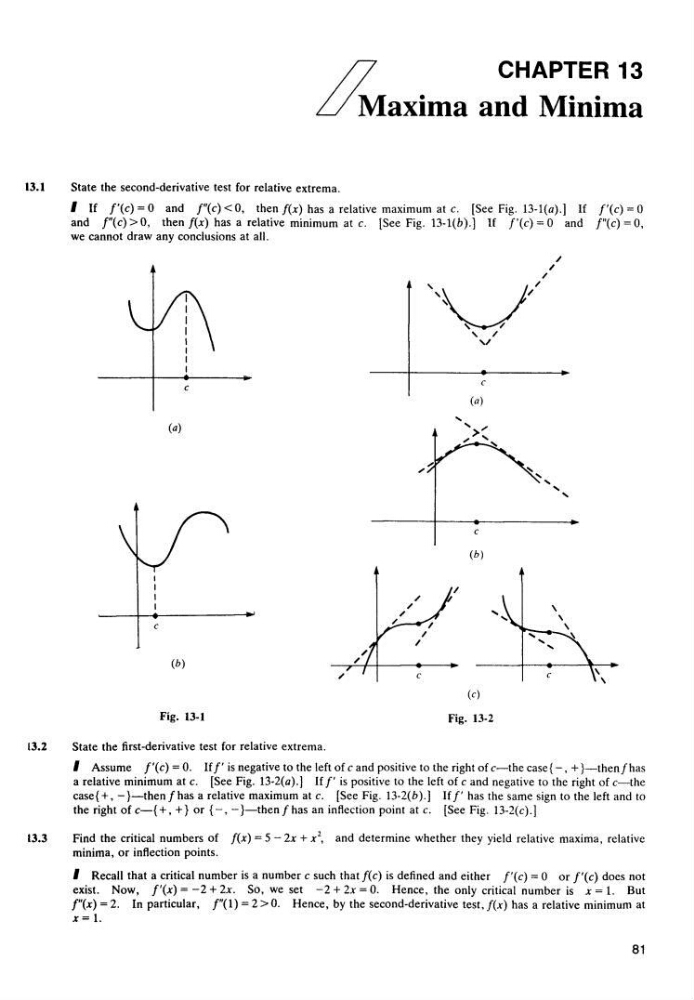
I If f'(c) = 0 and /"(e) <0, then f(x) has a relative maximum at c. [See Fig. 13-l(a).] If /'(c) = 0
and /"(c)>0, then f(x) has a relative minimum at c. [See Fig. 13-l(b).] If f'(c) = Q and /"(c) = 0,
we cannot draw any conclusions at all.
Fig. 13-1
Fig. 13-2
13.2
State the first-derivative test for relative extrema.
I Assume f'(c) = 0. If/' is negative to the left of c and positive to the right of c—thecase{-,+}—then/has
a relative minimum at c. [See Fig. 13-2(o).] If/' is positive to the left of c and negative to the right of c—the
case{ + , -}—then/has a relative maximum at c. [See Fig. 13-2(6).] If/' has the same sign to the left and to
the right of c—{ + , +} or { —, —}—then/has an inflection point at c. [See Fig. 13-2(c).]
13.3
Find the critical numbers of f(x) = 5 — 2x + x
2 , and determine whether they yield relative maxima, relative
minima, or inflection points.
I Recall that a critical number is a number c such that /(c) is defined and either /'(c) = 0 or /'(c) does not
exist. Now, f'(x) = -2 + 2x. So, we set -2 + 2x = Q. Hence, the only critical number is x = \. But
/"(AT) = 2. In particular, /"(I) = 2>0. Hence, by the second-derivative test, f(x) has a relative minimum at
*=1.
81
(*)
(c)
(*)
(«)
(«)
Maxima and Minima
13.1
State the second-derivative test for relative extrema.
I If f'(c) = 0 and /"(e) <0, then f(x) has a relative maximum at c. [See Fig. 13-l(a).] If /'(c) = 0
and /"(c)>0, then f(x) has a relative minimum at c. [See Fig. 13-l(b).] If f'(c) = Q and /"(c) = 0,
we cannot draw any conclusions at all.
Fig. 13-1
Fig. 13-2
13.2
State the first-derivative test for relative extrema.
I Assume f'(c) = 0. If/' is negative to the left of c and positive to the right of c—thecase{-,+}—then/has
a relative minimum at c. [See Fig. 13-2(o).] If/' is positive to the left of c and negative to the right of c—the
case{ + , -}—then/has a relative maximum at c. [See Fig. 13-2(6).] If/' has the same sign to the left and to
the right of c—{ + , +} or { —, —}—then/has an inflection point at c. [See Fig. 13-2(c).]
13.3
Find the critical numbers of f(x) = 5 — 2x + x
2 , and determine whether they yield relative maxima, relative
minima, or inflection points.
I Recall that a critical number is a number c such that /(c) is defined and either /'(c) = 0 or /'(c) does not
exist. Now, f'(x) = -2 + 2x. So, we set -2 + 2x = Q. Hence, the only critical number is x = \. But
/"(AT) = 2. In particular, /"(I) = 2>0. Hence, by the second-derivative test, f(x) has a relative minimum at
*=1.
81
(*)
(c)
(*)
(«)
(«)