

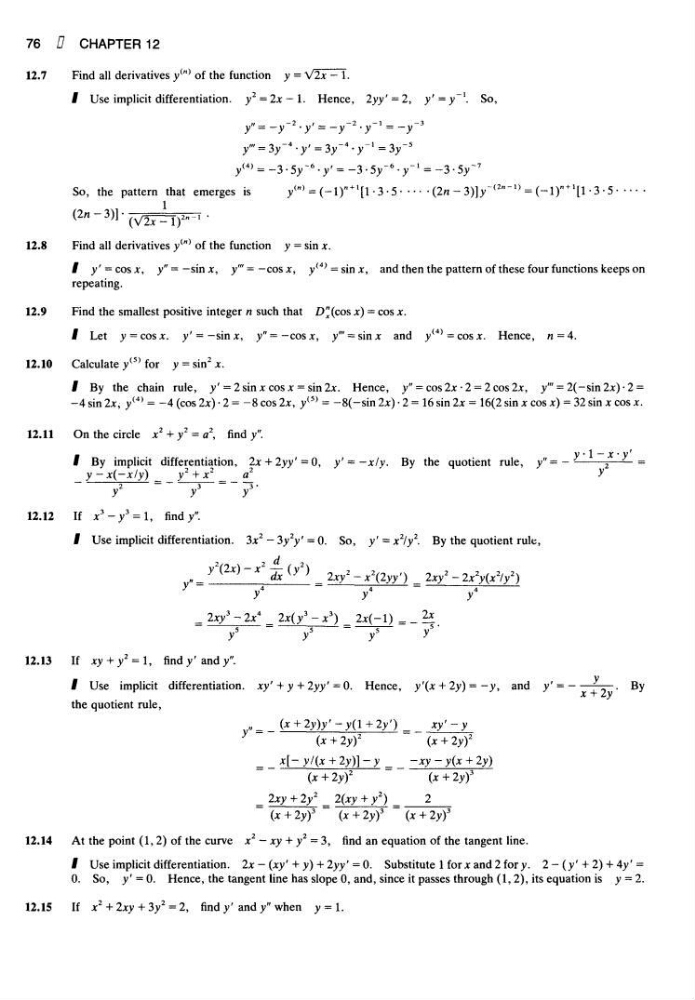
12.13
If xy + y
2 = l, find y' and y".
76
CHAPTER 12
12.7
Find all derivatives y
w of the function
Use implicit differentiation, y =2x-l. Hence, 2yy' = 2, y'=y '. So,
y" = -y~
2
• y' = -y~
2
-y~
1 =
-y~
3
y>» = 3y-*.y>=3y-<.y->=3y-S
y
w = -3 • 5y~
6 -y' = -3- 5y"
6 • y~
l = -3 • 5y~
7
So, the pattern that emerges is
12.8
Find all derivatives y
M of the function y = sin x.
y' = cos x, y" = — sin x, y'" = -cos x, y
<4> = sin x, and then the pattern of these four functions keeps on
repeating.
12.9
Find the smallest positive integer n such that D"(cos x) - cos x.
Let y = cosx. y'= — sinx, y"=—cosx, y'" = smx and 3* —cos*. Hence, n=4.
12.10
Calculate >>
<5) for y = sin
2 x.
By the chain rule, y' = 2 sin x cos x = sin 2*. Hence, y" = cos 2x • 2 = 2 cos 2x, y'" = 2(-sin 2x) • 2 =
-4 sin 2x, y
w = -4 (cos 2x) • 2 = -8 cos 2x, >C5) = -8(-sin 2x) • 2 = 16 sin 2x = 16(2 sin x cos x) = 32 sin x cos x.
12.11
On the circle x
2 + y
2 = a
2 , find y".
By implicit differentiation, 2x + 2yy'=0, y'=—x/y. By the quotient rule,
12.12
If x
3 -/ = l, find/'.
Use implicit differentiation. 3x
2 -3y
2 y' = Q. So, ;y' = ;t
2
/}'
2
. By the quotient rule,
Use implicit differentiation, xy' + >> + 2yy' =0. Hence, yX* + 2y) = -y, and y' =
By
the quotient rule,
12.14
At the point (1,2) of the curve x
2 — xy + y
2 =3, find an equation of the tangent line.
I Use implicit differentiation. 2x - (xy' + y) + 2yy' = 0. Substitute 1 for x and 2 for y. 2 - (y' + 2) + 4y' =
0. So, y'=0. Hence, the tangent line has slope 0, and, since it passes through (1,2), its equation is y = 2.
12.15
If x
2 + 2xy + 3y
2 = 2, find y' and /' when y = l.
If xy + y
2 = l, find y' and y".
76
CHAPTER 12
12.7
Find all derivatives y
w of the function
Use implicit differentiation, y =2x-l. Hence, 2yy' = 2, y'=y '. So,
y" = -y~
2
• y' = -y~
2
-y~
1 =
-y~
3
y>» = 3y-*.y>=3y-<.y->=3y-S
y
w = -3 • 5y~
6 -y' = -3- 5y"
6 • y~
l = -3 • 5y~
7
So, the pattern that emerges is
12.8
Find all derivatives y
M of the function y = sin x.
y' = cos x, y" = — sin x, y'" = -cos x, y
<4> = sin x, and then the pattern of these four functions keeps on
repeating.
12.9
Find the smallest positive integer n such that D"(cos x) - cos x.
Let y = cosx. y'= — sinx, y"=—cosx, y'" = smx and 3* —cos*. Hence, n=4.
12.10
Calculate >>
<5) for y = sin
2 x.
By the chain rule, y' = 2 sin x cos x = sin 2*. Hence, y" = cos 2x • 2 = 2 cos 2x, y'" = 2(-sin 2x) • 2 =
-4 sin 2x, y
w = -4 (cos 2x) • 2 = -8 cos 2x, >C5) = -8(-sin 2x) • 2 = 16 sin 2x = 16(2 sin x cos x) = 32 sin x cos x.
12.11
On the circle x
2 + y
2 = a
2 , find y".
By implicit differentiation, 2x + 2yy'=0, y'=—x/y. By the quotient rule,
12.12
If x
3 -/ = l, find/'.
Use implicit differentiation. 3x
2 -3y
2 y' = Q. So, ;y' = ;t
2
/}'
2
. By the quotient rule,
Use implicit differentiation, xy' + >> + 2yy' =0. Hence, yX* + 2y) = -y, and y' =
By
the quotient rule,
12.14
At the point (1,2) of the curve x
2 — xy + y
2 =3, find an equation of the tangent line.
I Use implicit differentiation. 2x - (xy' + y) + 2yy' = 0. Substitute 1 for x and 2 for y. 2 - (y' + 2) + 4y' =
0. So, y'=0. Hence, the tangent line has slope 0, and, since it passes through (1,2), its equation is y = 2.
12.15
If x
2 + 2xy + 3y
2 = 2, find y' and /' when y = l.