

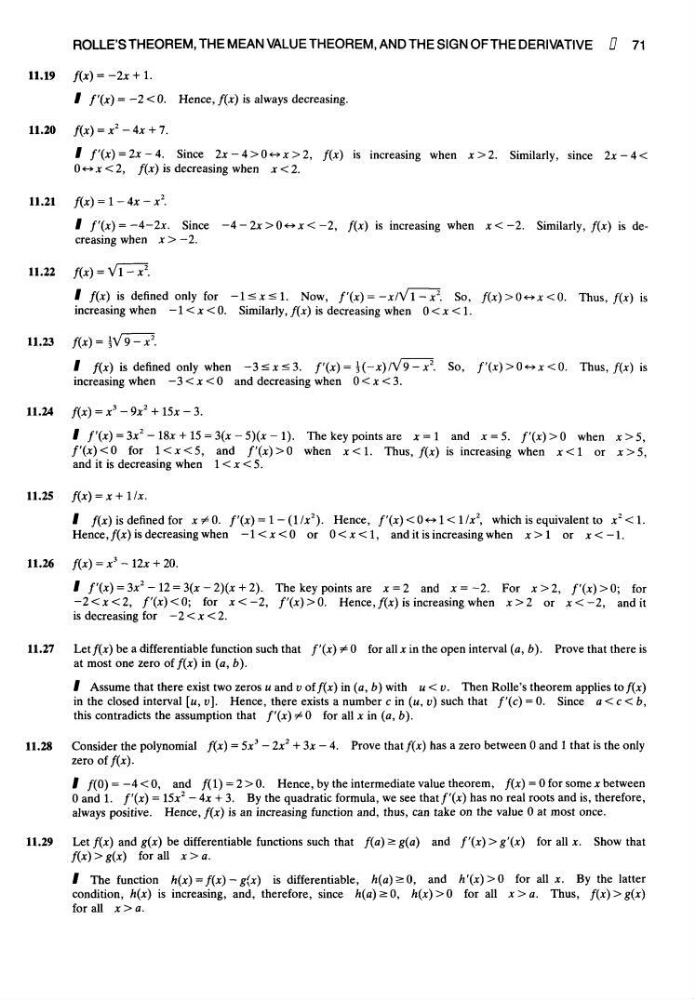
11.19 f(x) = -2x + 1.
I f'(x) = —2 <0. Hence, f(x) is always decreasing.
11.20 f(x) = x
2 -4x + 7.
I f'(x) = 2x-4. Since 2x-4>Q**x>2, f(x) is increasing when x>2. Similarly, since 2x-4<
0 <-» * < 2, f(x) is decreasing when x<2.
11.21 f(x) = 1 - 4x - x
2 .
1 f'(x)=-4-2x. Since -4- 2x>Q++x< -2, f(x) is increasing when x<-2. Similarly, f(x) is decreasing when x > —2.
11.22
/(*) = Vl - x
2 .
f(x) is denned only for -1<*<1. Now, f'(x) = -xNl - x2. So, f(x) >Q**x <0. Thus, /(*) is
increasing when -1< x < 0. Similarly, f(x) is decreasing when 0 < x < 1.
11.23
I f(x) is defined only when -3
increasing when — 3<;t<0 and decreasing when 0
3 - 9x
2 + 15x - 3.
I f'(x) = 3x
2 -l8x + 15 = 3(x-5)(x- 1). The key points are x = l and * = 5. f'(x)>Q when jc>5,
/'(AC)O when x5,
and it is decreasing when 1 < x < 5.
11.25
f(x) = x + l/x.
I f(x) is denned for x^O. f'(x) = \-(\lx
2 ). Hence, /'(*)!< l/ x \ which is equivalent to x
2! or AC<—1.
11.26 f(x) = x
3 - \2x + 20.
I f'(x) = 3x
2 — l2 = 3(x — 2)(x + 2). The key points are x = 2 and x = —2. For Ac>2, f'(x)>0; for
-2Q. Hence, f(x) is increasing when x>2 or x<-2, and it
is decreasing for -2 < x < 2.
11.27
Let f(x) be a differentiable function such that f'(x)^0 for all AC in the open interval (a, b). Prove that there is
at most one zero of f(x) in (a, b).
I Assume that there exist two zeros u and v off(x) in (a, b) with u
11.28
Consider the polynomial f(x) = 5x
3 - 2x
2 + 3x-4. Prove that f(x) has a zero between 0 and 1 that is the only
zero of/(AC).
I /(0)=-4<0, and /(1) = 2>0. Hence, by the intermediate value theorem, f(x) = 0 for some x between
0 and 1. /'(*) = 15AC
2 - 4AC -I- 3. By the quadratic formula, we see that/'(*) has no real roots and is, therefore,
always positive. Hence, f(x) is an increasing function and, thus, can take on the value 0 at most once.
11.29
Let/(AC) and g(x) be differentiable functions such that /(a)sg(a) and f'(x)> g'(x) for all x. Show that
f(x) > g(x) for all x > a.
1 The function h(x) = f(x) - g(x) is differentiable, /*(«)>0, and h'(x)>0 for all x. By the latter
condition, h(x) is increasing, and, therefore, since /i(«)>0, h(x)>0 for all AC > a. Thus, /M>g(Ac)
for all AC > a.
ROLLE'STHEOREM, THE MEAN VALUE THEOREM, AND THE SIGN OFTHE DERIVATIVE
71
I f'(x) = —2 <0. Hence, f(x) is always decreasing.
11.20 f(x) = x
2 -4x + 7.
I f'(x) = 2x-4. Since 2x-4>Q**x>2, f(x) is increasing when x>2. Similarly, since 2x-4<
0 <-» * < 2, f(x) is decreasing when x<2.
11.21 f(x) = 1 - 4x - x
2 .
1 f'(x)=-4-2x. Since -4- 2x>Q++x< -2, f(x) is increasing when x<-2. Similarly, f(x) is decreasing when x > —2.
11.22
/(*) = Vl - x
2 .
f(x) is denned only for -1<*<1. Now, f'(x) = -xNl - x2. So, f(x) >Q**x <0. Thus, /(*) is
increasing when -1< x < 0. Similarly, f(x) is decreasing when 0 < x < 1.
11.23
I f(x) is defined only when -3
increasing when — 3<;t<0 and decreasing when 0
3 - 9x
2 + 15x - 3.
I f'(x) = 3x
2 -l8x + 15 = 3(x-5)(x- 1). The key points are x = l and * = 5. f'(x)>Q when jc>5,
/'(AC)
and it is decreasing when 1 < x < 5.
11.25
f(x) = x + l/x.
I f(x) is denned for x^O. f'(x) = \-(\lx
2 ). Hence, /'(*)
2
11.26 f(x) = x
3 - \2x + 20.
I f'(x) = 3x
2 — l2 = 3(x — 2)(x + 2). The key points are x = 2 and x = —2. For Ac>2, f'(x)>0; for
-2
is decreasing for -2 < x < 2.
11.27
Let f(x) be a differentiable function such that f'(x)^0 for all AC in the open interval (a, b). Prove that there is
at most one zero of f(x) in (a, b).
I Assume that there exist two zeros u and v off(x) in (a, b) with u
11.28
Consider the polynomial f(x) = 5x
3 - 2x
2 + 3x-4. Prove that f(x) has a zero between 0 and 1 that is the only
zero of/(AC).
I /(0)=-4<0, and /(1) = 2>0. Hence, by the intermediate value theorem, f(x) = 0 for some x between
0 and 1. /'(*) = 15AC
2 - 4AC -I- 3. By the quadratic formula, we see that/'(*) has no real roots and is, therefore,
always positive. Hence, f(x) is an increasing function and, thus, can take on the value 0 at most once.
11.29
Let/(AC) and g(x) be differentiable functions such that /(a)sg(a) and f'(x)> g'(x) for all x. Show that
f(x) > g(x) for all x > a.
1 The function h(x) = f(x) - g(x) is differentiable, /*(«)>0, and h'(x)>0 for all x. By the latter
condition, h(x) is increasing, and, therefore, since /i(«)>0, h(x)>0 for all AC > a. Thus, /M>g(Ac)
for all AC > a.
ROLLE'STHEOREM, THE MEAN VALUE THEOREM, AND THE SIGN OFTHE DERIVATIVE
71