

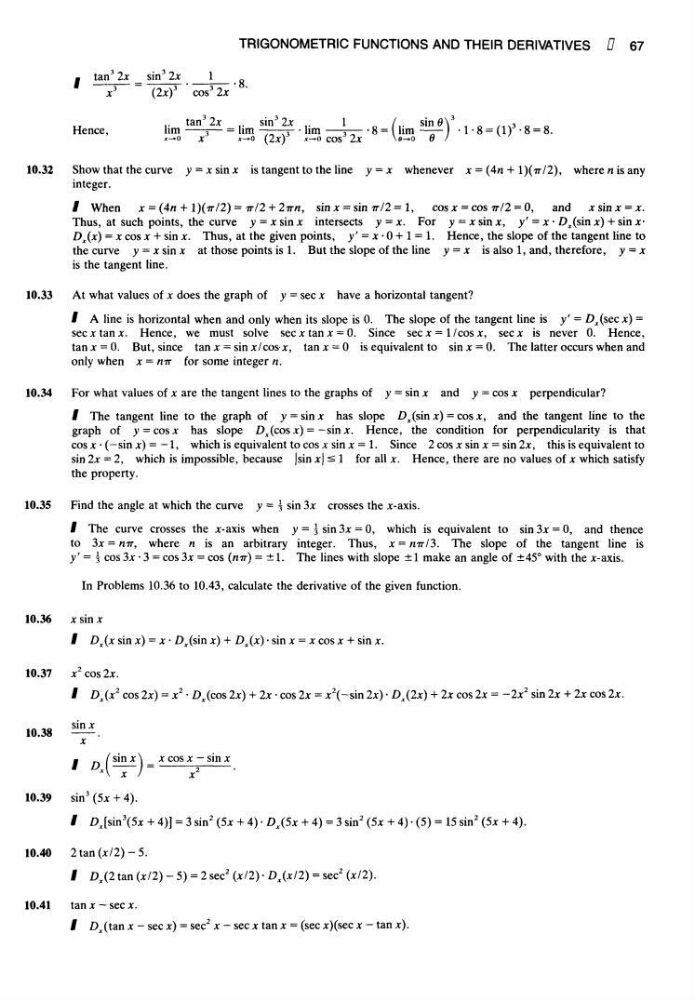
TRIGONOMETRIC FUNCTIONS AND THEIR DERIVATIVES
67
Hence,
10.32
Show that the curve y = xsin* is tangent to the line y = x whenever x = (4n + l)(ir/2), where n is any
integer.
When x = (4n +l)(ir/2)= TT/2 + 2irn, sin * = sin ir/2 = 1, cos x = cos ir/2 = 0, and xsinx = x.
Thus, at such points, the curve y = *sin* intersects y = x. For y = *sinjc, y' = x • D x (sm x) + sin xD f (x) = x cos A; + sin x. Thus, at the given points, y' = x • 0 + 1 = 1. Hence, the slope of the tangent line to
the curve y = jcsinx at those points is 1. But the slope of the line y = x is also 1, and, therefore, y = *
is the taneent line.
10.33
At what values of x does the graph of y = sec x have a horizontal tangent?
I A line is horizontal when and only when its slope is 0. The slope of the tangent line is y' = D^sec x) =
sec ;t tan*. Hence, we must solve sec*tan* = 0. Since sec x = 1 /cos x, sec* is never 0. Hence,
tan* = 0. But, since tan x = sin* /cos-*, tan* = 0 is equivalent to sin* = 0. The latter occurs when and
only when x = nir for some integer n.
10.34
For what values of x are the tangent lines to the graphs of y = sin x and y = cos x perpendicular?
I The tangent line to the graph of y = sin x has slope D^(sin x) = cos x, and the tangent line to the
graph of >> = cosx has slope D^(cos x) = -sin x. Hence, the condition for perpendicularity is that
cos x • (-sin x) = -1, which is equivalent to cos x sin x = 1. Since 2 cos x sin x — sin 2x, this is equivalent to
sin 2x = 2, which is impossible, because |sin jr| :£ 1 for all x. Hence, there are no values of x which satisfy
the property.
10.35
Find the angle at which the curve y = 3 sin 3x crosses the x-axis.
I The curve crosses the x-axis when y = | sin 3x = 0, which is equivalent to sin 3x = 0, and thence
to 3x = ntr, where n is an arbitrary integer. Thus, x = mr/3. The slope of the tangent line is
y' = 3 cos 3x • 3 = cos 3x = cos (mr) = ±1. The lines with slope ±1 make an angle of ±45° with the x-axis.
In Problems 10.36 to 10.43, calculate the derivative of the given function.
10.36
x sin x
D x (x sin x) = x • D^(sin x) + D x (x) • sin x = x cos x + sin x.
10.37
x
2 cos 2x.
D x (x
2 cos 2x) = x
2 • D x (cos 2x) + 2x • cos 2x = ;c
2
(-sin 2x) • D x (2x) + 2x cos 2x = -2x
2 sin 2x + 2x cos 2x.
10.38
10.39
10.40
2 tan (x/2)-5.
10.41
tan x - sec x.
D x (tan x - sec x) = sec x - sec x tan x = (sec x)(sec x - tan x).
D x (2 tan (x/2) - 5) = 2 sec
2 (x/2) • D,(x/2) = sec
2 (x/2).
D,[sin
3
(5x + 4)] = 3 sin
2 (5x + 4) • D x (5x + 4) = 3 sin
2 (5x + 4) • (5) = 15 sin
2 (5x + 4).
sin
3 (5x + 4).
67
Hence,
10.32
Show that the curve y = xsin* is tangent to the line y = x whenever x = (4n + l)(ir/2), where n is any
integer.
When x = (4n +l)(ir/2)= TT/2 + 2irn, sin * = sin ir/2 = 1, cos x = cos ir/2 = 0, and xsinx = x.
Thus, at such points, the curve y = *sin* intersects y = x. For y = *sinjc, y' = x • D x (sm x) + sin xD f (x) = x cos A; + sin x. Thus, at the given points, y' = x • 0 + 1 = 1. Hence, the slope of the tangent line to
the curve y = jcsinx at those points is 1. But the slope of the line y = x is also 1, and, therefore, y = *
is the taneent line.
10.33
At what values of x does the graph of y = sec x have a horizontal tangent?
I A line is horizontal when and only when its slope is 0. The slope of the tangent line is y' = D^sec x) =
sec ;t tan*. Hence, we must solve sec*tan* = 0. Since sec x = 1 /cos x, sec* is never 0. Hence,
tan* = 0. But, since tan x = sin* /cos-*, tan* = 0 is equivalent to sin* = 0. The latter occurs when and
only when x = nir for some integer n.
10.34
For what values of x are the tangent lines to the graphs of y = sin x and y = cos x perpendicular?
I The tangent line to the graph of y = sin x has slope D^(sin x) = cos x, and the tangent line to the
graph of >> = cosx has slope D^(cos x) = -sin x. Hence, the condition for perpendicularity is that
cos x • (-sin x) = -1, which is equivalent to cos x sin x = 1. Since 2 cos x sin x — sin 2x, this is equivalent to
sin 2x = 2, which is impossible, because |sin jr| :£ 1 for all x. Hence, there are no values of x which satisfy
the property.
10.35
Find the angle at which the curve y = 3 sin 3x crosses the x-axis.
I The curve crosses the x-axis when y = | sin 3x = 0, which is equivalent to sin 3x = 0, and thence
to 3x = ntr, where n is an arbitrary integer. Thus, x = mr/3. The slope of the tangent line is
y' = 3 cos 3x • 3 = cos 3x = cos (mr) = ±1. The lines with slope ±1 make an angle of ±45° with the x-axis.
In Problems 10.36 to 10.43, calculate the derivative of the given function.
10.36
x sin x
D x (x sin x) = x • D^(sin x) + D x (x) • sin x = x cos x + sin x.
10.37
x
2 cos 2x.
D x (x
2 cos 2x) = x
2 • D x (cos 2x) + 2x • cos 2x = ;c
2
(-sin 2x) • D x (2x) + 2x cos 2x = -2x
2 sin 2x + 2x cos 2x.
10.38
10.39
10.40
2 tan (x/2)-5.
10.41
tan x - sec x.
D x (tan x - sec x) = sec x - sec x tan x = (sec x)(sec x - tan x).
D x (2 tan (x/2) - 5) = 2 sec
2 (x/2) • D,(x/2) = sec
2 (x/2).
D,[sin
3
(5x + 4)] = 3 sin
2 (5x + 4) • D x (5x + 4) = 3 sin
2 (5x + 4) • (5) = 15 sin
2 (5x + 4).
sin
3 (5x + 4).