

8.47
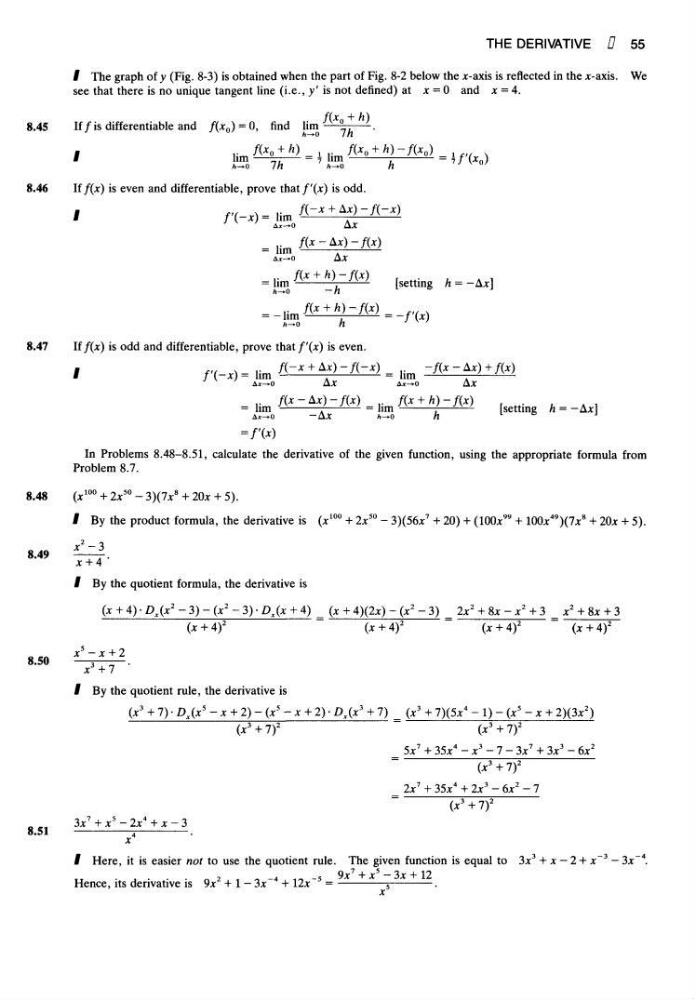
If/00 is odd and differentiable, prove that/'OO is even.
8.49
8.51
Here, it is easier not to use the quotient rule. The given function is equal to 3x
3 + x•- 2 + x
3 - 3*
4
.
Hence, its derivative is
THE DERIVATIVE
55
The graph of y (Fig. 8-3) is obtained when the part of Fig. 8-2 below the x-axis is reflected in the *-axis. We
see that there is no unique tangent line (i.e., y' is not defined) at x = 0 and * = 4.
8.45
If/is differentiable and
find
8.46
If/00 is even and differentiable, prove that/'OO is odd.
By the quotient rule, the derivative is
In Problems 8.48-8.51, calculate the derivative of the given function, using the appropriate formula from
Problem 8.7.
By the product formula, the derivative is (x
100 + 2x
50 - 3)(56x
7 + 20) + (100*
99 + l(Xk
49 )(7x
8 + 20* + 5).
8.48
8.50
setting
By the quotient formula, the derivative is
If/00 is odd and differentiable, prove that/'OO is even.
8.49
8.51
Here, it is easier not to use the quotient rule. The given function is equal to 3x
3 + x•- 2 + x
3 - 3*
4
.
Hence, its derivative is
THE DERIVATIVE
55
The graph of y (Fig. 8-3) is obtained when the part of Fig. 8-2 below the x-axis is reflected in the *-axis. We
see that there is no unique tangent line (i.e., y' is not defined) at x = 0 and * = 4.
8.45
If/is differentiable and
find
8.46
If/00 is even and differentiable, prove that/'OO is odd.
By the quotient rule, the derivative is
In Problems 8.48-8.51, calculate the derivative of the given function, using the appropriate formula from
Problem 8.7.
By the product formula, the derivative is (x
100 + 2x
50 - 3)(56x
7 + 20) + (100*
99 + l(Xk
49 )(7x
8 + 20* + 5).
8.48
8.50
setting
By the quotient formula, the derivative is