

THE DERIVATIVE
53
Find the derivative of the function f(x) = (2x — 3)
2
.
I f(x) = 4x
2 - 12* + 9. Hence, /'(*) = 8* - 12. [Notice that the same method would be difficult to carry
out with a function like (2x - 3)
20
.]
Where does the normal line to the curve y = x — x
2
at the point (1,0) intersect the curve a second time?
I y' = l~2x. The tangent line at (1,0) has slope 1—2(1) = —!. Hence, the normal line has slope 1, and a
point-slope equation for it is y = x-l.
Solving y = x - x
2
and y = x - 1 simultaneously, x - x
2 =
x — I, x
2 = 1, x = ±1. Hence, the other point of intersection occurs when x = — 1. Then y = x — 1 =
-1 - 1 = -2. So, the other point is (-1, -2).
Find the point(s) on the graph of y = x
2
at which the tangent line is parallel to the line y — 6x — 1.
I Since the slope of y = 6x — 1 is 6, the slope of the tangent line must be 6. Thus, the derivative 2x = 6,
x = 3. Hence, the desired point is (3,9).
Find the point(s) on the graph of y = x
3
at which the tangent line is perpendicular to the line 3x + 9y = 4.
I The equation of the line can be rewritten as _y = -jx+5, and so its slope is - j. Hence, the slope of the
required tangent line must be the negative reciprocal of -1, namely, 3. So, the derivative 3x
2 = 3, x
2 = 1,
x = ±1. Thus, the solutions are (1,1) and (—1, —1).
Find the slope-intercept equation of the normal line to the curve y = x
3
at the point at which x = |.
I The slope of the tangent line is the derivative 3x
2 , which, at x = |, is 5. Hence, the slope of the normal
line is the negative reciprocal of 5, namely, -3. So, the required equation has the form y = —3x + b. On
the curve, when x=\, y = x
3 = TJ . Thus, the point (|, ^) lies on the line, and j? = -3( 3 ) + fe, 6= if.
So, the required equation is y = —3x + ff.
At what points does the normal line to the curve y = x
2 - 3x + 5 at the point (3, 5) intersect the curve?
I The derivative 2x — 3 has, at x = 3, the value 3. So, the slope of the normal line is - 3, and its
equation is y = — 3* + b. Since (3, 5) lies on the line, 5 = — 1 + b, or b = 6. Thus, the equation of the
normal line is y = — jx + 6. To find the intersections of this line with the curve, we set — jjc + 6 =
x
2 -3x + 5, 3x
2 -8x-3 = 0, (3x + l)(x - 3) = 0, x = -\ or * = 3. We already know about the point
(3,5), the other intersection point is (— 3, T )•
8.30
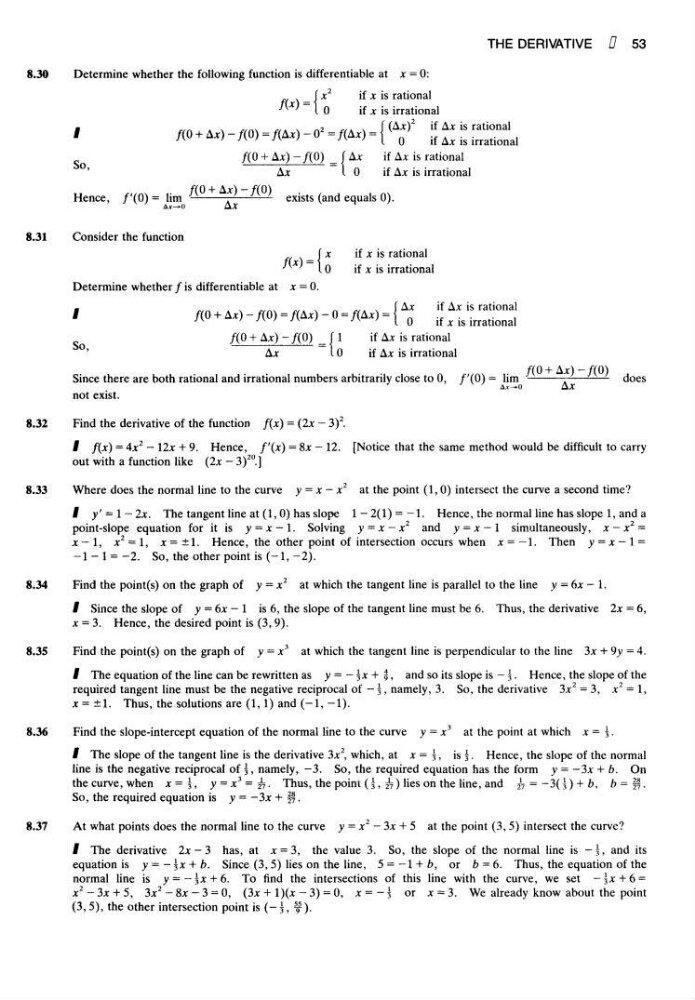
Determine whether the following function is differentiable at x = 0:
if x is rational
if x is irrational
if AJC is rational
if Ax is irrational
if Ax is rational
if Ax is irrational
So,
Hence,
exists (and equals 0).
8.31
Consider the function
if x is rational
if x is irrational
Determine whether / is differentiable at x = 0.
if Ax is rational
if x is irrational
if Ax is rational
if Ax is irrational
8.32
8.33
8.34
8.35
8.36
8.37
So,
not exist.
Sincethere are bothrational and irrational numbers arbitrarily close to0,
does
53
Find the derivative of the function f(x) = (2x — 3)
2
.
I f(x) = 4x
2 - 12* + 9. Hence, /'(*) = 8* - 12. [Notice that the same method would be difficult to carry
out with a function like (2x - 3)
20
.]
Where does the normal line to the curve y = x — x
2
at the point (1,0) intersect the curve a second time?
I y' = l~2x. The tangent line at (1,0) has slope 1—2(1) = —!. Hence, the normal line has slope 1, and a
point-slope equation for it is y = x-l.
Solving y = x - x
2
and y = x - 1 simultaneously, x - x
2 =
x — I, x
2 = 1, x = ±1. Hence, the other point of intersection occurs when x = — 1. Then y = x — 1 =
-1 - 1 = -2. So, the other point is (-1, -2).
Find the point(s) on the graph of y = x
2
at which the tangent line is parallel to the line y — 6x — 1.
I Since the slope of y = 6x — 1 is 6, the slope of the tangent line must be 6. Thus, the derivative 2x = 6,
x = 3. Hence, the desired point is (3,9).
Find the point(s) on the graph of y = x
3
at which the tangent line is perpendicular to the line 3x + 9y = 4.
I The equation of the line can be rewritten as _y = -jx+5, and so its slope is - j. Hence, the slope of the
required tangent line must be the negative reciprocal of -1, namely, 3. So, the derivative 3x
2 = 3, x
2 = 1,
x = ±1. Thus, the solutions are (1,1) and (—1, —1).
Find the slope-intercept equation of the normal line to the curve y = x
3
at the point at which x = |.
I The slope of the tangent line is the derivative 3x
2 , which, at x = |, is 5. Hence, the slope of the normal
line is the negative reciprocal of 5, namely, -3. So, the required equation has the form y = —3x + b. On
the curve, when x=\, y = x
3 = TJ . Thus, the point (|, ^) lies on the line, and j? = -3( 3 ) + fe, 6= if.
So, the required equation is y = —3x + ff.
At what points does the normal line to the curve y = x
2 - 3x + 5 at the point (3, 5) intersect the curve?
I The derivative 2x — 3 has, at x = 3, the value 3. So, the slope of the normal line is - 3, and its
equation is y = — 3* + b. Since (3, 5) lies on the line, 5 = — 1 + b, or b = 6. Thus, the equation of the
normal line is y = — jx + 6. To find the intersections of this line with the curve, we set — jjc + 6 =
x
2 -3x + 5, 3x
2 -8x-3 = 0, (3x + l)(x - 3) = 0, x = -\ or * = 3. We already know about the point
(3,5), the other intersection point is (— 3, T )•
8.30
Determine whether the following function is differentiable at x = 0:
if x is rational
if x is irrational
if AJC is rational
if Ax is irrational
if Ax is rational
if Ax is irrational
So,
Hence,
exists (and equals 0).
8.31
Consider the function
if x is rational
if x is irrational
Determine whether / is differentiable at x = 0.
if Ax is rational
if x is irrational
if Ax is rational
if Ax is irrational
8.32
8.33
8.34
8.35
8.36
8.37
So,
not exist.
Sincethere are bothrational and irrational numbers arbitrarily close to0,
does