

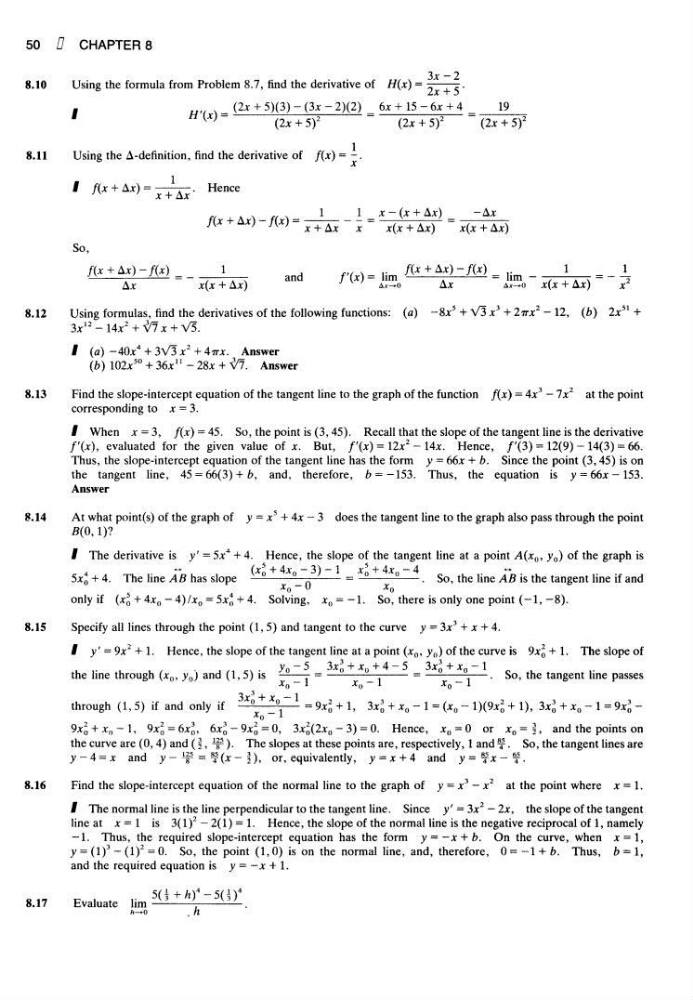
8.11
Using the A-definition, find the derivative of
8.13
Find the slope-intercept equation of the tangent line to the graph of the function f(x) = 4x
3 - 7x
2
at the point
corresponding to x = 3.
When x = 3, f(x) - 45. So, the point is (3,45). Recall that the slope of the tangent line is the derivative
/'(*), evaluated for the given value of x. But, /'(*) = 12x
2 - Ux. Hence, /'(3) = 12(9) - 14(3) = 66.
Thus, the slope-intercept equation of the tangent line has the form y = 66x + b. Since the point (3,45) is on
the tangent line, 45 = 66(3) + 6, and, therefore, b = -153. Thus, the equation is v=66*-153.
Answer
Hence
So,
and
8.12
Using formulas, find the derivatives of the following functions: (a)
(a) -40x
4 + 3V3 x
2 + 4Trx. Answer
(b) W2x
50 + 36x
u - 2Sx + i/7. Answer
8.17
Evaluate
50
CHAPTER 8
8.10
Using the formula from Problem 8.7, find the derivative of
8.14
At what point(s) of the graph of y = x
5 + 4x - 3 does the tangent line to the graph also pass through the point
5(0,1)?
The derivative is y' = 5x
4 + 4. Hence, the slope of the tangent line at a point A(x a , y 0 ) of the graph is
5*o + 4. The line AB has slope
So, the line AB is the tangent line if and
only if (x 0 + 4x 0 - 4) Ix 0 = 5x1
+ 4 - Solving, x 0 = — 1. So, there is only one point (—1, —8).
8.15
Specify all lines through the point (1, 5) and tangent to the curve y = 3>x
3 + x + 4.
y' = 9x
2 + l. Hence, the slope of the tangent line at a point (x a , y a ) of the curve is 9*0 + 1. The slope of
the line through (x 0 , y 0 ) and (1,5) is
So, the tangent line passes
through (1,5) if and only if
= 9x
2
0 + l, 3*2 + jr 0 -l = (je 0 -l)(9*S + l), 3x
3
0 + x 0 -l=9x
3
0 -
9**+ *„-!, 9*0 = 6*0, 6*o-9*o = 0, 3* 0 (2* 0 - 3) = 0. Hence, * 0 = 0 or * 0 =|, and the points on
the curve are (0, 4) and (§, ^). The slopes at these points are, respectively, 1 and f. So, the tangent lines are
y — 4 = x and y — *TT = T(X—%), or, equivalently, y = x + 4 and y
=S fX— ".
8.16
Find the slope-intercept equation of the normal line to the graph of y = jc
3 — x
2
at the point where x = l.
The normal line is the line perpendicular to the tangent line. Since y' = 3x
2 — 2x, the slope of the tangent
lineal x = 1 is 3(1)
2 - 2(1) = 1. Hence, the slope of the normal line is the negative reciprocal of 1, namely
— 1. Thus, the required slope-intercept equation has the form y = —x + b. On the curve, when x = \,
y = (I)
3 - (I)
2 = 0. So, the point (1,0) is on the normal line, and, therefore, 0 = -1 + b. Thus, b = \,
and the required equation is y = — x + 1.
Using the A-definition, find the derivative of
8.13
Find the slope-intercept equation of the tangent line to the graph of the function f(x) = 4x
3 - 7x
2
at the point
corresponding to x = 3.
When x = 3, f(x) - 45. So, the point is (3,45). Recall that the slope of the tangent line is the derivative
/'(*), evaluated for the given value of x. But, /'(*) = 12x
2 - Ux. Hence, /'(3) = 12(9) - 14(3) = 66.
Thus, the slope-intercept equation of the tangent line has the form y = 66x + b. Since the point (3,45) is on
the tangent line, 45 = 66(3) + 6, and, therefore, b = -153. Thus, the equation is v=66*-153.
Answer
Hence
So,
and
8.12
Using formulas, find the derivatives of the following functions: (a)
(a) -40x
4 + 3V3 x
2 + 4Trx. Answer
(b) W2x
50 + 36x
u - 2Sx + i/7. Answer
8.17
Evaluate
50
CHAPTER 8
8.10
Using the formula from Problem 8.7, find the derivative of
8.14
At what point(s) of the graph of y = x
5 + 4x - 3 does the tangent line to the graph also pass through the point
5(0,1)?
The derivative is y' = 5x
4 + 4. Hence, the slope of the tangent line at a point A(x a , y 0 ) of the graph is
5*o + 4. The line AB has slope
So, the line AB is the tangent line if and
only if (x 0 + 4x 0 - 4) Ix 0 = 5x1
+ 4 - Solving, x 0 = — 1. So, there is only one point (—1, —8).
8.15
Specify all lines through the point (1, 5) and tangent to the curve y = 3>x
3 + x + 4.
y' = 9x
2 + l. Hence, the slope of the tangent line at a point (x a , y a ) of the curve is 9*0 + 1. The slope of
the line through (x 0 , y 0 ) and (1,5) is
So, the tangent line passes
through (1,5) if and only if
= 9x
2
0 + l, 3*2 + jr 0 -l = (je 0 -l)(9*S + l), 3x
3
0 + x 0 -l=9x
3
0 -
9**+ *„-!, 9*0 = 6*0, 6*o-9*o = 0, 3* 0 (2* 0 - 3) = 0. Hence, * 0 = 0 or * 0 =|, and the points on
the curve are (0, 4) and (§, ^). The slopes at these points are, respectively, 1 and f. So, the tangent lines are
y — 4 = x and y — *TT = T(X—%), or, equivalently, y = x + 4 and y
=S fX— ".
8.16
Find the slope-intercept equation of the normal line to the graph of y = jc
3 — x
2
at the point where x = l.
The normal line is the line perpendicular to the tangent line. Since y' = 3x
2 — 2x, the slope of the tangent
lineal x = 1 is 3(1)
2 - 2(1) = 1. Hence, the slope of the normal line is the negative reciprocal of 1, namely
— 1. Thus, the required slope-intercept equation has the form y = —x + b. On the curve, when x = \,
y = (I)
3 - (I)
2 = 0. So, the point (1,0) is on the normal line, and, therefore, 0 = -1 + b. Thus, b = \,
and the required equation is y = — x + 1.