

44
7.7
7.8
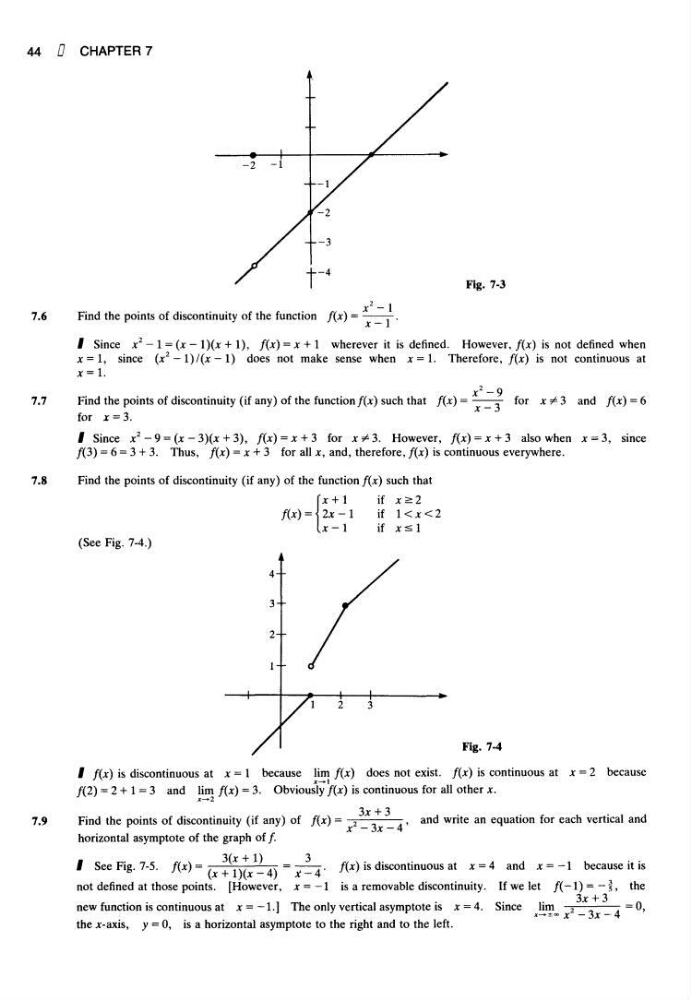
Fig. 7-3
7.6
Find the points of discontinuity of the function
Since x
2 — 1 = (x — l)(x + 1), f(x) = x + l wherever it is defined. However,/(or) is not defined when
x = \, since (x
2 - l)/(x - 1) does not make sense when x = l. Therefore, f(x) is not continuous at
x=l.
Find the points of discontinuity (if any) of the function f(x) such that
for x = 3.
f(x) is discontinuous at x = 1 because lim f(x) does not exist. f(x) is continuous at x = 2 because
/(2) = 2+1 = 3 and lim /(*) = 3. Obviously f(x) is continuous for all other x.
7.9
Find the points of discontinuity (if any) of
horizontal asymptote of the graph of /.
, and write an equation for each vertical and
Since x
2 -9 = (x -3)(* + 3), /(*) = *+ 3 for x ^3. However, f(x) = x + 3 also when x = 3, since
/(3) = 6 = 3 + 3. Thus, f(x) = x + 3 for all x, and, therefore, f(x) is continuous everywhere.
Find the points of discontinuity (if any) of the function /(*) such that
(See Fig. 7-4.)
Fig. 7-4
See Fig. 7-5.
f(x) is discontinuous at x = 4 and x = -1 because it is
\
S \
f
not defined at those points. [However, x = —1 is a removable discontinuity,
new function is continuous at *=—!.] The only vertical asymptote is x = 4.
the jc-axis, y = 0, is a horizontal asymptote to the right and to the left.
If we let
Since
the
CHAPTER 7
FOR
AND
7.7
7.8
Fig. 7-3
7.6
Find the points of discontinuity of the function
Since x
2 — 1 = (x — l)(x + 1), f(x) = x + l wherever it is defined. However,/(or) is not defined when
x = \, since (x
2 - l)/(x - 1) does not make sense when x = l. Therefore, f(x) is not continuous at
x=l.
Find the points of discontinuity (if any) of the function f(x) such that
for x = 3.
f(x) is discontinuous at x = 1 because lim f(x) does not exist. f(x) is continuous at x = 2 because
/(2) = 2+1 = 3 and lim /(*) = 3. Obviously f(x) is continuous for all other x.
7.9
Find the points of discontinuity (if any) of
horizontal asymptote of the graph of /.
, and write an equation for each vertical and
Since x
2 -9 = (x -3)(* + 3), /(*) = *+ 3 for x ^3. However, f(x) = x + 3 also when x = 3, since
/(3) = 6 = 3 + 3. Thus, f(x) = x + 3 for all x, and, therefore, f(x) is continuous everywhere.
Find the points of discontinuity (if any) of the function /(*) such that
(See Fig. 7-4.)
Fig. 7-4
See Fig. 7-5.
f(x) is discontinuous at x = 4 and x = -1 because it is
\
S \
f
not defined at those points. [However, x = —1 is a removable discontinuity,
new function is continuous at *=—!.] The only vertical asymptote is x = 4.
the jc-axis, y = 0, is a horizontal asymptote to the right and to the left.
If we let
Since
the
CHAPTER 7
FOR
AND