

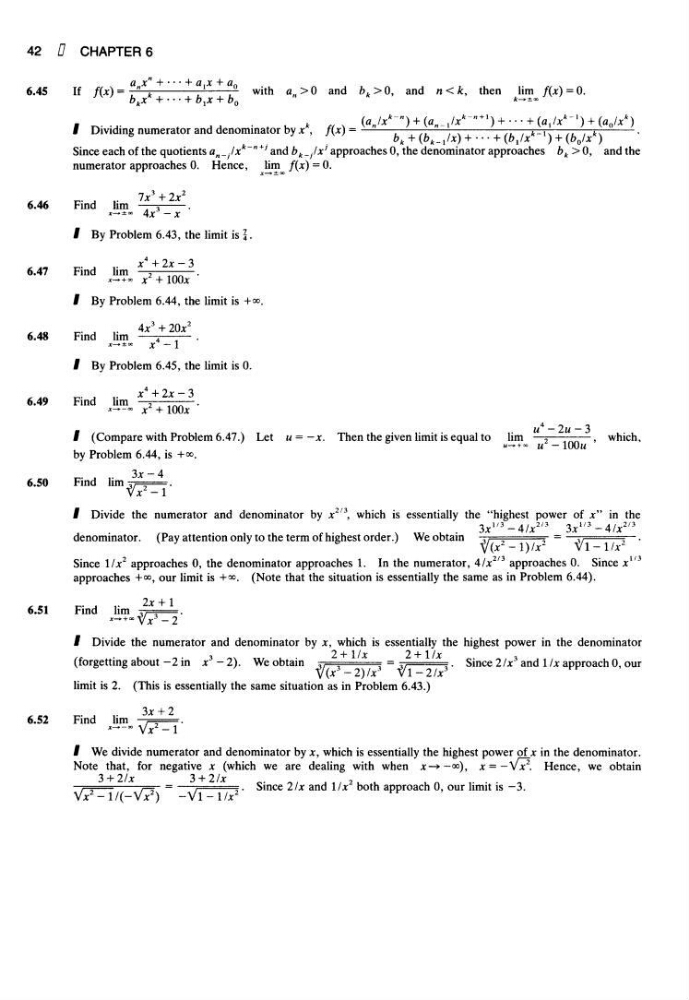
By Problem 6.45, the limit is 0.
42
CHAPTER 6
6.45
with a n > 0 and b k > 0, and n
k ,
-
Since each of the quotients «„_,/* ~"
+l and b k ^jlx' approaches 0, the denominator approaches b k >0, and the
numerator approaches 0. Hence, Urn f(x) = 0.
6.46
6.47
6.48
Find
By Problem 6.43, the limit is I.
Find
By Problem 6.44, the limit is +w.
Find
6.49
(Compare with Problem 6.47.) Let u — —x. Then the given limit is equal to
which.
by Problem 6.44, is +00.
6.50
Find
Divide the numerator and denominator by x
2 '
3 , which is essentially the "highest power of x" in the
denominator. (Pay attention only to the term of highest order.) We obtain
Since l/x
2 approaches 0, the denominator approaches 1. In the numerator, 4/*
2 '
3 approaches 0. Since x
1 '
3
approaches +<», our limit is +<». (Note that the situation is essentially the same as in Problem 6.44).
6.51
Find
Divide the numerator and denominator by x, which is essentially the highest power in the denominator
(forgetting about —2 in x
3 — 2). We obtain
Since
and 1 /x approach 0, our
limit is 2. (This is essentially the same situation as in Problem 6.43.)
6.52
Find
If
We divide numerator and denominator by x, which is essentially the highest power of x in the denominator.
Note that, for negative x (which we are dealing with when *—»—<»), x = -Vx. Hence, we obtain
Since 21 x and l/x
2 both approach 0, our limit is —3.
42
CHAPTER 6
6.45
with a n > 0 and b k > 0, and n
k ,
-
Since each of the quotients «„_,/* ~"
+l and b k ^jlx' approaches 0, the denominator approaches b k >0, and the
numerator approaches 0. Hence, Urn f(x) = 0.
6.46
6.47
6.48
Find
By Problem 6.43, the limit is I.
Find
By Problem 6.44, the limit is +w.
Find
6.49
(Compare with Problem 6.47.) Let u — —x. Then the given limit is equal to
which.
by Problem 6.44, is +00.
6.50
Find
Divide the numerator and denominator by x
2 '
3 , which is essentially the "highest power of x" in the
denominator. (Pay attention only to the term of highest order.) We obtain
Since l/x
2 approaches 0, the denominator approaches 1. In the numerator, 4/*
2 '
3 approaches 0. Since x
1 '
3
approaches +<», our limit is +<». (Note that the situation is essentially the same as in Problem 6.44).
6.51
Find
Divide the numerator and denominator by x, which is essentially the highest power in the denominator
(forgetting about —2 in x
3 — 2). We obtain
Since
and 1 /x approach 0, our
limit is 2. (This is essentially the same situation as in Problem 6.43.)
6.52
Find
If
We divide numerator and denominator by x, which is essentially the highest power of x in the denominator.
Note that, for negative x (which we are dealing with when *—»—<»), x = -Vx. Hence, we obtain
Since 21 x and l/x
2 both approach 0, our limit is —3.