

40 0 CHAPTER 6
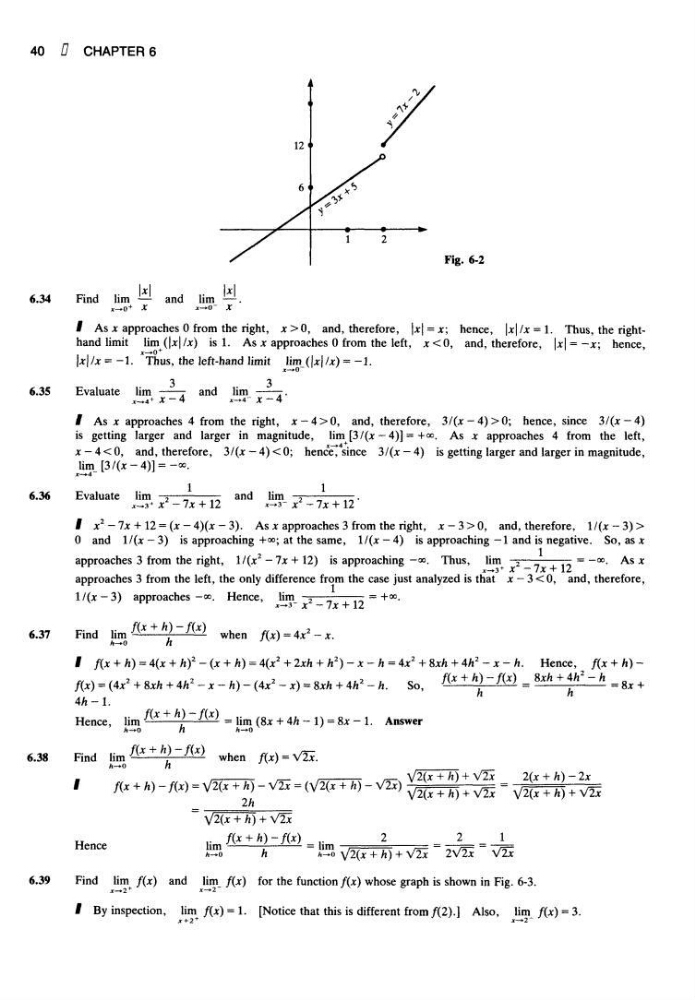
Fig. 6-2
6.34
6.35
6.36
As x approaches 0 from the right, * >0, and, therefore, |AC| = *; hence, |or|/jc = l. Thus, the righthand limit lim (|*|/x) is 1. As x approaches 0 from the left, x<0, and, therefore, \x\ = -x; hence,
|*|Ix = -I. *Thus, the left-hand limit lim (|jc|Ix) = -1.
As x approaches 4 from the right, x — 4>0, and, therefore, 3/(x — 4)>0; hence, since 3/(jc— 4)
is getting larger and larger in magnitude, lim [3/(jc -4)] = +». As * approaches 4 from the left,
X— *4
+
x — 4 < 0, and, therefore, 3/(x — 4) < 0; hence, since 3/(jc — 4) is getting larger and larger in magnitude,
lim [3/(x-4)]=-«.
x
2 — 7* + 12 = (x — 4)(x — 3). As x approaches 3 from the right, *-3>0, and, therefore, l/(x — 3)>
0 and l/(x — 3) is approaching +00; at the same, \l(x — 4) is approaching —1 and is negative. So, as x
approaches 3 from the right, l/(*
2 -7* + 12) is approaching — ». Thus, lim -5 - - = — °°. ASA:
~
/^ ~r _
approaches 3 from the left, the only difference from the case just analyzed is that x — 3<0, and, therefore,
l/(*-3) approaches -oo. Hence,
6.37
6.38
6.39
Find
when
By inspection, lim /(*) = 1. [Notice that this is different from /(2).] Also, lim f(x) = 3.
jt + 2"*"
x— »2
Find
Evaluate
Evaluate
and
f(x + h) = 4(x + h)
2 -(x + h) = 4(x
2 + 2xh + h
2
) - x - h = 4x
2 + 8xh + 4h
2 -x-h. Hence, f(x + h)f(x) = (4x
2 + Sxh + 4h
2 -x~h)- (4x
2 -x) = 8xh + 4h
2 - h. So,
4/j-l.
Hence,
Answer
Find
when
Hence
Find lim . f(x) and lim /(jc) for the function /(JE) whose graph is shown in Fig. 6-3.
Fig. 6-2
6.34
6.35
6.36
As x approaches 0 from the right, * >0, and, therefore, |AC| = *; hence, |or|/jc = l. Thus, the righthand limit lim (|*|/x) is 1. As x approaches 0 from the left, x<0, and, therefore, \x\ = -x; hence,
|*|Ix = -I. *Thus, the left-hand limit lim (|jc|Ix) = -1.
As x approaches 4 from the right, x — 4>0, and, therefore, 3/(x — 4)>0; hence, since 3/(jc— 4)
is getting larger and larger in magnitude, lim [3/(jc -4)] = +». As * approaches 4 from the left,
X— *4
+
x — 4 < 0, and, therefore, 3/(x — 4) < 0; hence, since 3/(jc — 4) is getting larger and larger in magnitude,
lim [3/(x-4)]=-«.
x
2 — 7* + 12 = (x — 4)(x — 3). As x approaches 3 from the right, *-3>0, and, therefore, l/(x — 3)>
0 and l/(x — 3) is approaching +00; at the same, \l(x — 4) is approaching —1 and is negative. So, as x
approaches 3 from the right, l/(*
2 -7* + 12) is approaching — ». Thus, lim -5 - - = — °°. ASA:
~
/^ ~r _
approaches 3 from the left, the only difference from the case just analyzed is that x — 3<0, and, therefore,
l/(*-3) approaches -oo. Hence,
6.37
6.38
6.39
Find
when
By inspection, lim /(*) = 1. [Notice that this is different from /(2).] Also, lim f(x) = 3.
jt + 2"*"
x— »2
Find
Evaluate
Evaluate
and
f(x + h) = 4(x + h)
2 -(x + h) = 4(x
2 + 2xh + h
2
) - x - h = 4x
2 + 8xh + 4h
2 -x-h. Hence, f(x + h)f(x) = (4x
2 + Sxh + 4h
2 -x~h)- (4x
2 -x) = 8xh + 4h
2 - h. So,
4/j-l.
Hence,
Answer
Find
when
Hence
Find lim . f(x) and lim /(jc) for the function /(JE) whose graph is shown in Fig. 6-3.