

442
CHAPTER 46
46.75
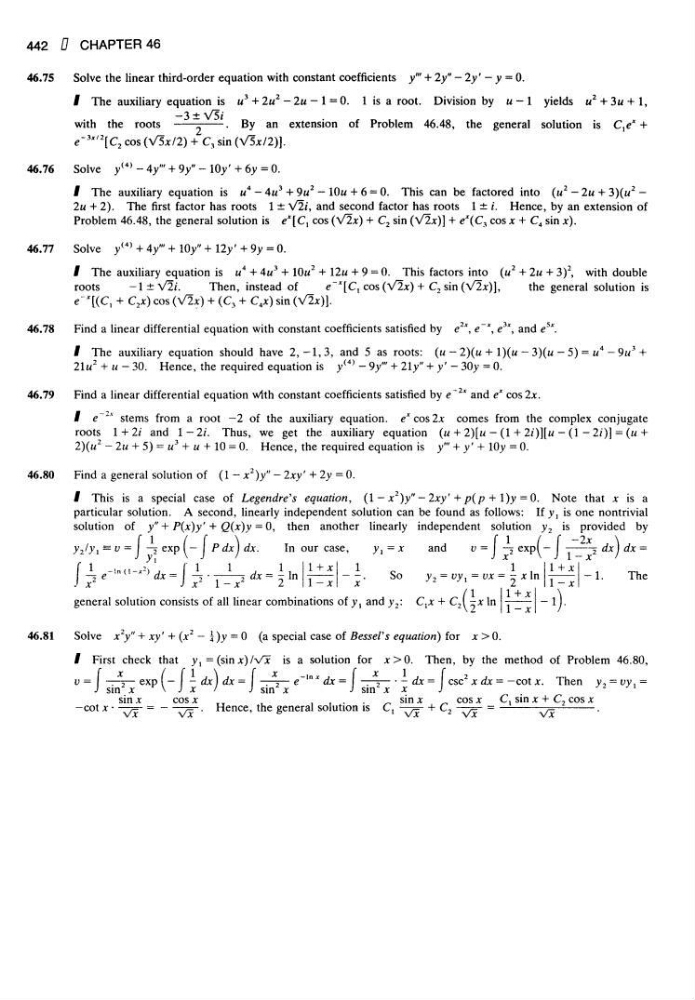
Solve the linear third-order equation with constant coefficients y'" + 2y" — 2y' — y = 0.
The auxiliary equation is «
3 + 2u
2 — 2u — 1 = 0. 1 is a root. Division by u — 1 yields «
2 + 3w + l,
By an extension of Problem 46.48, the general solution is C t e* +
with the roots
e'
3 "
2 [C 2 cos (V5x/2) + C 3 sin (V5jc/2)].
Hence, the general solution is
Then y 2 = vy,=
-cot x
46.81
general solution consists of all linear combinations of y, and y 2 :
Solve
(a special case of Bessel's equation) for x > 0.
Then, by the method of Problem 46.80,
is a solution for x > 0.
First check that
46.80
46.79
Find a linear differential equation with constant coefficients satisfied by e
2 * and e* cos 2x.
Find a general solution of (1 — X
2 )y" — 2xy' + 2y =0.
This is a special case of Legendre's equation, (1 - x
2 )y" - 2xy' + p(p + l)y =0. Note that x is a
particular solution. A second, linearly independent solution can be found as follows: If y, is one nontrivial
solution of y" + P(x)y' + Q(x)y = 0, then another linearly independent solution y 2 is provided by
In our case,
y, = x
and
So
The
46.78
Find a linear differential equation with constant coefficients satisfied by e
2 ', e *, e
3
*, and e
5
*.
The auxiliary equation should have 2, —1,3, and 5 as roots: (u - 2)(u + l)(u - 3)(w - 5) = w
4 - 9w
3 +
21w
2 + w - 30. Hence, the required equation is y
<4) - 9y'" + 21y" + y' - 30y = 0.
46.77
Solve y
(4) + 4y'" + lOy" + 12y' + 9y = 0.
The auxiliary equation is «
4 + 4w
3 + 10M
2 + 12a +9 = 0. This factors into (u
2 + 2u + 3)
2
, with double
roots
-1±V2/.
Then, instead of
e~*[C t cos(V2;c) + C 2 sin (V2x)],
the general solution is
e"'[(C l + C 2 x) cos (V2x) + (C 3 + C 4 x) sin (V2x)].
46.76
Solve y
(4) -4y"' + 9y"-10y' + 6y = 0.
The auxiliary equation is w
4 - 4u
3 + 9u
2 - 10w + 6 = 0. This can be factored into (u
2 - 2w + 3)(w
2 -
2« + 2). The first factor has roots 1 ± V2t, and second factor has roots 1 ± i. Hence, by an extension of
Problem 46.48, the general solution is e*[C, cos (V2x) + C 2 sin (V2x)] + e'(C 3 cos x + C 4 sin x).
e ~
l stems from a root -2 of the auxiliary equation, e* cos 2x comes from the complex conjugate
roots 1 + 2/ and 1 - 2i. Thus, we get the auxiliary equation (u + 2)[u - (1 + 2i)][u - (1 - 2/)] = (M +
2)(u
2 — 2u + 5) = u
3 + u + 10 = 0. Hence, the required equation is y'" + y' + lOy = 0.
CHAPTER 46
46.75
Solve the linear third-order equation with constant coefficients y'" + 2y" — 2y' — y = 0.
The auxiliary equation is «
3 + 2u
2 — 2u — 1 = 0. 1 is a root. Division by u — 1 yields «
2 + 3w + l,
By an extension of Problem 46.48, the general solution is C t e* +
with the roots
e'
3 "
2 [C 2 cos (V5x/2) + C 3 sin (V5jc/2)].
Hence, the general solution is
Then y 2 = vy,=
-cot x
46.81
general solution consists of all linear combinations of y, and y 2 :
Solve
(a special case of Bessel's equation) for x > 0.
Then, by the method of Problem 46.80,
is a solution for x > 0.
First check that
46.80
46.79
Find a linear differential equation with constant coefficients satisfied by e
2 * and e* cos 2x.
Find a general solution of (1 — X
2 )y" — 2xy' + 2y =0.
This is a special case of Legendre's equation, (1 - x
2 )y" - 2xy' + p(p + l)y =0. Note that x is a
particular solution. A second, linearly independent solution can be found as follows: If y, is one nontrivial
solution of y" + P(x)y' + Q(x)y = 0, then another linearly independent solution y 2 is provided by
In our case,
y, = x
and
So
The
46.78
Find a linear differential equation with constant coefficients satisfied by e
2 ', e *, e
3
*, and e
5
*.
The auxiliary equation should have 2, —1,3, and 5 as roots: (u - 2)(u + l)(u - 3)(w - 5) = w
4 - 9w
3 +
21w
2 + w - 30. Hence, the required equation is y
<4) - 9y'" + 21y" + y' - 30y = 0.
46.77
Solve y
(4) + 4y'" + lOy" + 12y' + 9y = 0.
The auxiliary equation is «
4 + 4w
3 + 10M
2 + 12a +9 = 0. This factors into (u
2 + 2u + 3)
2
, with double
roots
-1±V2/.
Then, instead of
e~*[C t cos(V2;c) + C 2 sin (V2x)],
the general solution is
e"'[(C l + C 2 x) cos (V2x) + (C 3 + C 4 x) sin (V2x)].
46.76
Solve y
(4) -4y"' + 9y"-10y' + 6y = 0.
The auxiliary equation is w
4 - 4u
3 + 9u
2 - 10w + 6 = 0. This can be factored into (u
2 - 2w + 3)(w
2 -
2« + 2). The first factor has roots 1 ± V2t, and second factor has roots 1 ± i. Hence, by an extension of
Problem 46.48, the general solution is e*[C, cos (V2x) + C 2 sin (V2x)] + e'(C 3 cos x + C 4 sin x).
e ~
l stems from a root -2 of the auxiliary equation, e* cos 2x comes from the complex conjugate
roots 1 + 2/ and 1 - 2i. Thus, we get the auxiliary equation (u + 2)[u - (1 + 2i)][u - (1 - 2/)] = (M +
2)(u
2 — 2u + 5) = u
3 + u + 10 = 0. Hence, the required equation is y'" + y' + lOy = 0.