

440
CHAPTER 46
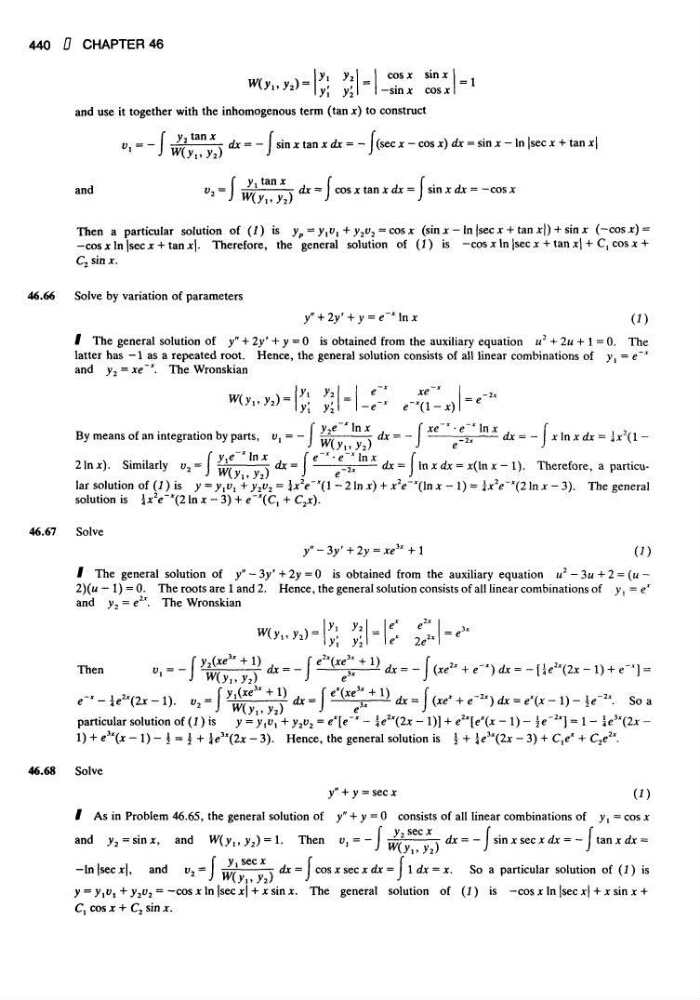
and use it together with the inhomogenous term (tan x) to construct
and
Then a particular solution of (1) is y p = y l v l + y 2 v 2 = cos x (sin* - In |secx + tan *|) + sinx (-cos*) =
-cosxln|sec;t + tan;c|. Therefore, the general solution of (1) is -cos x In |sec x + tan x\ + C, cos x +
C 2 sin x.
46.66
Solve by variation of parameters
y" + 2y' + y = e * In x
(1)
The general solution of y" + 2y' + y=Q is obtained from the auxiliary equation «
2 + 2« + l = 0. The
latter has -1 as a repeated root. Hence, the general solution consists of all linear combinations of y l = e~*
and y, = xe~*. The Wronskian
By means of an integration by parts,
2 In*). Similarly
Therefore, a particular solution of (1) is
solution is
The general
'2lnx-3) + e"(C l + C 2 x).
46.67
Solve
y" - 3y'+ 2y = xe
3 * + 1
(1)
The general solution of y"-3y' + 2y = 0 is obtained from the auxiliary equation u
2 -3w+2 = (u -
2)(u — 1) = 0. The roots are 1 and 2. Hence, the general solution consists of all linear combinations of y l = e"
and >> 2 = e
2 '. The Wronskian
Then
particular solution of (1) is
Hence, the general solution is
46.68
Solve
y" + y = sec x
(1)
As in Problem 46.65, the general solution of y" + y - 0 consists of all linear combinations of y, = cos x
and y 2 = sin x, and W(y t , y 2 ) — 1. Then
y = y l v l + y 2 v 2 = -cos* In |secjc| + *sinjc. The general solution of (1) is -cos x In |sec *| + x sin x +
C, cos x + C 2 sin x.
So a particular solution of (1) is
sin x sec x dx = — tan x dx =
cos x sec xdx = ldx = x.
-Inlsecjd, and
Download
from Wow! eBook
CHAPTER 46
and use it together with the inhomogenous term (tan x) to construct
and
Then a particular solution of (1) is y p = y l v l + y 2 v 2 = cos x (sin* - In |secx + tan *|) + sinx (-cos*) =
-cosxln|sec;t + tan;c|. Therefore, the general solution of (1) is -cos x In |sec x + tan x\ + C, cos x +
C 2 sin x.
46.66
Solve by variation of parameters
y" + 2y' + y = e * In x
(1)
The general solution of y" + 2y' + y=Q is obtained from the auxiliary equation «
2 + 2« + l = 0. The
latter has -1 as a repeated root. Hence, the general solution consists of all linear combinations of y l = e~*
and y, = xe~*. The Wronskian
By means of an integration by parts,
2 In*). Similarly
Therefore, a particular solution of (1) is
solution is
The general
'2lnx-3) + e"(C l + C 2 x).
46.67
Solve
y" - 3y'+ 2y = xe
3 * + 1
(1)
The general solution of y"-3y' + 2y = 0 is obtained from the auxiliary equation u
2 -3w+2 = (u -
2)(u — 1) = 0. The roots are 1 and 2. Hence, the general solution consists of all linear combinations of y l = e"
and >> 2 = e
2 '. The Wronskian
Then
particular solution of (1) is
Hence, the general solution is
46.68
Solve
y" + y = sec x
(1)
As in Problem 46.65, the general solution of y" + y - 0 consists of all linear combinations of y, = cos x
and y 2 = sin x, and W(y t , y 2 ) — 1. Then
y = y l v l + y 2 v 2 = -cos* In |secjc| + *sinjc. The general solution of (1) is -cos x In |sec *| + x sin x +
C, cos x + C 2 sin x.
So a particular solution of (1) is
sin x sec x dx = — tan x dx =
cos x sec xdx = ldx = x.
-Inlsecjd, and
Download
from Wow! eBook